
Really sad to hear of the death of the great Hungarian art-film director, Bela Tarr, at the young age of 70. The master of the glacially slow take, his singularly dark, visionary black and white fever dreams, especially those made in collaboration with the Nobel Prize winning author Laszlo Krasznahorkai (among them the 7 1/2 hour Sátántangó, Damnation, Werckmeister Harmonies, and The Turin Horse, all with music by Mihaly Vig) are some of the most profound and stunning works of contemporary art cinema. Intense contemplation through repeated viewings of his hypnotic oeuvre is seemingly capable of actually stopping the passage of time. Susan Sontag declared that she would "be glad to see Sátántangó every year for the rest of my life" (all 7 1/2 hours of it. You can laugh at its extreme length–sometimes it's shown with an intermission, but that makes it even longer. Still, I've never seen anyone walk out of it). His films, set in the grimy dysfunctionality of rural post-Communist Hungary, ultimately have a mystical aura about them, a kind of transcendence in the wonder of the universe. Still, you would never confuse Tarr with Terrence Malick. His metaphysical worldview is definitely painted black, laced with touches of absurdist humor–and I think he stands more in the tradition of literary titans such as Celine, Beckett, and Dostoevsky, and painters such as Mark Rothko and Franz Kline (and many old master painters as well), than film makers–although some of the films of Werner Herzog, Carl Dreyer, early David Lynch, and Romanian director Radu Jude have certain affinities with Tarr's output. But his cinema really exists on a plane of its own, and I highly recommend him.
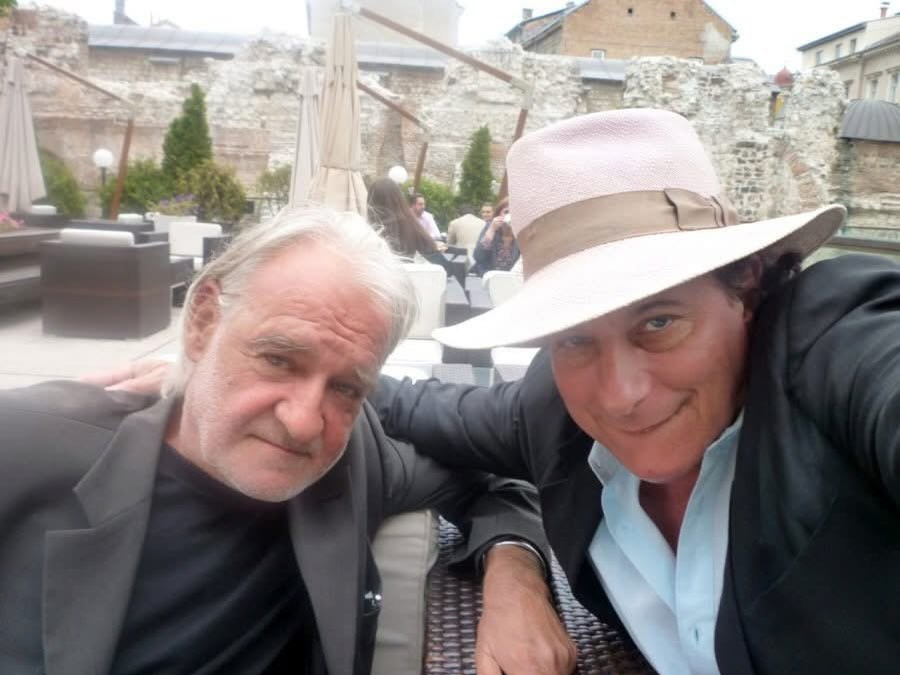
A few years ago, I made a pilgrimage to Sarajevo to meet the Master and hang out with him for the afternoon. He was then heading up a Film Academy with a select group of eight young, fledgling filmmakers. Sadly, he had forsaken the hustle of trying to get his films financed at this point (shades of Orson Welles); it was a dead end for him. His work was still feted at film festivals all over the world, and I went to visit him the very last time he was in New York, when the Film Society of Lincoln Center mounted a retrospective. It was right after a Q&A following a screening of an early film, Family Nest, and he was sitting on the patio outside the Walter Reade, looking a bit jet-lagged and blue. As I approached him, his face crinkled up, and he broke into a big smile. He was quite a lovely guy, a gentle humanist really, with the creative warmth of a blazing sun within him, and we had a pleasant reminiscence about our meeting in Sarajevo.
Despite the over arching bleakness and despair of many of Bela Tarr's films, they still are full of life (especially in the pub scenes) and occasional redeeming points of lightand they are ever more relevant today: Werckmeister Harmonies ends with the terrifying rise and rampage of Fascists triggered at a Dark Carnival in a nameless village presided over by a maniacal "Prince” and its prize exhibit, an enormous dead whale, and Sátántangó depicts the manipulation of the lumpen residents of a broken down collective farm in the middle of nowhere by conmen and spies for the communist government secret police.
Bela Tarr's films are eternal–and are not going gentle into that good night.
(Read The Guardian obit here.)