If you love to look at intricate, well-designed art work, there are three artists showing in Chelsea now that have very special qualities.
The two-person show at Kinz, Tillou + Feigen is a must see. Megan Greene's intensely detailed fabric and floral-based abstractions made with white pencil and gouache on black paper are stunning, edgy, and beautiful. The work is outlaw, along the line of a Hells Angels aesthetic, yet refined with the finesse one likes to see in fine pencil work.
Also at Kinz, Tillou + Feigen are the mixed media works of Lori Field, who offers wondrous drawn and painted collages (left) under an encaustic skin.
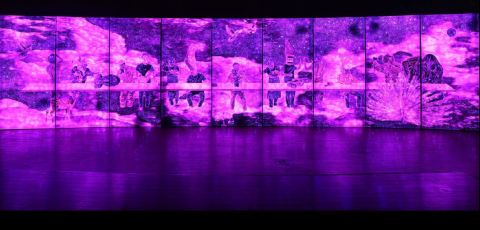
If you think that because in 2008 in America we finally have a gentleman of color and a woman who have realistic shots at the Presidency, we’ve buried the bloody hatchets of racism and sexism, then you must see the simultaneously exhilarating and harrowing exhibit Kara Walker: My Complement, My Enemy, My Oppressor, My Love.
Kara Walker, the young (a year shy of 40) African-American artist who is rapidly gaining fame and notoriety with her expansive and jarring silhouettes of larger-than-life scenarios from the antebellum South, is making waves, both positive and negative, with creations that slam the senses as they depict scenes of conflict, exhilaration, power wielding, and sexual reverie in the context of racial discrimination and gender bias.
Last week, in between installing my exhibition at Blue Star Contemporary Art Center and attending the openings for that show, I was able to visit a number of galleries in San Antonio. As I had experienced in my four previous trips to San Antonio, I found a lively art scene fueled by a proud community of hard-working artists, gallerists, curators, and directors supported by a good number of critical publications, city officials, and enthusiastic collectors. Make yourself available for a First Friday and you'll be amazed by the four or five thousand visitors that will pass through just about every art space in the downtown area.
Most art aficionados will recall Andy Warhol’s early work as an illustrator, when he made fanciful renderings of 1950s fashion footwear. Recently, I’ve come to know two artists who focus a considerable amount of time and effort on the art of the shoe. During a recent studio visit, I was treated to a sneak peak of the shoe paintings of artist and hat/clothing designer Yuka Hasegawa [right], as she prepared for her solo show at Gallery Milieu in Tokyo. Her shoe paintings ranged in style from smoky Surrealism to more concrete representations, each having a certain personality in mind for its wearer.
With its famous Speedway, the once champion Colts, and the popular Pacers, Indianapolis is first and foremost a sports town. What most do not know is that Indianapolis has an art scene, albeit limited, with one world-class institution, the Indianapolis Museum of Art (IMA), as its core. At the IMA, you will find a number of stellar art objects ranging from Asian and African antiquities to formidable examples of modern and contemporary art from Europe and the United States. For one, they offer one of the Ecce Homo (ca. 1510, left) paintings by Hieronymus Bosch, which features a relatively calm Christ before of a mob populated with the typical Bosch crazies.
During a recent visit to Brooklyn and Queens, I went to two galleries where I will be showing in 2008 and found intriguing shows. The first location was Dorsky Gallery Curatorial Programs, a pristine space with a world-class program that features four guest-curated shows per year. At this time, curator Joshua Altman, who is also the current director at Stux Gallery in Chelsea, offers his take on artists who create animations that, for the most part, ignore any standard animation techniques. The show is titled Extremes & In-Betweens, which refers to how the outermost positions of a character’s body movements set the mark for the changing movements in-between, a concern or approach that rarely, if ever, enters into the minds of the artists assembled here.
One of the best aspects of the Manhattan art scene, and perhaps my favorite, is its diversity. You need only go to a handful of galleries to experience a broad range of concepts and aesthetics. Once in a while, you hit a few shows that blow out the borders a notch or two, keeping the whole thing increasingly fresh and expansive.
This is the case with two current exhibitions, Michael Anderson: Media Violence at Marlborough Chelsea, and Hiroshi Senju at Sundaram Tagore Gallery. Michael Anderson’s art has painterly, fluid, reactive and compelling iconography culled from street posters.
The third and final leg of Frolic opened November 6th at the Taipei Gallery, an impressive space that unfolds from the lobby of the Taipei Economic and Cultural Office building to an open second floor space. As was the case in the first two shows, curators Thalia Vrachopoulos and Jane Ingram Allen chose art that evoked whimsical thought.
Projected above the throngs of opening visitors is Yi-Li Yeh’s double video Orange Flower 1, showing a young woman dressed in a yellow, phallic-laden outfit as she runs through a series of martial arts poses while spewing flowers (life) from her outstretched arms.
The second of three exhibitions collectively titled Frolic: Humor and Mischief in New Taiwanese Art opened at Tenri Cultural Institute of New York on October 18th. The atmosphere at the opening, as it was at 2 X 13 gallery two weeks ago, was energizing. For the second installment, curators Thalia Vrachopoulos and Jane Ingram Allen offer the work of 13 young artists who, this time around, have a bit more of an Eastern focus esthetically.
Inspired by the exhibition’s focus on humor, Wen-fu Yu offers “God Bless You!” (above left), a mixed media installation composed of bird netting and white duck feathers.
Some of you who know me would have heard about the Intelligent Design Project that Michael Zansky and I have been presenting in a number of spaces throughout the U.S. . The third show in the series opened at Kasia Kay Art Projects on the 12th of October, and I look forward to hearing from anyone who sees the show in Chicago.
From this point on, I would like to tell you about what I saw in other Chicago galleries, all well worth a visit. First, in the west loop, I happened by four exhibitions that were real winners.
Born in Kapuvár, Hungary in 1923, Judit Reigl resides in Paris and is considered a major figure in European art – but not here. In fact, you could say she is relatively unknown in the U.S. save for shows like the one up now at Janos Gat Gallery, her first New York exhibition.
Reigl, like the show as a whole, is abruptly pure. It took me a few minutes to rewire my brain to think in terms of art that truly was made for cerebral pleasure, for the artist herself, and not for the making of a marketable object. And that, to me, is a very European attitude – or at least this was the case in the middle of the twentieth century.
The atmosphere on opening night at 2 X 13 was festive and tantalizing. The exhibition offers a sampling of works that put forth a diverse overview of the concept of humor. Nothing is too overt, and most works suggest some sort of social or emotional mores, but less specific than I expected. Curators Thalia Vrachopoulos (based in New York) and Jane Ingram Allen (based in Taiwan) managed to project, via their chosen artists and works, an eastern feel with western bent, making it all seem comfortably different.
Fay Ku’s large gouache on paper works reminded me very much of Amy Cutler's works, but the narrative in Ku’s art is a bit more problem-oriented. In one work, a woman spies her heavily overgrown pubis while in another, half tree, half nubile women attempt to swallow blowfish whole, which leads to punctured cheeks and problematic situations.
Gudjon Bjarnason employs chance, relying heavily on a very extreme form of controlled chaos. At the core of this exhibition are variously mangled minimalist metal sculptures that he fabricates and later destroys, either by dropping them from great heights or blowing them up with dynamite. Extreme, but Bjarnason is from Iceland – a land that tends to suggest extremes, from the immensely various amounts of available sunlight through the year, to the strangeness of the glaciers and volcanoes that dominate the landscape.
I came to know the Omega Institute through a show I co-curated with Kathleen Cooley (Fear is a Four Letter Word) at their last Being Fearless conference in New York City. Omega, as you may already know, is an innovative institute with a holistic approach to life and living that is progressive and full. I went up to their main campus in Rhinebeck for Family Week this summer and had a fulfilling and spiritually uplifting stay. While there, I happened by the Ram Dass Library at the center of the campus where the mixed media works of P.C. Turczyn were on display.
As a rule, library shows can be pretty mediocre, even amateurish, so I didn’t expect to be impressed – but I was impressed. Turczyn’s work, which is based on basic patterns found in nature, was meticulously crafted and beautifully designed. There was a palpable energy or force in the work that really grabbed my attention.
The chances of seeing a storefront in midtown Manhattan converted into a blank canvas for an artist to create an automatic, abstract work of art is pretty slim, given the real estate values in the city these days. But the Lab Gallery has been doing such outside-the-box thinking for some time. I had the good fortune of being associated with this progressive approach as a curatorial advisor through January of this year, so I like swinging by now and again to see what is going on at the Lab.
Amidst the cacophony of fast and loose summer group shows offered in Chelsea this year stands, literally and figuratively, one unforgettable exhibition. The art of Dustin Yellin is a cross between painting and sculpture, science and science fiction. His magical objects, some taller than the viewer, are comprised of dozens of layers of resin that are meticulously painted with acrylic and inks - layer atop layer - until a sinuous "life form" appears that looks like it would be at home in sea, sand, or air.
Each object is a comment on nature, genetic experimentation, color and form, culminating, in this reviewer's mind, in some of the freshest and most distinct art being made today.
"The art of our era is not art, but technology. Today Rembrandt is painting automobiles; Shakespeare is writing research reports; Michelangelo is designing more efficient bank lobbies," notes oft-quoted Howard Sparks.
Well, the sensible Barbara London, Associate Curator, Department of Media, The Museum of Art (MOMA), might just have forced Mr. Sparks to augment his theory an iota. With her entertaining new exhibit, Automatic Update, which runs until September 10th, London clearly showcases the reverse process, with five contemporary artists extracting art from technology.
Contemporary art from Asia seems to be increasingly abundant everywhere you look, from our leading museums to our most progressive galleries. So it is no wonder that more and more curators are scrambling to shed light on the differences and the distinctions from country to country. And it is hard to say where influences originate, and it is even harder to say what came first. But I do see an intriguing amount of crossover from American artists to Asian concepts and esthetics, and vice versa in Incarnation, a stellar show curated by Inhee Iris Moon.
And from what I understand from Ms. Moon, this is just a piece of a pie that is far more diverse and complicated. With all that said, I am thoroughly impressed by all the work in the exhibition, especially with respect to the curator's emphasis on art that reveals great clarity of vision, an emphasis on craft, and the indication of the larger, more wholly spiritual picture.
Shinduk Kang’s art is a breath of fresh air. The colors, materials, and techniques she employs are clean, ageless, and fine. There is a festiveness, and a reverence too, for the things she makes, while her focus is keen and sharp, making her art bold in a very easily absorbed way.
The main gallery at Tenri is lined, floor to 14-foot-high ceiling, with a patchwork of silky, translucent fabric that is generally used in making the inner slip of traditional clothing (Han Bok). The use, or reuse of these lightweight and durable fabrics also refers to another tradition in Korea, of using off cuts of fabrics as gift wrapping (POJaGI).
I never have enough time to get around to see everything I want to see. So if you are too busy too, maybe a quick pass through these few shows will give you enough of an art fix to last you till the next time that window opens a crack.
2X13 Gallery, located on the fourth floor at 531 West 26th Street, offers two one-person shows. The one I thought to be more than worth anyone’s time was Bing Lee’s two rooms of art. The main room is a wall painting titled “Nacho American Cheese” (left), a curious work that balances quirky and oddly repetitive black forms against a traffic sign yellow ground. Using just a few stencils and somewhat narrative free-formed shapes that all fit together, Lee manages a mix of organic fluidity and mechanical control.
Installation art allows the viewer to enter an alternate realm of perception, one created in space by the artist. The renowned Iranian film-maker Abbas Kiarostami has created an intriguing multi-screen video installation, called Five, on view at MoMA until May 28 in its first presentation in the United States.
Kiarostami’s films (ATaste of Cherry and Through the Olive Trees, to name a couple) are characterized by their view of ordinary people whose everyday lives reflect the depths of human feeling. But when asked to discuss his films in 1998, he spoke of how he looked at filmmaking, as opposed to his subject matter: “When I look at nature, I see a frame of painting.
In his gallery in Beacon, NY, Carl Van Brunt has managed to hold his audience through sheer honesty — grooming a stable of mid-career, young, and emerging artists, some self-taught — and his approach keeps you coming back for more.
As you entered the space in April, you were surrounded by Stanford Kay's paintings (left). Kay seems to have shifted to a more lyrical, painterly approach with a subject he has been "in series" with for some time: books. It is not hard to reference Rauschenberg's quarter-mile installation with his hand-selected history and book stacks. This is a broad subject to work with and I like the fact that Kay approaches it with a painter’s hand, and that, in an online, mp3, fast food world, he has managed to evoke the warmth of books and paintings — objects that you can still reach out and touch without wondering what is on the other side.
Bodo Korsig’s work is both funny and serious. He plays with the subconscious, the familiar, the mundane, and the miniscule. He gets you though, hitting you head on with the periphery, turning things around, stretching, reorienting.
His art can be painting, print, or sculpture. Everything is hung on the walls, some coming out a bit from the wall, such as his painted aluminum works. Even the paintings, despite their diminutive sizes, are made on very thick stretchers so they jut out into the space. This is important because these works, in order to get into your head, need to follow you a bit. In one instance, the gallery light that illuminates the piece “Erase Your Past” is placed at art height level.
The title of this exhibition, In the Age of the Innocents, brings to mind The Age of Innocence, an Edith Wharton novel about society, class, and culture. However, I suspect sculptor Tony Moore is not making a reference, with his spelling of the word innocents, to the rules of the society. Moore, instead, is addressing the state of the world today, and how so many moral codes are being broken while so many innocents are dying. You only need look at a television news broadcast for a moment, skim a newspaper, or tune into a talk radio station to be reminded how many victims of unnecessary violence there are.
Roz Chast is funny. Best known for her nearly 30-year stint with The New Yorker magazine, she is the quintessential observer. Let’s say she can best be described in artistic terms as a Situationalist. (You need those ists and isms.) What she takes from her everyday observations, she turns into crisp, clean extrapolations of a given situation, event, or moment, often filling that extrapolation with emphasizing details in curious locations. She can find, and express with wonderful words and images, the confounding and confusing to the commonest of experiences. What I find most appealing about her work is that it is sublimely approachable. Her drawn lines are expressive, yet forgiving. The expressions her subjects bare are subtle yet telling, and her compositions, which are straightforward and true, are filled with wit and humor from edge to edge.
Sure signs of spring: The groundhog not being frightened by his shadow. Baseball standings showing the Royals, Devil Rays, and Pirates tied for first place. Articles about income tax. Marshmallow Peeps and chocolate bunnies. And Bill Donohue, head of the Catholic League, denouncing another “attack” on Christianity. This year – and this is not an April Fool’s joke! – the last two are related, because Donohue’s mad about a new chocolate Easter treat, which he claims is “one of the worst assaults on Christian sensibilities ever.” He must have very delicate sensibilities and no sense of proportion whatsoever.
What is this horrible assault? Artist Cosimo Cavallaro’s “My Sweet Lord,” a six-foot tall, 200-pound depiction of the crucified Christ made out of milk chocolate.
This show’s title tells you all you need to know about the almost polar opposite elements of morbidity and sexuality that run throughout the exhibition. But it is not so necessary to know or understand the artist’s specific intentions to sense the import of the art offered here. After all, work of this caliber will stand alone, separate from any overall narrative or intention.
Lauren Beck is a wizard with watercolor.
Haviland Street Gallery is an oasis, a vintage home turned gallery, with its space originally designed for living, not looking. And I hesitate to say this, but all this welcoming homeyness makes the overall art experience here fun. We get so used to the white windowless boxes we call galleries that one can easily forget that art is being made in people’s homes and in distinctive studios. For this exhibit, Gloria Santoyo Ruenitz offers a number of beautifully composed works that are wistful, celebratory, painterly and steeped in objects and symbolism. And, even though the potent content of these art works is rather specific and direct, as the exhibition’s title suggests, it takes a good amount of time to fully appreciate these works.
Milan-based artist Danilo Buccella's paintings feature young women frail, defiant, alone, and old beyond their years. They are iconic, beacons of a new age. At the risk of sounding like my parents, our children, especially the young woman I see in my daily life, are faced with nearly impossible physical goals. The visuals suggest a so-called beauty or desirability, even a cuteness which is relatively singular, and for most, unnatural, and just plain out of hand. Check out his painting on the left -- THE GUEST from 2005 (43 x 63 inches - oil on canvas).
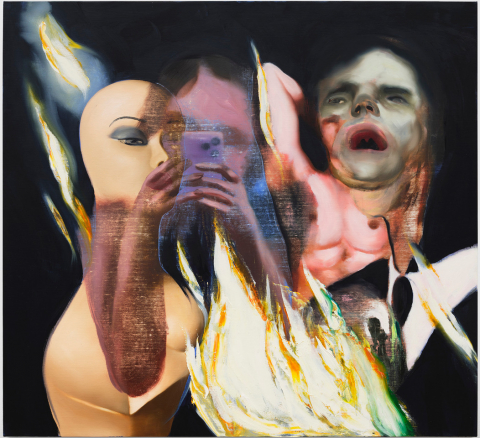
Two young artists from the west, Brandon Maldonado of New Mexico (born 1980) and Sarah Sohn of Los Angeles (born 1984), have landed at the Aidan Savoy Gallery on Stanton Street. I mention their youth because it is so much a part of how one takes them in—the fact that they are still in a formative phase. Maldonado’s work dominates the space, in part because his color palette is so much brighter and more intense than that of Sohn. His works—with their hot colors and bold, even surreal images—catch the eye and demand attention. Sohn’s work is paler, closer to monochromatic, and more aloof in its imagery.
At twenty-six, Maldonado is painting under a number of influences: