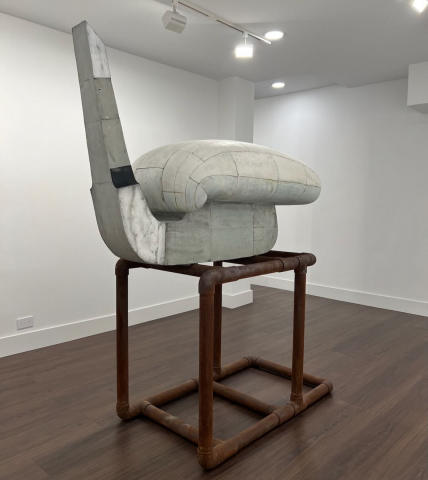
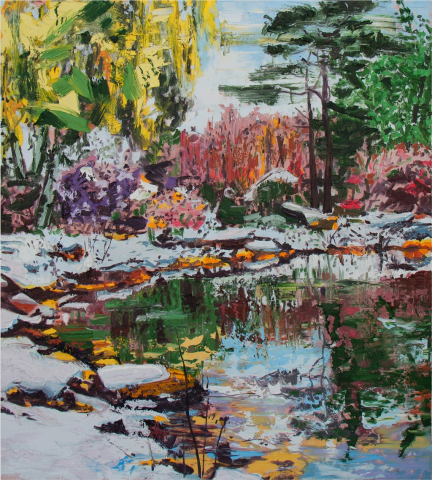
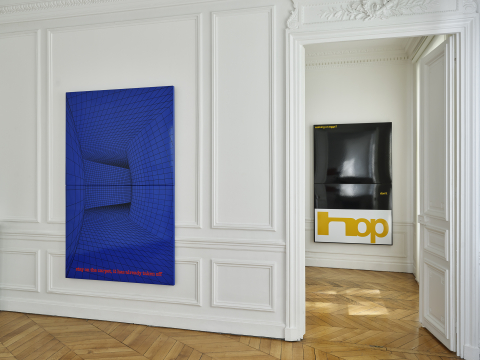
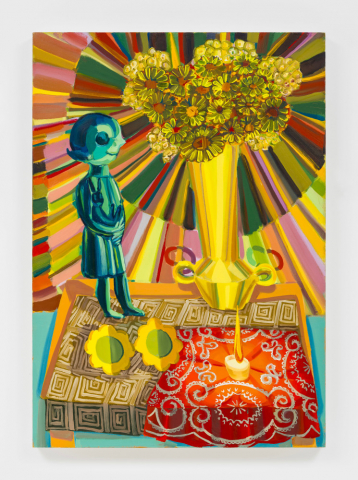
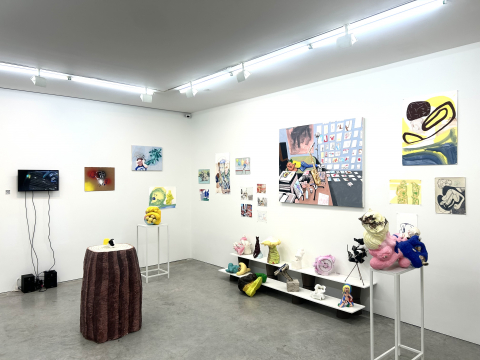
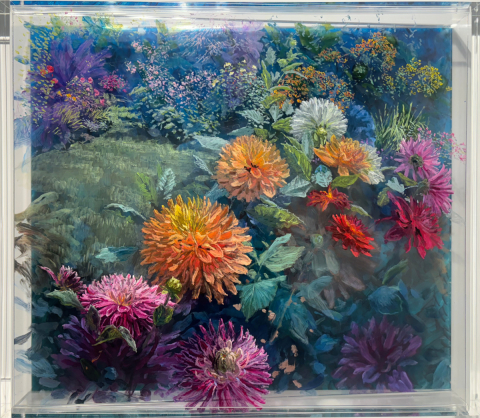
New Hudson/Second NatureThe five artists who have been selected for New Hudson/Second Nature by curator Suzanne Ball give you the idea that, despite the changes, the Hudson Valley remains a powerful draw for the more creative among us. Read more »
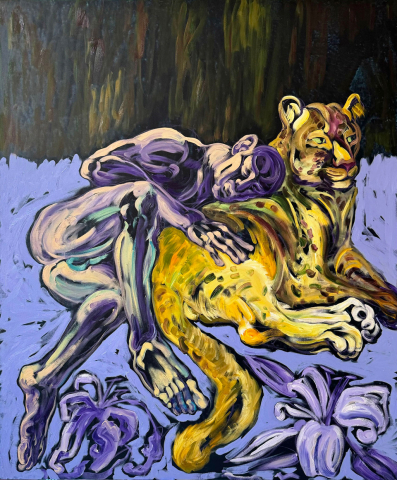
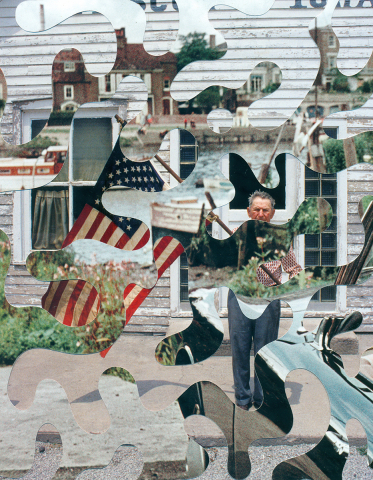
David Humphrey's new work can be seen in solo exhibitions at Fredricks & Freiser, New York, opening November 8, 2012, and at The American University Museum in Washington, DC, opening November 3, 2012.
Bradley Rubenstein: The last time I was at your studio, we were looking at an empty landscape in progress. You said, "This one is just waiting for a protagonist." You were thinking in terms of storytelling -- a part of the picture was the character, another was the set. Read more »
It happens quickly -- discomfort in a public place -- and it is a very effective element to control, as you will experience with the work of Carrie Mae Weems. Early on in the exhibition at the Frist Center for the Visual Arts, Carrie Mae Weems: Three Decades of Photography and Video, Weems confronts her audience with her AINT JOKIN’ series from 1987-88. Here she combines images and text that project racial stereotyping with works such as "Black Woman with Chicken" [left] and "Black Man Holding Watermelon." In another piece nearby we see a vintagepolitical drawing of Abraham Lincoln looking a bit disheveled, seated in a room filled with props and papers positioned above the question: WHAT DID LINCOLN SAY AFTER A DRINKING BOUT?. The answer-box nearby reveals: I FREED THE WHAT?. The exposure to this, and other bits of appropriated hurtful humor will surely prompt an uncomfortable feeling in most viewers as it flies in the face of current, ‘public’ trends toward universal political correctness. Read more »
Jackson Pollock and Tony Smith: Sculpture: An Exhibition on the Centennial of their BirthsNominally a show of sculpture, Matthew Marks is presenting something more like relics of art world myth, or a romanticized artist-buddy story (think Lust for Life or Schnabel's Basquiat). It seems an odd pairing at first glance: Pollock, whose paintings consist of poured or dripped skeins of paint and are the archetype of Ab Ex passion, and Tony Smith, whose Buckminster Fuller-like geodesic monuments ushered in an Age of Cool. This show presents the remains of a day, one spent at Smith's New Jersey home, when Smith tried to coax out of the fallow (and soon-to-be-dead) Pollock a few last attempts at making art and ended up becoming a sculptor himself. Read more »
Richard PhillipsI am running late, so I park the Ducati on the sidewalk and toss the keys to an eager production assistant. It is incredibly hot and crowded as I push my way through a crowd of background actors to the location, which has been carefully designed to look like a gallery. Wardrobe has given me an antique Ramones t-shirt (which actually has some of Debbie Harry's vintage blood on the sleeve) and a period Hugo Boss Nazi SS uniform jacket with five firing-squad bullet holes through the left lapel (vintage blood carefully removed). Also, store-torn Alexander McQueen jeans (a gift from an Olsen twin, I think) and flip-flops, which are decorated with pictures of colorful monkeys. Read more »
Matt Bahen: The Weight of LightThe paintings of Matt Bahen are nothing if not quiet. That is not to say that they do not speak to us, directly and clearly; they do, but in hushed voices, as if imparting a secret. It might be easy to overlook such work -- simple, almost monochromatic paintings of derelict landscapes -- were it not so good.
Bahen's subjects are ruined places: empty industrial buildings, Anselm Kiefer-ish woods, and frozen, snowy rivers. It would be more precise to say that these are Bahen's locations; his real subject matter is paint. In "The August of the Night" (2012 [left]) and "In the Quiet of the Dark" (2012), Bahen uses the plays of light, gliding through empty spaces and tracing rectangular windowpane patterns on the walls to exercise a muscular brush, loading heavily leaded pigment layer by layer -- essentially sculpting that most fleeting thing, light, out of dense pigments. Read more »
Angela Dufresne: Parlors and PastoralsThings fall apart…at least in the recent paintings of Angela Dufresne, whose works are in a two-gallery exhibition at Monya Rowe and CRG entitled Parlors and Pastorals. That is the impression at first glance: nominal landscapes and scenes of bourgeois interiors, these paintings, awash with color and executed with an impressive arsenal of painterly paint handling, are slipping glimpses into scenes both real and imagined, caught in a state of permanent contingency. Read more »
"Wisteria" by Maruyama Ōkyo and Edo Period ScreensWhile in Japan vacationing with my in-laws, I had the good fortune to catch an exhibit built around an Important Cultural Property (an official designation) of Japan: an exquisite pair of six-panel screens by Maruyama Ōkyo (1733-1795). The other ten byōbu (screens) in the exhibit are valuable for much more than context; several of them are just as remarkable as the featured work, and this two-gallery exhibit kept me occupied for over an hour. It was too breathtakingly beautiful not to document. Read more »
Cat Crotchett is a visual artist and professor at Western Michigan University. She recently sat down with Bradley Rubenstein in Chelsea to talk about her new work.
Bradley Rubenstein: It was great seeing some of your new pieces. I’m not sure exactly what we should call them -- they are a kind of hybrid print. I was comparing them to the two little Pollocks up at the Whitney now [Untitled (1939-42); Untitled (1944)] where he was also using wax as part of the process. Can we talk a little about your new pieces first?
Cat Crotchett: They are encaustic mono-prints and involve a very intuitive process based on random marks I make with the encaustic paint when I’m printing. At this point I can’t predict how they’ll look when they transfer to paper. When I look at the paint on the encaustic palette, I have an idea of how the piece might turn out, but the reality is something completely different. I’ve decided to embrace this abdication of control even though it is definitely uncomfortable. Read more »
Brenda Giegerich & Kaethe KauffmanKaethe Kauffman’s archival inkjet and mixed media scrolls are comprised of suggestive vignettes, lucid passages, and familiar pairings. However, an elusive narrative emerges that defies that base. The main thread, parts of the body, registers in ways that are both intimate and particular, while the anonymity of the faceless figures gives each work a more symbolist tone. There are patterns here as well that suggest one cause of behavior that develops through repetition. It is also quite possible that Ms. Kauffman is commenting on how we target gesture and color, then detail in our daily observations when we make a judgment or speculation. Read more »
Alighiero Boetti: Game Plan
Michael Lee Nirenberg is an artist and filmmaker living in New York. His current documentary is BACK ISSUES: The Hustler Magazine Story.
Bradley Rubenstein: Your most recent action, Redacted, involves overpainting your past works black, repeating this performance from canvas to canvas. Has the result of this performance series turned it into something like a trademark, a signature style based in old Suprematist methodology, a non-dialectical negation that might once have been witty but ultimately only guarantees its own recognition? A gimmick? Has it replaced your work as a filmmaker and documentarian? Read more »
Jake Scharbach: Re=DoJake Scharbach is a painter, photographer, and video artist living in Brooklyn, New York. His work has been included in the group shows It's a Small Small World at Family Business, the Fountain Art Fair, Recovery at Marketplace Gallery, Convergence at Lexington Avenue Armory, the ACE Film Festival, Chasama, and Click! at the Brooklyn Art Museum. Read more »
Signs & Symbols
Pedro Barbeito's exhibition Pop Violence presents a series of work ranging from 2005 to the present. The paintings are based on images of war taken primarily from the world news media. For Barbeito, these works address the formative role of violence in contemporary life, from a political ethos driven by "terror" and deception, to the aesthetics of visual assault prevailing in popular culture. They draw upon the anxieties of an age when we are afforded, primarily through the Internet, unprecedented visual access to the violence of war and political strife. The complexity of the differing treatment of the various layers and textures, combined with new visuals—some of them computer-generated diagrams, pixilation, patterns, grids, ambiguous forms, confusing plays between foreground and background, surface and depth, fragmented compositions, and striking colors -- all contribute to works of uncanny beauty. Read more »