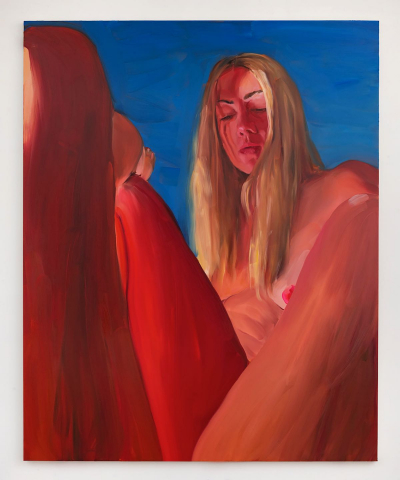
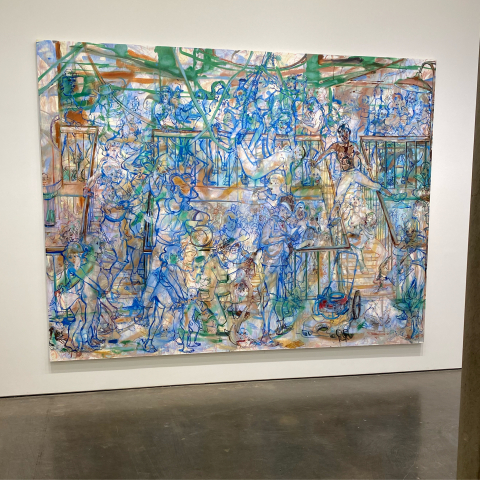
Lucian Freud: Homage to Lucian FreudYou are pretty sure you have a handle on things; a bead on the situation, so to speak. You know the speed that light travels (299,792,458 meters per second). This is of some help. You know, more or less, where you are: what universe, what planet, what continent, what street, what room number. You are focused on reading this. That will keep your mind occupied for well over one minute. Your body, however, is operating on another level altogether. Several, as a matter of fact. At the same time. None of which you are really concerned with right now. Your brain tells your heart to beat, your blood is oxygenated. You are digesting. Producing and accruing shit and piss. You are sweating. At some point you realize that you have unconsciously become wet.
Few artists have managed to capture the gross beauty that is the human. Lucian Freud (December 8, 1922–July 20, 2011) was one of them. His was not an art of our higher aspirations or perceptions of our selves, but a candid depiction of our animal existences. Read more »
Kal Spelletich: Where's My Jetpack?!The flight to Tokyo from London makes one stop, in Moscow. The layover is interesting. You can’t see much from the air or the airport. Dismal and cold. There is a First Class lounge where you are served tea and ice cream. There are lots of magazines, but none are in English. In the toilet the ceilings have little open slats, which make you think there might be hidden cameras. You’re a little scared.
Before flying was a means to an end, it was a sensation, a thought. The desire to fly was to experience weightlessness, a release from corporeality. The "flying machine" made man superhuman. For Kal Spelletich, flight's future promise may be gone, but not forgotten. Where are the jetpacks? The flying cars, the escape pods, anti-gravity boots and moon colonies? This is the future, your future, but not the one that was promised. Read more »
Monkey Spoon
Kim Foster Gallery
NYC
Through July 29th
Blurring the boundaries of time, memory, and materials, Monkey Spoon is a superb group show. Using non-cartoony pop-surrealist art, the show aims "to reveal something new through unusual combinations that expand the awareness of the viewer." The work in this show tackles significant issues, and instead of an instigating anger, a few abstract themes blend among the twelve artists' work: play, anonymity, and nostalgia.
While play is the work of childhood, sometimes the fun and games of adults reveal the unresolved nightmarish human nature within a culture. Fairy tales are prime fodder for this distortion, and John Howard's work is laden with our compulsive and greedy behavior. Caught in the act of addiction, with names such as "Tripical Obsession," "Gamblers Aides," and "Narcissus," his naughty pixies tempt humans, trapped in precarious balancing positions. Read more »
Cy Twombly: SculptureMen, like trees, wrote Abraham Lincoln, are best measured when down. With the passing of Cy Twombly last week at age 83, we may finally begin to count the rings. Sculpture, now at the Museum of Modern Art, is an opportunity to examine the lesser-known three-dimensional works of the American painter.
Twombly is best known for his scratchy, graffitied canvases, whose subject matter ranged over centuries of classical myths, great battles, and -- in his final series, Bacchus -- giant wine-colored flowery shapes. His signature style, a combination of handwriting, scribbles, and Ab-Ex gestures, can be sampled at MoMA in Leda and the Swan (1962), hanging near the start of the exhibition. Read more »
Born in Northern Ireland, now residing in Brooklyn, NY, Rodney Dickson made his mark with staunchly anti-war art. This stance led to a special interest in Vietnam and Cambodia, and he has exhibited frequently in the former country -- and around the world. CultureCatch's Bradley Rubenstein recently caught up with Dickson to review his career and bring us up to date on his evolution.
Bradley Rubenstein: Let's go back a few years, first, and touch briefly on the paintings of yours that I first saw: pictures of Tanya Roberts. They evolved out of a complex system of sending off fan shots or pap shots, which were faithfully, more or less, reproduced. In retrospect, though, it seems that you were really interrogating painting via an intercontinental telephone game -- seeing how others saw American culture. How did you see the project, and how, in a larger sense, did this have anything to do with your personal painting practices either before or after those works? Read more »
Vicki DaSilva: ReverbIn her continuing effort to bring to the fore artists who use light and sound as a primary medium, Able Fine Art NY Gallery curator Jill Conner offers Reverb, an exhibition of the works of photographer Vicki DaSilva. Read more »
Bradley Rubenstein: Your work combines a very sophisticated design sense with an almost teenage-like conception of surrealism -- a smart mix, I think. I picture you as the kid in high school who painted murals in the hallways or did the best copies of album covers. Did you have an interest in art when you were younger? And is some of that what you draw on when you work now?
Inka Essenhigh: Actually, when I was in high school I’d already had a lot of art training and was way too self-conscious to make anything really interesting. I’d say my best, freest period making art was between the age of three and maybe eight. I do draw on that stuff. Read more »
Carol Ross: Drawings and SculptureSince the fiasco of Richard Serra’s Tilted Arc, there has been a certain amount of animosity toward large, metal, abstract sculpture in New York City. There is, of course, that spinning cube-thing by NYU, which heshers and tourists seem to find some aesthetic value in, but other than that (and I believe I speak for all the philistines), big metal shit is really annoying to walk around when you are trying to get somewhere important. Fortunately, there are some sculptors who possess a level of sensitivity to the mobile viewer: Scott Burton, for example, or Carol Ross, whose recent works can be seen at Rooster Gallery in New York. Read more »
Zap: Masters of Psychedelic Art, 1965-1974I was an impressionable teen in the late 1960s, and Zap commix brought me a front row seat, albeit a twisted one, to a world of drugs, sex, psychedelia, violence, brilliance, and stupidity. As mentioned in essay by Gary Panter and Chris Byrne, the exhibition's curators state how the Zap artists "dared to critique and satirize the messy cultural and social network in progress." The Zap artists let it all hang out, literally and figuratively, and they targeted their like-minded peers as well, making it all the more compelling. Read more »
Alexander McQueen: Savage BeautyPolonius said it best: “Clothes maketh the man -- but make sure they are quality, not flashy...and above all to your own self be true.” From his lips to Alexander McQueen’s ears, it seems. For those who have been buried under a rock for the last fifteen years, or, perhaps more likely, locked in their Master’s dungeon, McQueen’s sartorial splendors may come as something of a shock. To those of us who have appreciated the curve and grace of Aimee Mullins (below-the-knee parapalegic, model/actress/athlete), admired Prince Charles’s Savile Row suits, watched Björk on the red carpet, or seen Lady Gaga (Six Million People Can’t Be Wrong), this exhibition may seem more overdue than revelatory. Oh, yeah. Alexander McQueen: Savage Beauty, is at MMA's Costume Institute through August. Read more »
Mark Grotjahn: Nine FacesFor nearly a century the search for the Primitive, the essential, untouched-by-civilization essence of Man, drove artists as diverse as Ensor and Picasso in their Modernist depictions. Apparently, this Conradian pursuit has not been completely exhausted, as the recent works of Mark Grotjahn at Anton Kern demonstrate.
"It was a distinct glimpse: the dugout, four paddling savages, and the lone white man turning his back suddenly on the headquarters, on relief, on thoughts of home -- perhaps; setting his face towards the depth of the wilderness, towards his empty and desolate station.” Conrad’s narrator, Marlowe, in paddling down the Congo in search of Kurtz, finds that he brings the seeds of corruption to the innocent savages that he has come to survey. In a similar vein, Grotjahn, with these paintings, seeks to bring a sense of purity, geometry, and order to the simple depiction of a human face but shows that such a task is insurmountable (at best) and fuck-headed (at worst). Read more »

This is for Irene, who still gets a thrill, when she sees Bill.
It has been said that memory recounted at leisure is adventure; if we hold that as truth, then the paintings of Willem de Kooning, those tortured creations of his struggles, constitute High Adventure, indeed. The Pace Gallery exhibit The Figure, Movement and Gesture focuses on his painterly transformation from abstraction to figuration and back again. "The figure," de Kooning once said, "is nothing unless you twist it around like a strange miracle." Twist it he did, contorting it into the pastoral landscapes, creating a new style of painting and blurring the boundaries of representation and abstraction. Read more »

Sylvia Roth, founder of Hudson River Editions, is a painter and master printer who has worked with the likes of Karen Finley, Richard Pousette-Dart, April Gornik, Alfonso Ossorio, and John Chamberlain. Among her many early brushes with greatness was Roth's study of painting with one of my all-time favorites, Philip Guston, at New York University. Read more »
David Salle: New PaintingsIt was not that long ago that David Salle seemed to strike a collective nerve with his simulations of paintings: for some, he resurrected Painting; for others he fucked its necrotic corpse. Among critics he was praised for revivifying the art form, along with his colleagues Julian Schnabel and Eric Fischl, and vilified by feminist critics for his reified soft-core porn subject matter. Artist and writers such as Peter Halley and Mira Schor drew up highly articulate sides in the battlefields that Salle called paintings. Read more »
Gary Stephan's recent one-person exhibitions include those at the Baumgartner Gallery; Cristinerose Gallery; Mary Boone Gallery; Diane Brown Gallery; and the Margo Leavin Gallery, CA. His work is included in the collections of the Museum of Modern Art; Solomon R. Guggenheim Museum; Metropolitan Museum of Art; Museum of Contemporary Art, Los Angeles; and the Museum of Contemporary Art, Miami. He is the recipient of a Guggenheim Fellowship, an NEA Grant, and a New York Foundation for the Arts Grant. Read more »