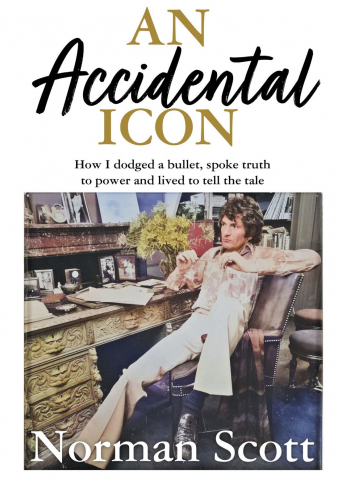
England is viewed by the wider world as a nation of eccentrics. This is considered a genetic characteristic, and something to be celebrated. Like most assumptions, the truth lies somewhat wide of the remark. Quentin Crisp, one such “National Treasure,” is now rightly revered as one, but his journey from pariah nuisance to that of sage-like venerability was a long and winding affair. He migrated to New York, remaining vital till the end, an amalgam of defiance and disappointment worn as wit.
Some considered him a latter-day Oscar Wilde, a comparison he didn't much value, remarking that he'd known many who'd been sent to prison for crimes of the flesh like Wilde's, without being broken or penning such bad verse.
Hollywood Pinups
by Timothy White (Collins Design)
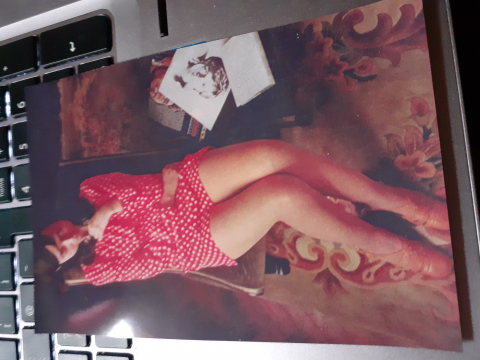
Some of my most profound pubescent mam... er, memories were the sensual and voluptuous pulp illustrations by Alberto Vargas. His luscious renderings were fuel for any red-blooded male. New York photographer Timothy White created this photo book as a continued exploration of his 1994 commissioned homage for the 50th Anniversary of the Esquire Magazine's Varga Girl pinup.
David Robilliard was a poet and painter who lived from 1952 to 1988.
EATING OUT
You're like a potato.
You'd go with anything.
"David Robilliard was the sweetest, kindest, most infuriating, artistic foul-mouthed, witty, charming, handsome, thoughtful, unhappy, loving and friendly person we ever met.
Kafka
By R. Crumb & Dave Zane Mairowitz (Kitchen Sink Press)
Franz Kafka was the master of the transformation, the dive into darkness, the unpeeling, the alchemical combination of right and wrong, up and down, matter of fact and out of your mind. Which is why, were he with us in the flesh, I'm sure he would approve of the Kismet that brought his story (and his stories) together with artist R. Crumb. It is an artistic marriage made in heaven -- well, to be precise, in hell.
Watchmen: Hardcover Edition
By Alan Moore, Dave Gibbons (DC Comics)
Whenever a new comic book-inspired movie is a big hit, comic book stores report that sales of that hero’s books often spike. Which is why, this past summer, books by Batman, Iron Man, and The Hulk did brisk business. But so too did another comic, one that won’t be seen on the big screen until March of next year, but got a bump nonetheless when its trailer appeared both online and at the San Diego Comic Con: Watchmen, the groundbreaking 1986/86 graphic novel by writer Alan Moore (From Hell, V for Vendetta) and artist Dave Gibbons (Give Me Liberty, Captain America). Though this book has often been called “unfilmable,” and not just by Moore, the rather impressive trailer got enough fans so excited that the book started flying off store shelves.
Dandy in the Underworld
by Sebastian Horsely (Sceptre)
Some books make promises they fail to keep, drawing the reader into a disappointing experience that, like many affairs, should have been abandoned long before the bitter end. Sebastian Horsley has created such a piece of literary malpractice. Dandy in the Underworld begins like a more modern Naked Civil Servant, a book which it constantly references to the point of laziness and theft, but hasn't the intellect to better.
New York Dolls: Photographs by Bob Gruen
by Bob Gruen (Abrams Image)
To homophobic men, they appeared outrageously gender-challenged in makeup and spandex, but to those groupies who knew them, they were true macho dudes from the rock fringe culture of New Yawk. Sex and drugs and roll 'n' roll. More Rolling Stones raunch and primal then the calculated and effeminate glam of David Bowie or Jobriath.
A Casualty Of War: The Arcadia Book of Gay Short Stories
Edited by Peter Burton (Arcadia Books)
In this post Will and Grace, Queer Eye, Broke Back Mountain world, where gay is the new black, and every home should at least know one, a "Gay" anthology seems a little like a quaintly queer idea. However since being homosexual, to twist Graucho Marx, consists largely of being the member of a club you didn't initially want to be a member of, especially if you come from a small town, or live in a tough part of any major metropolis, such projects retain a fundamental necessity.
It's been nearly two weeks since the suicide of David Foster Wallace and besides the shock, what's been rattling round in my head is the question, what would he have written next? The stories untold. The blank essays. I was wondering, even before he died, how DFW was going to respond to the well-meaning blast he got from critic James Wood in Wood's marvelous recent book, How Fiction Works,. Wood was too smart to go snarky on Wallace (and as much as confessed to it not hours after the news) and Wallace was too smart not to ingest the knowledge and spin it into something unseen, and wonderful. At least that's what I hoped. Now, I know. We won't hear anything.
Three Balconies: Stories and a Novella
by Bruce Jay Friedman (Biblioasis)
Time was serious writers wrote to entertain audiences. Not entertain in the “anything for a laugh” style we’re so accustomed to, but to move, to captivate, to probe, to scare, to inspire, to confuse. From Dickens to Tolstoy to Chandler to O’Connor to Lardner to Dahl to, even, Hemingway, these artists used stories and storytelling to get to people. These days movies, and mostly crappy movies, have taken over this role.
Sway
by Zachary Lazar (Little, Brown)
Flower Power.
Ychhh? Yes.
Lame? Well, yes and no. It never would have sprouted without its dark side.
Meetings With Morrissey
by Len Brown (Omnibus Books)
For an artist who has widely shared his heroes, his obsessions, and his occasional anger, Morrissey remains an enigma, retaining a certain aura of mystery one normally associates with a different era. He is a rock original who has no rock and roll habits. He doesn't do drugs or drink to excess. A vocal vegetarian and a man who has a way with words, he is the ultimate iconic ironic. A man who lives in the heads of his fans, but remains myth-like and remote. A familiar stranger.
Freddie & Me: A Coming-of-Age (Bohemian) Rhapsody
by Mike Dawson (Bloomsbury USA)
In many ways, it was Rock 'n’ Roll that turned comic books into graphic novels. Even before R. Crumb quite knew what he was doing, and even though his tastes run more toward 78s from the torrid climes, the liberating force, the form meets content of Rock -- the sheer, in-your-face, ugly-beautiful, smart-simple, visceral appeal infiltrated his work. Here you could write, and draw, and the feeling that resulted was a true one plus one equals three equation.
Apocalypse Nerd
by Peter Bagge (Dark Horse Comics)
If R. Crumb was the preeminent cartoonist to capture the ethos of the '60s and early '70s, then Peter Bagge is his successor in capturing American culture and society in the '90s and new millennium. His frenetic, caffeinated cartoon style brilliantly exposed the dysfunctional energy of slackers and Xers alike. His first solo title, Hate -- starring everyone's favorite loser, Buddy Bradley -- was my literary junkie's fix for all 30 glorious installments.
Magic Circles: The Beatles in Dream and History
by Devin McKinney (Harvard University Press, 2004)
What do toilets, holes, mutation, meat and Yellow Submarines have in common? In the mind of Devin McKinney, these are the overarching themes of The Beatles’ journey, both performed and recorded, from Liverpool to Hamburg to Liverpool to America to Japan to the Philippines to America and back to England. And what’s truly extraordinary is…he makes an excellent case.
Ask the Dust
by John Fante (Harper Perennial Modern Classics)
Bukowski was a fan. (He wrote the Preface for the 1979 reprint.) And it is easy to see why. Here is Fante's masterful story about the pursuit of fame and fortune on the fringe in the Land of Plenty. Take into account that it was published in 1939 and it shines all the more remarkably. His first of a four-part serial The Saga of Arturo Bandini. This is a sordid tale of two dysfunctional young lovers trying to make their way in Day (and Night) of the Locust-era Hollywood.
The Leopard
by Giuseppe Tomasi di Lampedusa (Pantheon Books)
Rejected as being unpublishable, The Leopard, a short book written from a perspective of privilege concerning a time of change, seemed destined to be lost with the death of its author in 1957, at the age of sixty.
Giuseppe Tomasi di Lampedusa, an urbane Sicilian, a prince with a palace in Palermo, lived in Paris and London, but always maintained a strong love and association for the island of his birth.
Fame as an afterthought to madness. Valerie Solanas 1936-1988.
Once upon a time, and not so very long ago, things took slower turns and more leisurely dives. Fame was usually a gradually developing state of grace or disgrace. Celebrity consisting largely of being noticed and the need for that desire to be fulfilled. It was about doing something worthy of note. It now consists of of shameless bravado. The right dress, the wrong drug or sex tape. Feeble-minded efforts at being seen or commented upon. Blame Madonna or the Spice Girls, Michael Jackson or Britney Spears. Or simply blame fame.
Somewhere Towards the End
by Diana Athill (Granta)
Age is not a popular topic in literature. When young, it seems too distant, once old it looms too near, so it is sparingly used, the full picture being perceived as too grim and too painful for prolonged attention. There is also the distinct likelihood that being caught up in the process, one is rendered incapable of annotating the experience.
A Dose of Rock 'n' Roll
by Nancy Lee Andrews (Dalton Watson Fine Books)
In 1969, Nancy Lee Andrews worked for the world renowned Ford Modeling Agency. “I was the tall, All-American dark girl, different from Penelope Tree, my contemporary, who was edgy.” Andrews’ entry into the music business soon followed. The Fillmore East had just opened in the East Village, featuring acts like The Association, Mad Dogs and Englishmen, Leon Russell, Freddy King, The Cream, Hendrix, and a close friend mentioned they could gain access to the club through the back door.
The Fall of France
by Julian Jackson (Oxford University Press)
History tends to be written by the winners. How interesting and how poignant it is, then, to read a history of loss, specifically the way that France – glorious, democratic, politically and artistically advanced France – folded in three weeks' time to the Nazis during the first half of the first year of World War II. Julian Jackson’s The Fall of France, while not written with the style of a Nabokov or the wit of a Wodehouse, has the power to shake you to the pit of your stomach, and to make you ask questions that reverberate to the bottom of your soul. And keep turning the pages in a blur all the while.
Joe Gould's Secret
by Joseph Mitchell (Vintage)
Some characters are a writer's once-in-a-lifetime gift. In Joseph Mitchell's case, his came in the bedraggled guise of Joe Gould, a Harvard-educated Bowery bum and panhandler. At times a likeable rogue, at others a Grade A pain in the ass, Gould was served well by the generous attention that Mitchell afforded him.
Twenty-five hundred pages or so later, I sit at the end of the year dumbfounded as to how I’m supposed to concoct a best of 2007 list. I’m obsessed with the best of 1868 or of 1873 or 1855 – or, should I say, of ever. And I’m not alone. By dint of Kismet, it seems I wasn’t the only one having a Tolstoy year in 2007. Something about the soundbiting and youtubing of our collective sensibility sent others to the Count. This fall marked the publication of a massive, drum roll please, lauded, heralded, dissected and mightily worthy, translation of War and Peace by the indefatigable husband and wife team of Richard Pevear and Larissa Volokhonsky.
Touch: Naked Girls Home Alone
by Peter Gorman (Goliath)
In his latest book, Peter Gorman's camera is a voyeur figuratively hidden inside a mirror. He has an extraordinary eye for capturing the day-to-day life of real New York women who aren't huffed and puffed and all airbrushed up. Their surroundings are real, not phony sets with lighting and make-up and an attending entourage of distracting assistants. As you can guess, this is not your Girl Next Door coffee table anthology.
Hey, man, 50 years, and On the Road is still going, still selling, still talking in your own special bebop prose to the young at heart. It’s a classic. And you, of course, have long gone to the great beyond with Janis and Jimi and Elvis, and all the other cool lost souls of excess—too much talent, too little control.
Life is so filled with ironies. It took you years to sell that book that has now sold in the millions.
Norman Mailer roared over the literary scene forever and now he's gone. He spat out words like the boxers he so loved sprayed punches, but no more. He ran for mayor of New York City, and he could have been mayor of the world. He talked shit and wrote like an angel. A son of Harvard he enlisted to be a combat grunt in WWII so he could get material, and it worked.
Skin Lane
by Neil Bartlett (Serpent's Tail, paperback)
Neil Bartlett's new novel is a strange elegy to a lost city, a lost trade, and in many ways the manner in which time tramples all that was once important to the lived and spent. We are all destined to leave detritus. All that mattered will mean little to future eyes. The loves, the losses, the passions that burned so fiercely, become invisible with the savage progress of existence.
Catherine James has lived eight lives in 57 short years and her Dandelion: Memoir of a Free Spirit (St. Martin's Press) devastates with emotional sabotages that seem so outrageous that you swear you must be reading fiction. I read the advance copy in one sitting, blown away by the poignancy and ease with which Miss James shares her years of perilous plight. The abuse she suffers at the hands of her Hollywood femme fatale mother Diana reads like Mommy Dearest meets Piper Laurie’s character in the movie adaptation of Stephen King’s Carrie. Chapter after chapter she is left pummeled by another emotional battering from someone close to her. Even when she’s able to finally run away from tortuous reality, which is one of her early blessings, she encounters emotional hardships that rival any I’ve read or seen in film.
Song Without Words: The Photographs and Diaries of Countess Sophia Tolstoy
by Leah Bendavid-Val (National Geographic Society)
Count Leo Tolstoy, author of War and Peace, Anna Karenina, The Death of Ivan Ilych, and so many other masterpieces (to use an overused, but totally apt word) seems like he should have lived in another eon. Surely he must have hung out with Socrates, or Aeschylus, or, at the very least, Shakespeare. But he didn't. If not quite of our time, he did manage to live into the 20th century (1910 to be exact), and there are films and photographs of him.
The House That George Built: With a Little Help from Irving, Cole, and a Crew of About Fifty
by Wilfred Sheed (Random House)
There's a story towards the end of this crackling essay cum history that could sum up the bittersweet but ballyhooing tonality of the entire glorious screed. We see an aging but still-in-fighting-trim Yip Harburg, leftie songsmith of the golden age, the Gershwin age, as he's regaling the '60s radical Father Berrigan and his gang with a rousing rendition of his "Brother, Can You Spare a Dime."