
Mike Cockrill: Falling in Place
Mosaic Artspace, 19-28 31st Place (Andromeda Building)
Long Island City, NY 11101
Thru March 20th
I became a curious fan of Mike Cockrill's paintings and drawings on Facebook, beginning in 2022, when the artist returned from a Covid-imposed isolation to meet in public. I approached him at a Mark Kostabi show on West Broadway. He's tall and confident, easy to pick out in a crowd. One of the reasons I was attracted to his FB art profile is his graphic versatility, drawing skills, and sharp imagination. Artists such as Daumier and Goya, and editorial cartoonists like Jules Feiffer, created nightmare fantasies and ironic jokes with their pens.
His technical facility is deceptively mainstream, serving a subversive bend. "I had an early fascination with popular forms like magazine illustration and political cartoons." As a young artist, he took a job designing business forms in the financial district for Merrill Lynch, getting an inside view of cubicle life.
By the time we became acquainted, I had morphed into a veteran of the outdoor billboard-painting scene. In the blue-collar circus of ropes and ladders, the painter of big signs was called the "mechanic." Apart from a chuckle about the sinister Charles Bronson movie by that title, I identified with the cold impersonality of the content (cars, bottles, fax machines). The old-school bosses and shop managers put complete trust in my hands. I often dreamed about a clean job at a Madison Avenue desk.
1> Office Drones
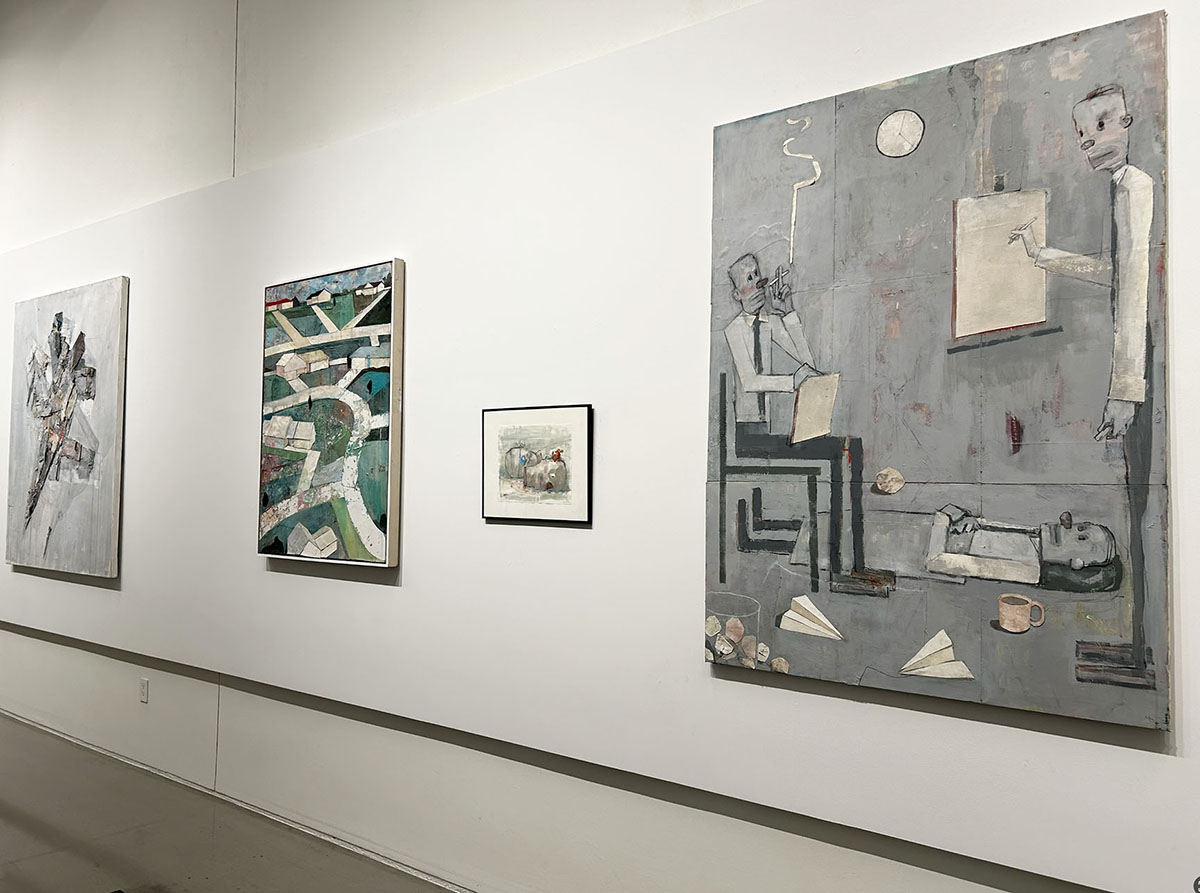
In The Idea Room, a distressed gray office like a prison cell, three co-workers are pitching a campaign proposal. They are dressed in sparse Mormon black pants and shoes, white shirts, and ties. The result of their labors is demonstrably futile, the floor littered with paper airplanes and crumpled pages. An executive sucks on the lifeline of a cigarette while another sketches an invisible idea on a floating easel, yet a third lies supine in the exhausted pose of a patient in a psychiatric session. The figures are rendered as ciphers, thin suggestions with clown noses. A clockface stares like a merciless moon.
2> Maps and Neighborhoods
Mike is from Virginia, a bedroom community close to the nation's government offices. In other paintings, he shows off his gift for storytelling in sunny, halcyon landscapes. The types of children and activities in those are deceptively innocent and attractive. Mike's plots add a sinister twist. In earlier works of lawn parties, sweet girls in pastel pinafores hold pistols aimed at cowering clowns.
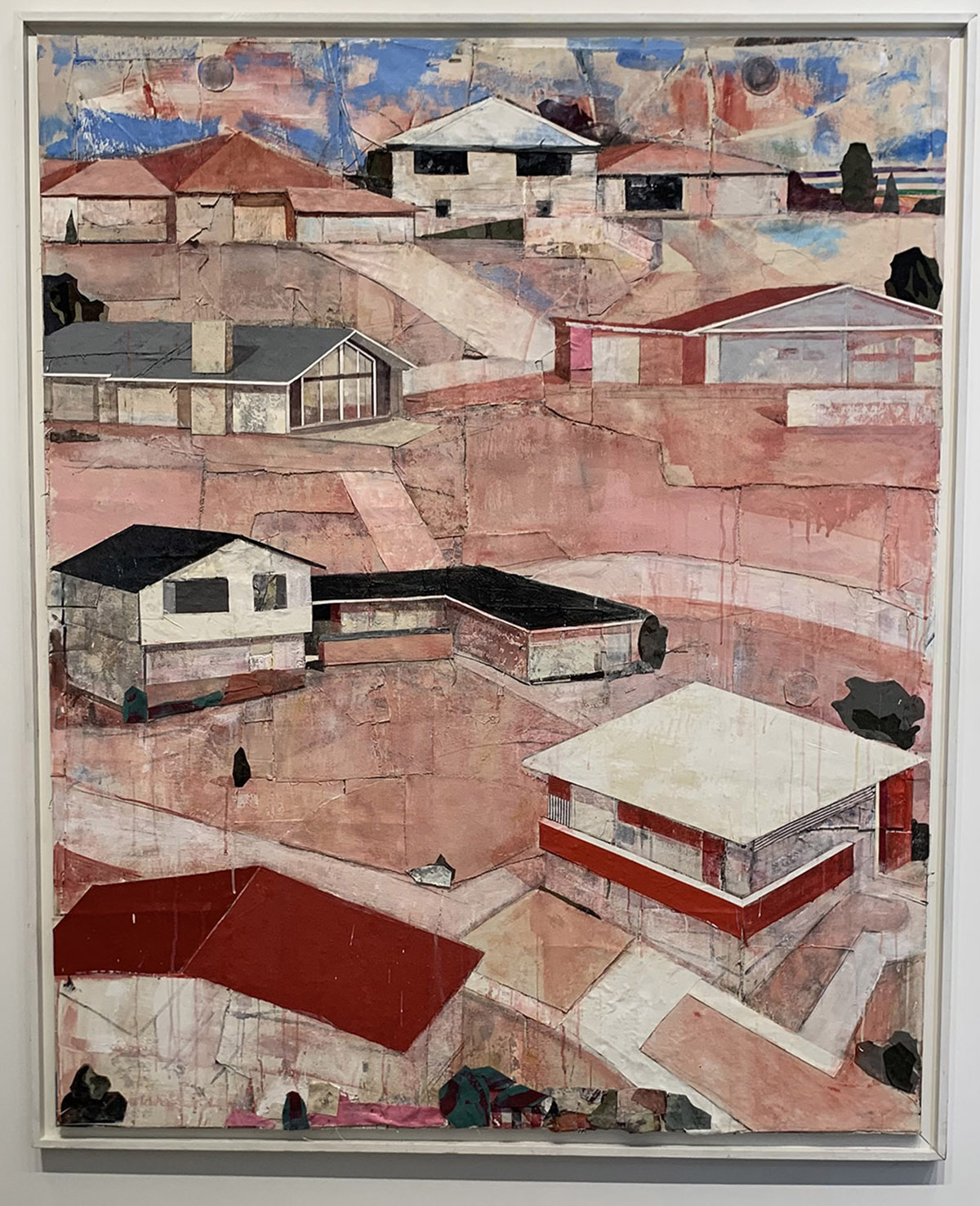
His views of suburban houses are devotional and can resemble pre-Renaissance Italian art. The ranch-style houses are composed with a model-maker's care and patience, often using multiple perspectives, or more pastorally, seen from a bird's-eye view. In these, we see a sharp-edged Japanese space, the curved roads gracefully disobey logical connections. The surface is layered and scraped to reveal hidden layers, with drips and veils, seams of patchwork, affirming the flat canvas. Nowhere do we see the anecdote of dogs, figures walking, and cars on errands. An eerie quiet prevails, as if the families have all departed for offices and schools–perhaps a reminder of the Cold War.
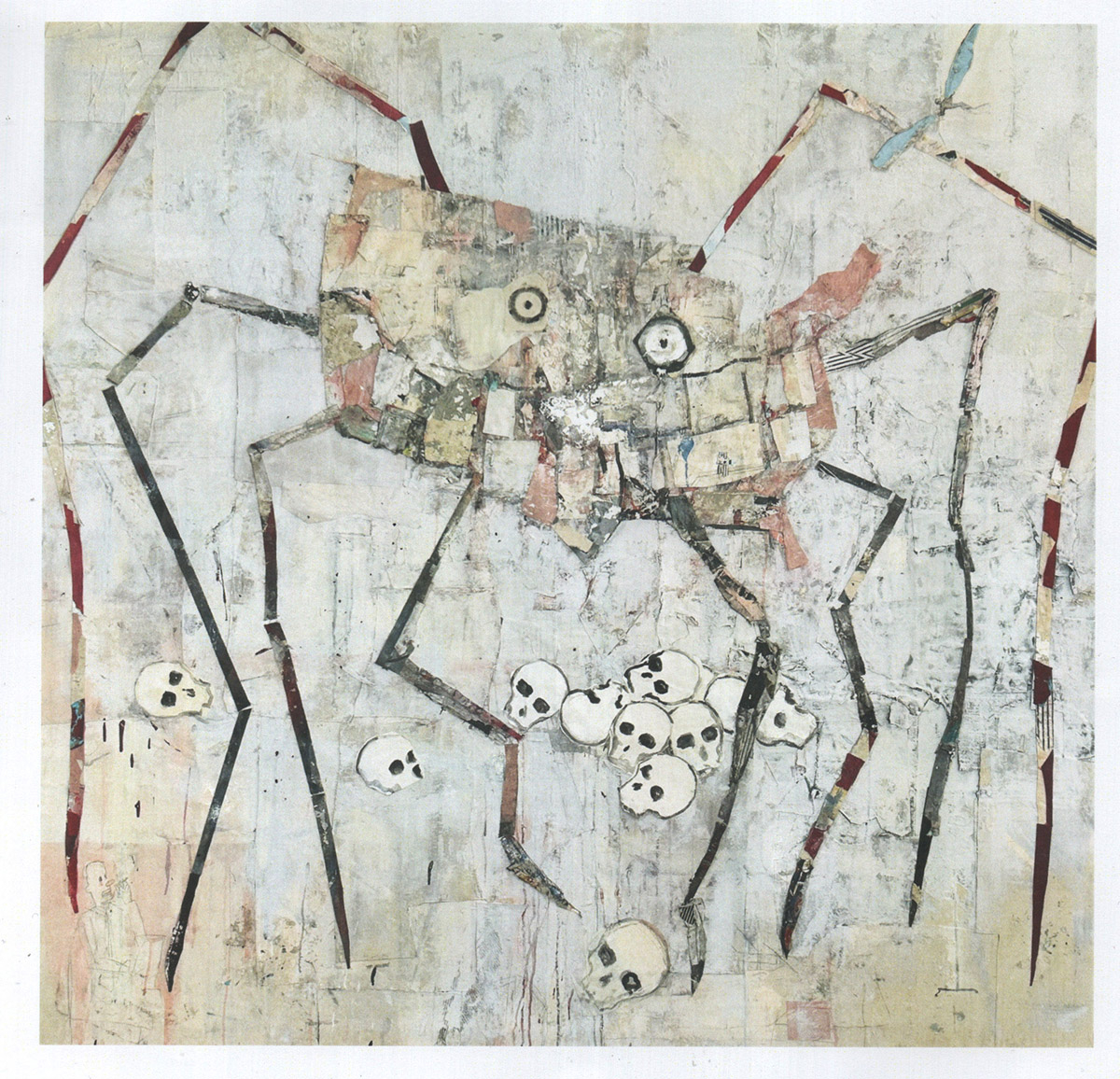
The grinning malevolent map of the USA is another of Cockrill's inventions. The omnivorous face of a US map grasps with tentacles and mechanical arms, a reminder of MAGA's threats of rogue imperialism, the face of America: arms dealer to the world. Heads roll, and bloody conquests from history are revived: the map is an ogre–the tenuous Union affirmed by Lincoln at the surrender of Lee's army still festers, remains a squirming, itching bed-case. Anger against scapegoated minorities is normalized.
3> Falling in Place: Watteau and Fragonard
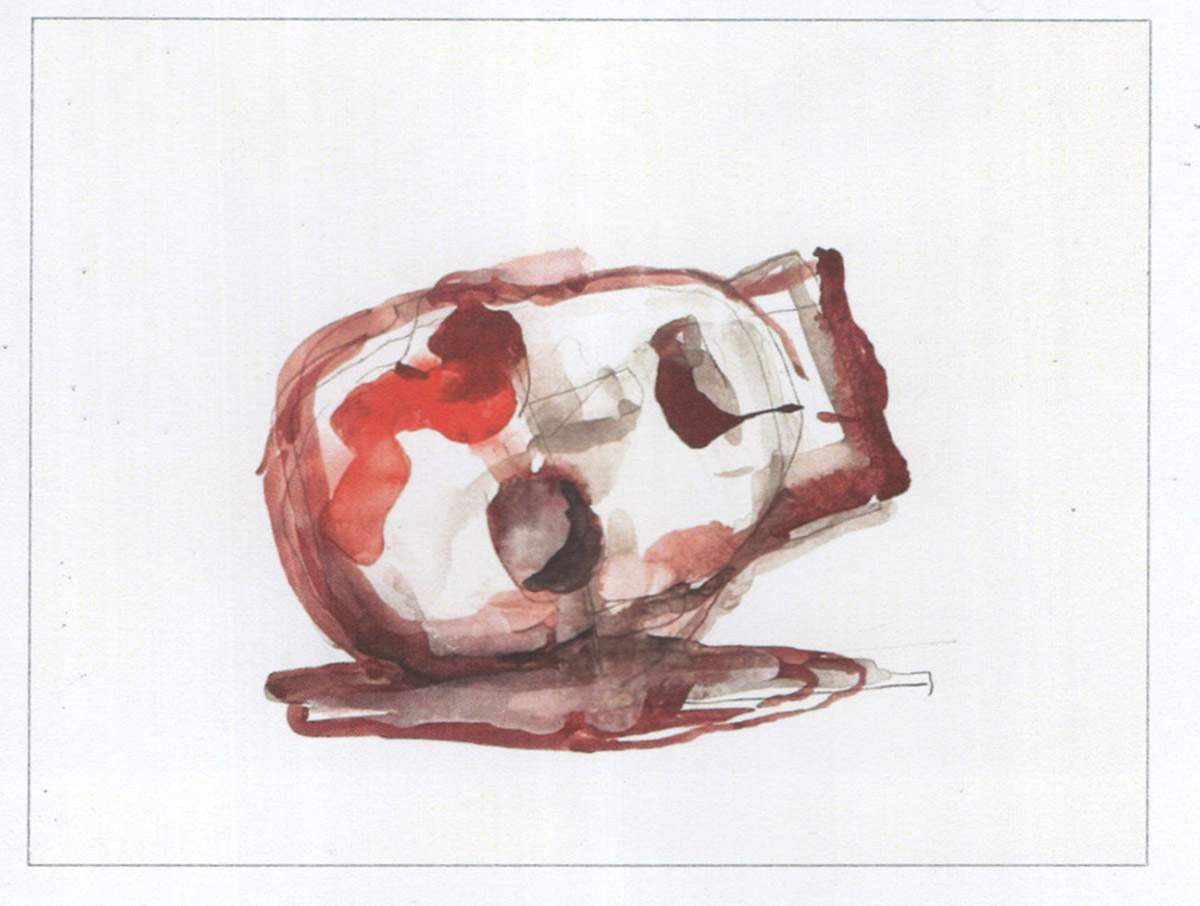
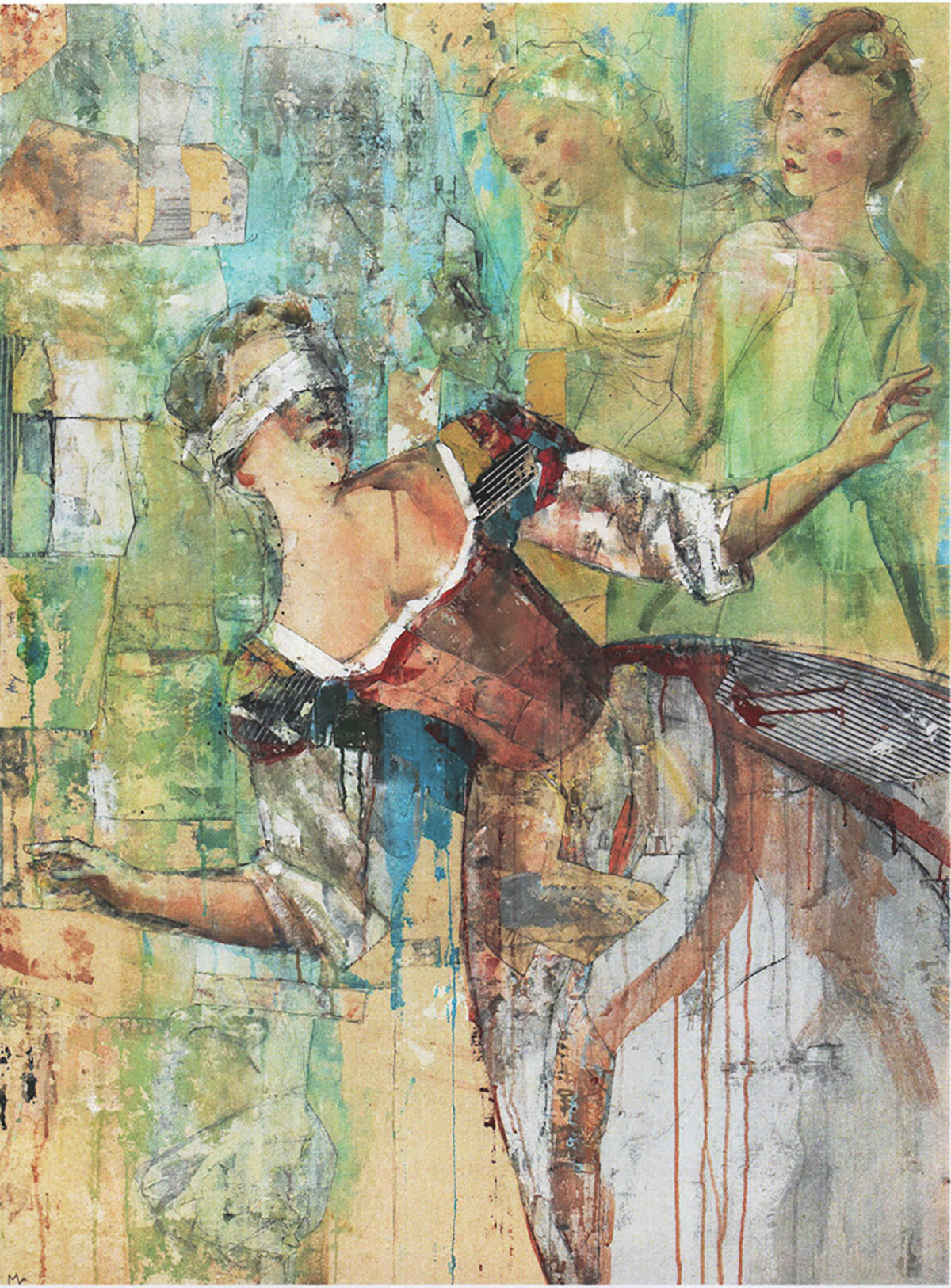
One wonders whether, by drawing on Watteau and Fragonard, Mike gives free rein to beauty and refinement without contemporary content. Or maybe the bubble-dwelling courtiers of the Rococo era mimic the climate deniers or the isolationists of today's head-in-the-sand retreat from stable alliances? The Rococo world, highly decorated and refined, is now the poster child of a blind and willful negligence of the social order. A student of history knows what followed the last Bourbon monarchy: The French Revolution. Who can say, as some historians claim, that the violence of the 1790s was seismic, causing a chain reaction of mass death, into the Russian Revolution and the two World Wars? The expedient of the guillotine is expressed in Mike's related drawings of decapitated heads.
These concerns seem secondary to his fun in picture making, teasing delicate gestures of storybook women and girls from homely scraps and playful accidents on the canvas. The clash of materials and subject is charming as it is contradictory. His attachment of layers and shifting of the focal length on the players in this farcical, self-conscious space vibrates like an earthquake.
4> Parents
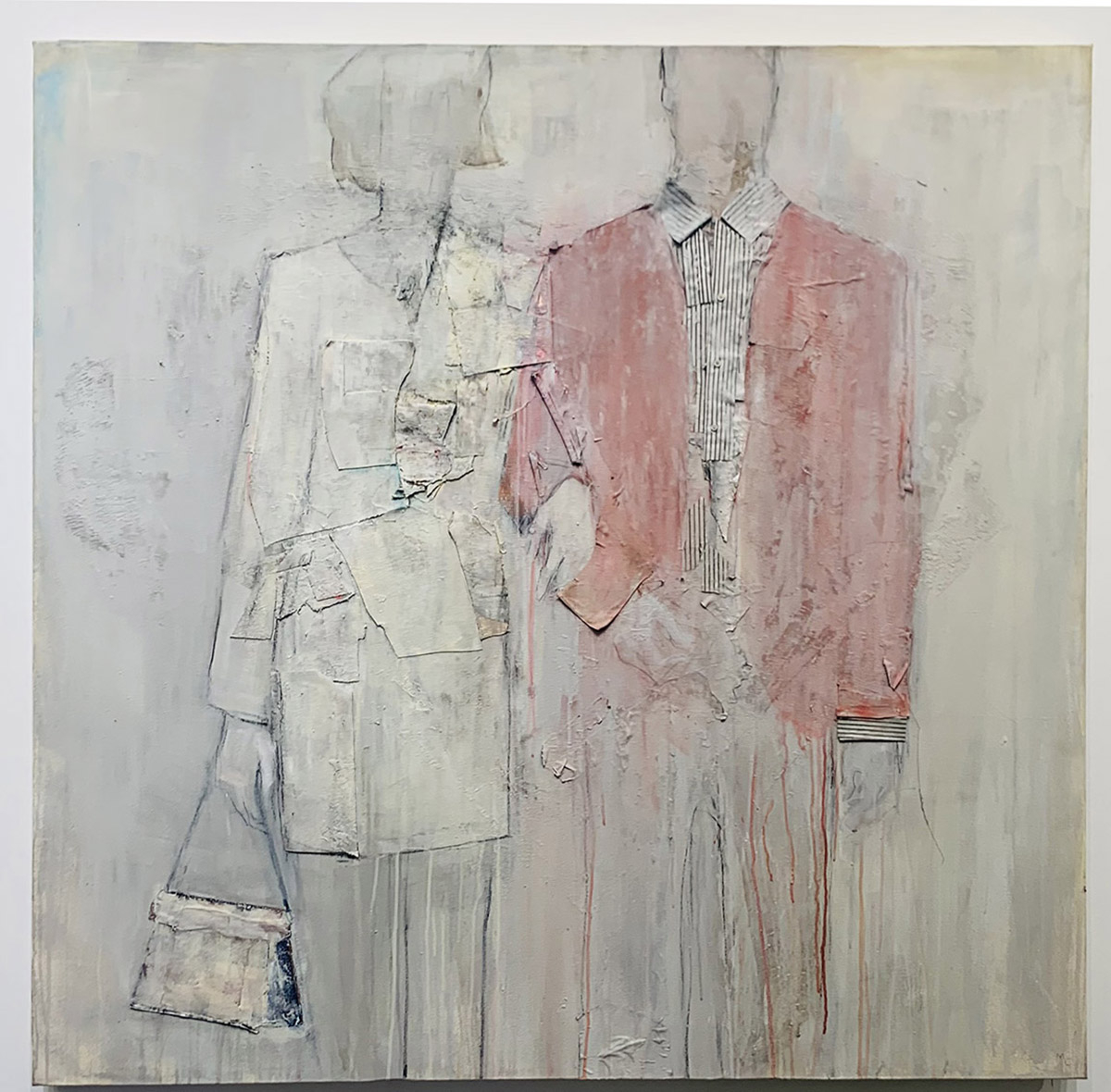
There is a similar cancellation or discretion in this canvas. A traditional painter would be locked into the tedious posing of the couple in tiring positions, the result usually forced into its own stiff reality. Mike suggests a dreamlike flash as the principals assume the pose–a memoir deliberately faded, a fashionable red blazer worn by dad, a stylish car coat and handbag for mom. The likeness is an homage, emerging from the mystique of unity.
In modern culture, the painter is an uneasy hero, constantly striving towards a more complete reality. Bonnard said: "...the artist is grounded in the palette, but when the illusion appears, that's when the nonsense begins." Degas worked on Young Spartans Exercising for ten years. Hopper spoke of "a deepening affection" in his slow process, coaxing finality out of only two paintings a year. They were fiercely committed and took painting as far as their talent would allow. Revision for Cockrill is a source of life.
5> Destruction and Reconstruction
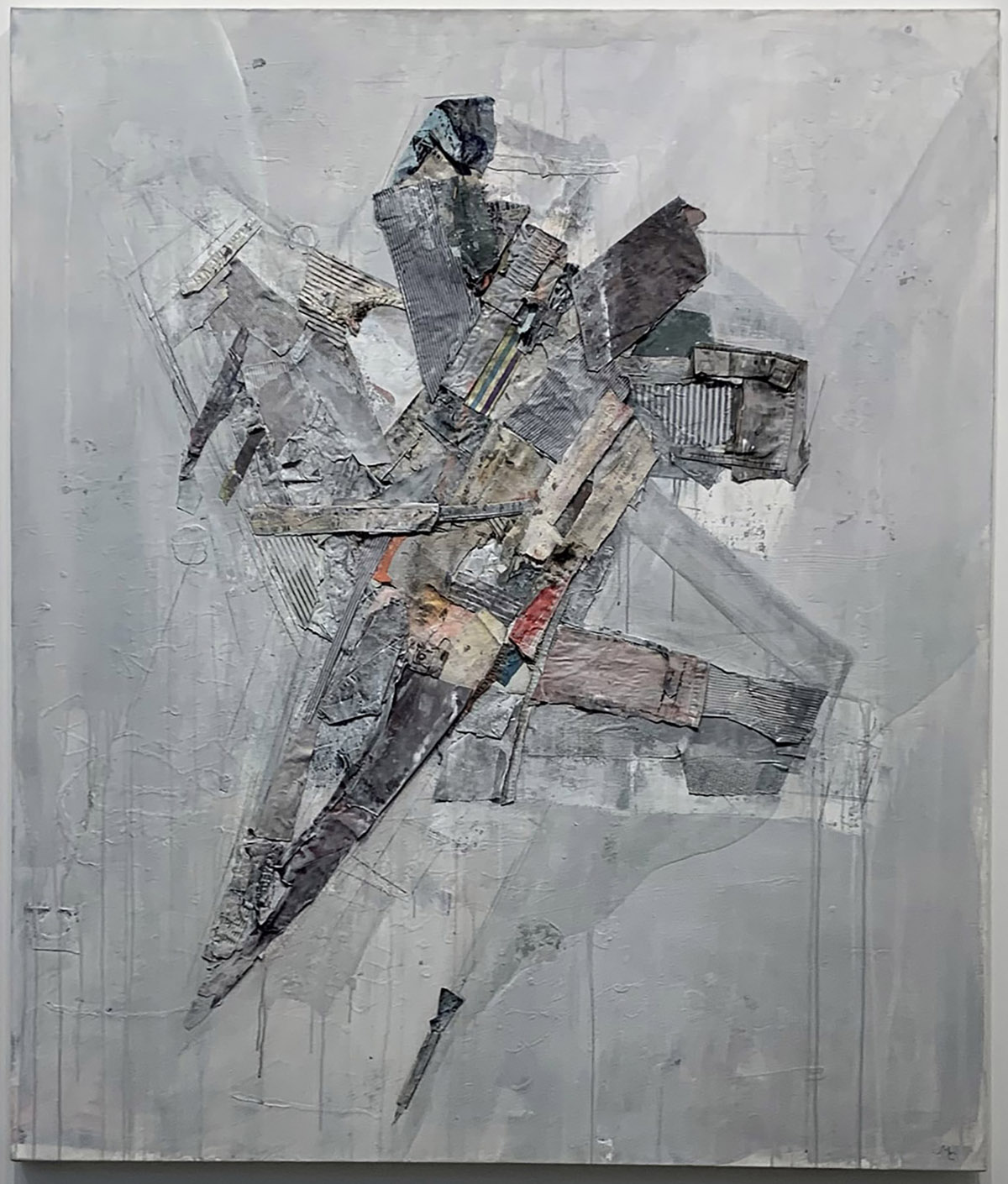
Perhaps living in our challenging, densely opinionated society requires nimble reassessments and constant reactions to the latest shocks. Who is not aware of some imbalance and insecurity? For artists, self-awareness is a top concern, as a daunting field of competitors claim and fight for their own style message. His painting, Fighter Jet No. 3, channels amoral, jarring realism—a pathos like stepping near a bird flattened by car tires. The layering of accurately cut textile shapes conveys a grim, inhuman force.
In modern culture, the painter is an uneasy hero, constantly striving towards a more complete reality. Bonnard said: "...the artist is grounded in the palette, but when the illusion appears, that's when the nonsense begins." Degas worked on Young Spartans Exercising for ten years. Hopper spoke of "a deepening affection" in his slow process, coaxing finality out of only two paintings a year. They were fiercely committed and took painting as far as their talent would allow. Revision for Cockrill is a source of life.
There was a saying from the abstract painters of the 1950s: "...you paint it out, and it is still there." What was the "it?" Could the artist see the ghost of his failed attempt through the veils of overlaid paint and start over on a new tack?
I think of the myopic trance of Melville's anti-hero, Captain Ahab, searching oceans for the white whale. Mike Cockrill's process of scavenging layers of textile, building images with ready-made colors from the thrift store racks, feeds and satisfies this anxiety. It comes of an impatience with fixed goals and of his roaming imagination. His work is from a tradition in which talented admirers of past masters allow themselves gauche manners and not-so-subtle jokes. Painters hope to surprise themselves, and maybe get some laughs.
John S. Paul, Brooklyn 2026
What a pleasure to read John Pauls insights and reflections on my current exhibition of collage paintings. Thank you JP, Millree Hughes and Culture Catch.