
Among the over 230 films produced in France last year, the costliest was Antonin Baudry’s yet-to-be-released, two-parter de Gaulle. Whether we get to see this seemingly intriguing $89- million offering, based on Julian Jackson’s bio, De Gaulle, une certaine idée de la France depends a lot on the gods, indie film companies, specialty venues, and most likely 2027’s “Rendez-Vous with French Cinema.”
This year, the 31st edition of Rendez-vous, an annual event organized by Film at Lincoln Center and UniFrance, showcased 22 features that assuredly supply une certaine idée of what’s happening in La République, the land that caused de Gaulle to exclaim: “How can you govern a country which has two hundred and forty-six varieties of cheese?"
Shoving aside the Brie de Meaux and the Camembert while plating the filmic, artistically this year’s offerings inspire little to complain about and much to praise, especially François Ozon’s masterful adaptation of Albert Camus’s classic, The Stranger; Oliver Assayas’ highly detailed look at the men who greased Putin’s rise to power, The Wizard of Kremlin; and Hasfia Herzi’s The Little Sister, a formidable Muslim lesbian coming-out tale that’s very reminiscent of Dee Rees’s lesbian classic Pariah (2011).
But for the moment, let’s address three films that delve into the inner sanctums of the writer’s mind that, unlike their American cousins, such as Barton Fink (1991), Shirley (2020), and Barfly (1987), do not deal with selling out to Hollywood, agoraphobia, alcoholism, or sex with Faye Dunaway.
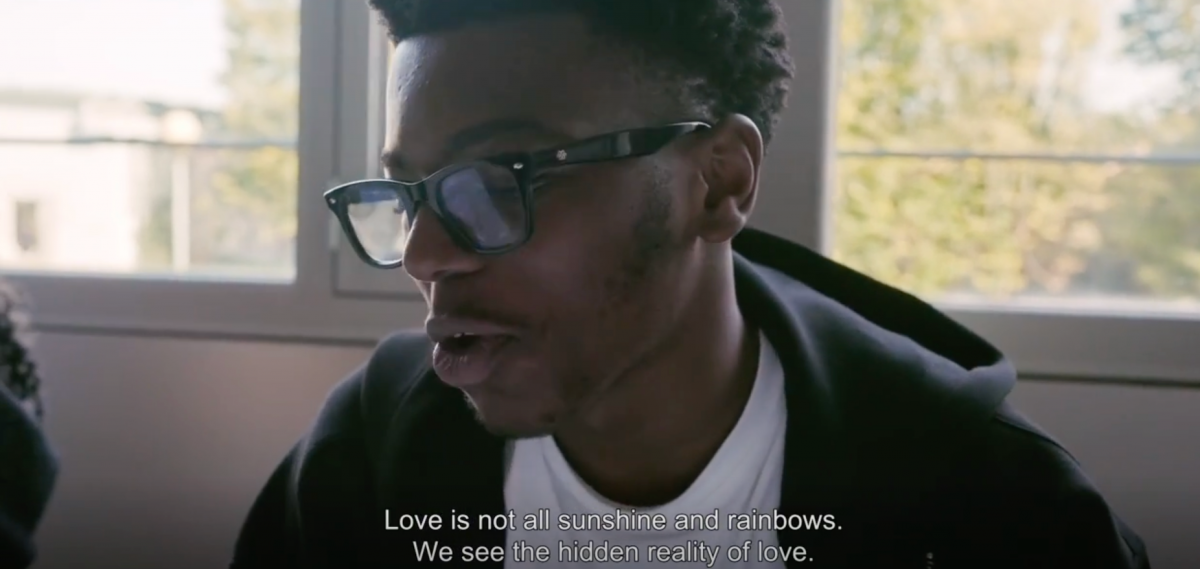
Claire Simon’s documentary Writing Life: Annie Ernaux Through the Eyes of High School Students will work its magic best for those who have already read the Nobel Prize-winning author’s autobiographical novels; for teachers of literature; and for those intrigued by how, in other countries, classroom discussions of rape, abortion, and the tangles of womanhood are openly embraced. For those who don’t read, a viewing of Audrey Diwan’s Happening (L'événement) (2021), an award-winning adaptation of Ernaux’s novel recounting her plight as a university student seeking an illegal remedy for an unwanted pregnancy, will do.
Traveling from one high school to another within France and French Guiana, Simon captures students of all economic stations, all immigration statuses, and all levels of articulateness interacting with Ernaux’s works, books that would hardly be allowed shelf-space in school libraries stateside.
For instance, The Young Man (2023) begins: “Five years ago, I spent an awkward night with a student who had been writing to me for a year and wanted to meet me. Often I make love to force myself to write...I hoped that orgasm, the most violent end to waiting that can be, would make me feel certain that there is no greater pleasure than writing a book.”
Additionally, there’s Simple Passion (1993), a barely fictionalized chronicle of Ernaux’s adulterous love affair with a foreigner she is obsessed with. As for Happening (2000), besides dealing with a young woman getting a backstreet abortion, the novel recounts how her education has distanced her from her poor, unschooled parents. What can they talk about any longer?
Dr. Seuss, this isn’t.
The film begins with one instructor opening a discussion with her class this way: “‘Better not to be stuck up your own arse.’ Why does [Ernaux] write that?”
Another class explores how what Ernaux calls her “flat-writing” style affects how the reader confronts her content. The author has explained her technique as “no lyrical reminiscences, no triumphant displays of irony. The neutral way of writing comes to me naturally.”
Of course, these are teens, so no one can be that surprised when a young woman giggles as she reads this passage from Happening: “I saw a baby doll dangling from my loins at the end of a reddish cord. I couldn’t even imagine having that inside of me. I had to walk with it to my room.”
Ernaux, who is not physically present in the documentary, is inspired by how she overcame a working-class background to become a professor and then win the most prestigious literary award. Though not everyone is impressed. One lad reacted negatively to the following passage: “Naturally, I would never wash until the next day to keep his sperm inside of me.” He spouted: “Personally, I think this is rather shocking. Because, well, even if it is an autobiographical book, and she tells about her life, I think some details could have been left out.”
Ernaux had already pre-responded to that response in Happening: “Sometimes I wonder if the purpose of my writing is to find out whether other people have done or felt the same things or, if not, for them to consider experiencing such things as normal. Maybe I would also like them to live out these very emotions in turn, forgetting that they had once read about them somewhere.”
Moving on to fictional films about fiction writers embracing poverty and experiencing family loss for their art, both Valérie Donzelli’s At Work (Á pied d’oeuvre) and Anna Cazenave Cambet’s Love Me Tender seem to validate Aldous Huxley’s proclamation: “Perhaps it's good for one to suffer. Can an artist do anything if he's happy? Would he ever want to do anything? What is art, after all, but a protest against the horrible inclemency of life.”
In At Work, a nominee for Best Film at the Venice Film Festival, the spectacled, consistently unshaven Paul (Bastien Bouillon) shrugs off his successful career as a photographer to put fingers to keyboard, causing his family to move to Canada without him. Shortly thereafter, as his funds dry up, he sells off his cameras, then he’s forced from his three-bedroom apartment to a dreary basement studio, and by the end, he’s carving up roadkill for snacks.
But please note that Paul is not entirely Quixotean in his quest. His first two books were published and received critical raves but unspectacular sales. Now his third novel has been rejected for being too depressing. Who wants depressing in today’s world? His agent notes. That’s for the TV news.
In his race to the bottom, Paul heads to an employment agency, only to learn that, being 42, unable to speak English, and with just a high school diploma, he’s only qualified to be a freelance handyman. That he also insists he needs time off daily to write is not a plus when job-seeking. Soon, he is unclogging toilets, moving post-holiday Christmas trees to the gutter, and cabbing.
That his teen son offers to send him money is not an ego booster either. No wonder he jots down: “I am to misery what 5 PM in winter is to darkness.”
But despair sometimes ends even for the artistic, even for one like Paul who notes:
“Being a writer is like tending a flame that longs to go out.
Finishing a text doesn’t mean being published.
Being published doesn’t mean being read.
Being read doesn’t mean being loved.
Being loved doesn’t mean success.
Success doesn’t promise wealth.
And yet writers are immune to discouragement.
Many as I am doing now expend their last reserves of strength in writing.”
Amen. If only David Wallace Foster had hung around with Paul, we’ve might have gotten a sequel to Infinite Jest.
Meanwhile, across town in Paris, in Cambet’s Love Me Tender, based upon Constance Debre’s novel and not upon Elvis Presley’s 1956 feature debut, we meet Clemence (a superb Vicky Krieps) at a public swimming pool after she’s swum two kilometers. On her way to her locker, she saunters past another female. A look soon turns into an embrace behind closed doors. The first words spoken in the film are: “I’m going to come.”
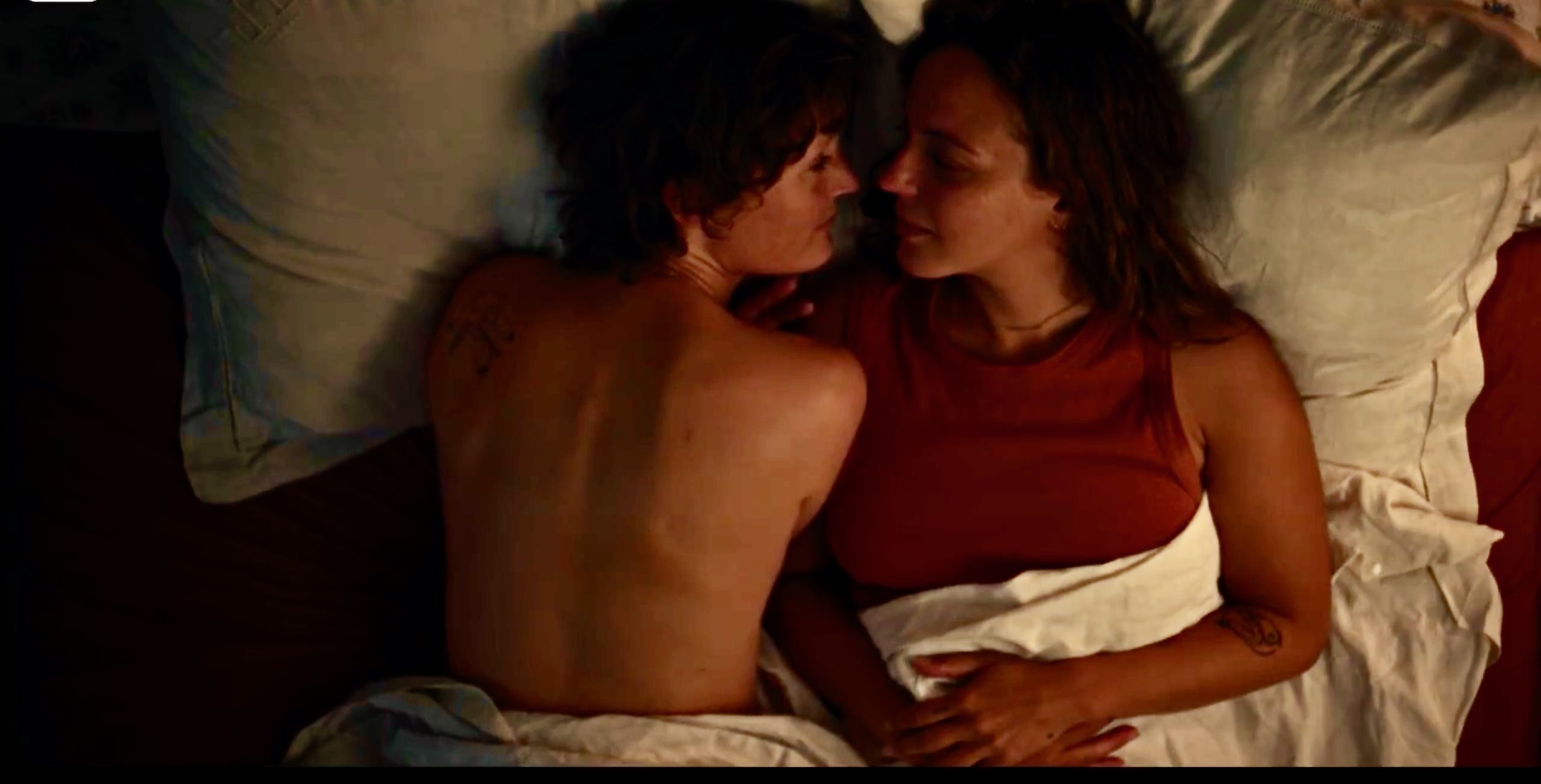
Yes, Clemence left home three years ago, giving up her career as a successful lawyer to transform herself into an impoverished writer who just recently discovered she’s a lesbian.
Her husband, Laurent (Antoine Reinartz), of 20 years, who hasn’t agreed to a divorce, is neither happy about Clemence’s embracing of her creative impulses nor her refusal to yield to his sexual desires. As she notes: “He was the first man I slept with and, for now, the last.”
Seeking revenge after her Saphic confession at a cafe, Laurent refuses to let her see her 8-year-old son, Paul, and falsely accuses her of incest and pedophilia, thus depriving Clemence of unsupervised visits with the lad. “On July 4th at 3:00 PM, he’ll ask for me to be stripped of parental responsibility.” She’ll soon have “the visiting rights of a junkie mother or violent father.”
Clearly, her current lover notes, “Now he knows you are a dyke, he’s pissed.” In fact, Laurent is so pissed that he brainwashes Paul into hating his mother.
As one shrink tells her, “Hate is a necessary part of love. There’s no love without hate. Those who say otherwise are either liars or cowards. It’s a vital part of a child’s love for his parents, especially a son for his mother, to hate her.” Freud argues the opposite, but vive la difference.
Anyway, between couplings, queer clubs, gay pride marches, motorcycling about in jeans and a tank top, plus testy confrontations with her spouse, girlfriends, and dad, Céleste, through both her writing and her fight for her son, overcomes self-doubt and the homophobic, patriarchal desolation strewn in her pathways. As the saying goes: “When life gives you prunes, make prune juice.”
(Rendez-vous with French Cinema was organized by Florence Almozini and Madeline Whittle in collaboration with Unifrance and Film at Lincoln Center.)