
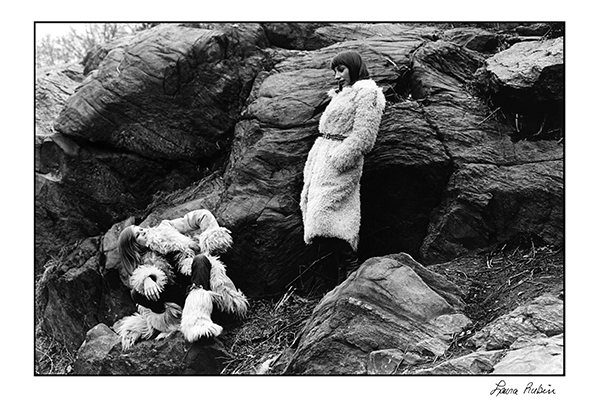
Every artist carries within them an idea of how they'd like to be best remembered, the impact they'd like to leave on a small or wider world. That world has a mind of its own, though, and gifts legacy in an arbitrary fashion, if it gifts any at all. Such has been the trajectory of the New York photographer Laura Rubin; her huge volume of work, from fashion shoots to derelict windows, is like snippets from a dream. Ghostly, elusive and somewhat unsettling, her tremendously atmospheric images haunt and stimulate, be they architectural in subject, street scenes in grainy intimacy, or the capturing a briefly glimpsed face. They have an abundance of beauty and grace, but with an edginess to their charm that makes them seem much older than they actually are. To those in the know, Laura Rubin is the photographer of the Warhol Circle, a title she never sought, never cultivated, nor much cares for, but like a wonky default setting, it is the regular garland that she is bestowed, a glittering momento mori, for all her subjects, cracked actors, drag queens, the dispossessed, are largely dead—her photographs, their afterlife gifted by the click of her probingly sympathetic lens.
New York-born Laura Rubin first became aware of Andy Warhol in 1964 through an article in Show magazine featuring monochromatic photographs of him. A curious and curiouser girl, she was suitably beguiled by his transient apparitional aspects, and his acolytes, little rich girl in a tailspin Edie Sedgwick and the downwardly mobile socialite Baby Jane Holzer. A wish to meet the silver-wigged wonder formulated. Before that, she had been acquainted with personages like the poet Gerard Malanga, whom she met at a folk dancing class in Greenwich Village in 1962, and Ronnie Cutrone, who was an artist in his own right. Both were Warhol's studio assistants. Certain things are likely, and there was an inevitability she encountered the pied piper of Pop Art and his colorful entourage; circles within circles overlap, merge, and eventually open outwards. In the larger small world that passed for artistic alternative, nobody was very far away in sixties Manhattan.
Rubin recalls, "I liked fashion magazines then and wanted to become a stylist for them. While taking an advertising course at the School of Visual Arts, I was required to study photography. I'd bought a copy of Video magazine, and there was a photo of Andy holding a Bolex camera. He was wearing a striped t-shirt, which was the style for some in those days. Soon after, I saw him in the flesh in Figaro's Cafe in the Village. There was a disco on the lower level on Sunday afternoons. After that, Andy began to appear everywhere. He was suddenly in demand. As the saying goes, 'Andy would turn up for the opening of an envelope.' I was hoping to be in one of his movies, but nothing happened." It seems likely that Laura was just a little too together to be included in and absorbed by Warhol's cavalcade.
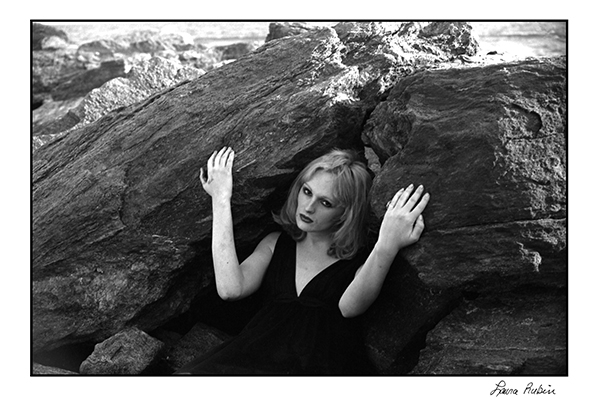
On account of her art and her craft, Laura Rubin has largely been an unwitting architect in her own reluctant byline. At a time when drag queens weren't considered appropriate subjects for inclusion in photographs, she immortalized them by rendering these moments elegant, beautiful, and real. The portraits she made have a legendary pull of old Hollywood publicity shoots, steeped in atmosphere, mystery, and rare beauty. It's no surprise that she admits to having a fascination for the intimate starkness of Victorian portrait photography. She made her down-at-heel in heels iconic, but never freaky. Over time, this aspect of innovation has been shunted to the margins by successive generations. Still, her take on Warhol icon and Lou Reed muse, Candy Darling, is transcendent, whilst her stark portraits of Holly Woodlawn are reminiscent of Joan Crawford in the 1940s, so vampishly stylish that she seems like a creature from another age. They are beyond drag. The term pioneer springs to mind. And as the sixties and seventies become historic eras entombed in amber, Rubin should be celebrated for being a true, if unintentional, mistress of innovation. In truth, she presented her alternative subjects as how they in part saw themselves, people of beauty who sought but generally didn't receive respect, and usually the wrong kind of recognition.
Laura Rubin didn't set out to be lionized as a photographer of Drag Queens. They populated the fringes and shadows of her Manhattan world, and, as a young, attractive woman with a camera, she was drawn to them like moths to a flame in hopes of immortality. It was their style, flashes and dashes of color and personality that drew her lens to them. She ran into Holly Woodlawn at Max's (a.k.a. Haraldo Santiago Franceschi Rodriguez Dankaki, 1946-2015), a crazy Puerto Rican with a penchant for dramatic poses. On seeing her photos, this resident of the back room at Max's Kansas City wished to be a subject. Rubin's rendering of her is both tragic, dynamic, and sublime. Holly had a way with words, or perhaps they had a way with her, as she proclaimed the end results of their session 'superfalous'—her mash-up of superlative and fabulous. At the time of their shooting, Holly was making the film Trash with Paul Morrissey, hence the ethos of vintage Hollywood so perfectly captured by Rubin.
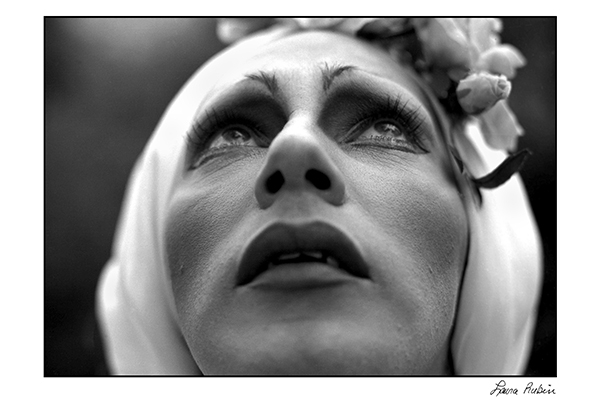
Candy Darling (1944-1974) was also a regular at Max's. Originally from Long Island, she was well on the way to establishing herself as a counterculture icon. Rubin's iconic shots were taken by accident since Candy's friend, Jeremiah Newton, was supposed to be Laura's original subject. Newton had simply asked if he could bring Candy along. He is to be thanked for posterity, as she hardly surprisingly edged into the frames. The photographs furnished Candy, who began life as James Lawrence Slattery, with a Kim Novak-esque tenderness and grace. Candy died in 1974 from cancer, the result of taking illegal hormone shots to assist her in her transformation into womanhood. Rubin's images have helped to galvanize and enhance her legacy as a great beauty, trans or otherwise. She inspired Lou Reed to compose "Candy Says" in his days with the Velvet Underground. He also immortalized her in the ever-popular "Walk On The Wild Side." She appeared in Klute with Jane Fonda and campaigned unsuccessfully for a part in the Mae West vehicle of Gore Vidal's outlandish Myra Beckenbridge. Only twenty-nine when she died, Candy was buried in her favorite dress, and the legendary Gloria Swanson arrived to pay her respects with a gracious wave.
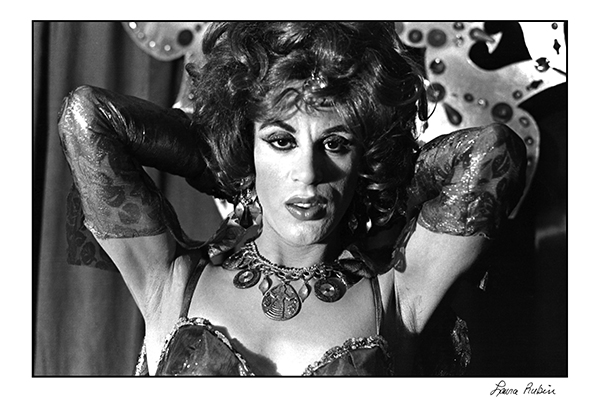
Maria Montez (a.k.a. Rene Rivera, 1935-2016) was a further subject in drag, also Puerto Rican. Montez was a star of underground film, most notably Jack Smith's Flaming Creatures, before evolving to early "Superstar" status in a handful of Warhol movies. It was Rubin's idea to ask him to pose after seeing him perform in a John Vocarro off-off-Broadway play in 1969. Unlike Candy and Holly, Montez never became a regular part of Andy's Factory entourage. There is a real intimacy to Laura's shots of him transforming via the application of lavish make-up and clothes; the exposure within an exposure. Nowadays, Rubin reflects that, "I later did color work of the drag shows, not because I was bothered about drag—there was no agenda in that way—but everything was visual, and they were nice. entertaining people."
That aspect of Rubin's vast catalog of work bears only the briefest fingerprint of her true vision, its scope, and its artfulness. Her monochrome shots of her native New York are a strange harlequin confetti of fleeting shards. Images grasped in the blink of a shutter, the impulse to preserve the fleetingness of a thought. They use the transposition of billboards against a building or skyline in a way that makes the eye question what it first thought it had seen. There are strange amalgams of things caught in doorways and shop windows, and the profound starkness of light, the random grace of a passer-by captured and preserved, the sadness inherent but unknown etched across a stranger's face. Yet, as of yet, there is no proper solo publication of this talented artist's work available, nothing for the uninitiated hungry eye to study and peruse. A tremendous oversight, yet a treasure trove for any diligent photography publisher or gallery. There is a single video montage with an appropriately chosen jazz soundtrack that serves as a perfect online entry point. Still, it affords only cursory attention to a talent that has been both celebrated and obscured by its association with the Warhol mythology.
Rubin remains sanguine about the presumptions and secondhand limelight her Warhol threads bring.
"Although I found Andy okay as a person, I didn't find him that earth-shaking to dissect. My mistake was not to bring my camera when taken to the Union Square Factory, but my attraction was more '60s socialites, their merging with edgy art chic. My connection with Warhol has perplexing and amusing overtones. One editor came over to my apartment and remarked, 'Oh my God! I thought you would have dark velvet drapes and black-painted walls!' The surprise was my oak flooring and rattan furniture. A minimal look, but to get that from a smart New Yorker! Or people think I'm a junkie!"
Now in her seventies, she has not had all that kind of life. She lost many friends to the AIDS crisis, and like many artists before her, has no health insurance or savings. She does, however, have medical bills from a litany of age-related illnesses. Her friend, the performance artist Penny Arcade, has set up a GoFundMe page (see below) to assist her. Prints of her legendary images are available for purchase. It is a worthy act for a worthy and worthwhile woman whose talents, despite many exhibitions, shows, and mentions, have not secured her in the present or the future.
-------------------------------------------------------
PLEASE DONATE TODAY!
Dear friends, 2026 has begun, and I send you all my best wishes. As most of you know for 8 years you have helped me keep a roof over the head of elderly photographer Laura Rubin who lives a very marginal existence without Social Security, Income or savings abandoned by her family suffering from Lupus and other autoimune illnesses That we have been able to keep her fed and with a roof over her head, we a group of strangers, attests to the power of our humanity. Laura lives month to month in fear and anxiety, with much physical pain from bone loss. And without your donations, she would have died from sepsis or been evicted from her apartment. Her immune system is non-functioning due to Lupus. We need to get her January rent paid—she has made an excuse to her landlord, but she is in a critical situation right now. ANY AMOUNT HELPS! There is little reserve in her bank account. She will be needing an IV to kill the current infection; her white blood cells are 3 times higher than normal. For donations of $225 USA, $275 international (includes FEDX), we have photos of ANDY WARHOL SUPERSTARS: Mario Montez, Candy Darling, Holly Woodlawn, Francis Francine, Geraldine Smith, Andrea Feldman, and Penny Arcade.
These are museum-quality, printed on double-weight archival paper. For photo selection, click on Google Drive.
Choose photos here: https://drive.google.com/drive/u/0/folders/10VsRVaWA8Srl_KHjgLq8kriMHQUjyyE1.
Please share with your Facebook friends. Laura is deeply grateful for your support. https://www.gofundme.com/f/help-laura-survive
Thank you. Penny Arcade