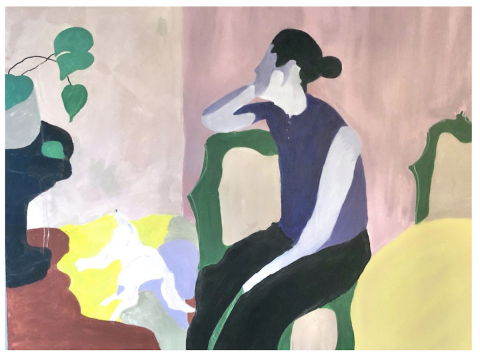
Vicki Sher: Yes/NoVicki Sher has been using a reduced visual vocabulary in her drawings for many years, combining simple line and color drawings with text to create oblique narratives. In her recent exhibition, Yes/No, she elaborates on this strategy, weaving a story, both personal and symbolic, of her Grandmother Pearl's post-stroke search for a descriptive language, based on her diminished capacity for speech. Sher integrates Pearl's story with one of the great modernist tropes in both painting and literature: the ability to describe and illustrate complex thinking through limited means. Read more »
In the heart of Jersey City’s colorful and eclectic Little India neighborhood is a secret that is about to explode the art world. Mana Contemporary is more than a gallery, more than a studio, more than a sensation. It’s a burning impression on the mind, body, and heart -- an interior garden of sorts that stimulates the senses by creating sparks in a quiet, light, white space. Housed in a sprawling, abandoned, brick tobacco factory, the industrial exterior trimmed with concrete loading docks and the crunchy sound of aluminum garage doors rolling up and down serve as a gateway between the quotidian and the imagination.
From the deep warm belly of the earth, the boundless starry sky, or the walloping waves of the sea, Mana’s diverse collections seem to ask, “Where do we come from and when will we meet?” Let’s start on the sixth floor. A ramp with a fenestrated wall on one side and a series of large photographic panels of black sky and rising red sun that radiate heat leads to the Eileen S. Kaminsky Family Foundation (ESKFF) Gallery. An avid art collector of American and international art, Kaminsky traveled the world selecting pieces that touched an emotion in her. Before entering, she shares a few words about what is inside: Read more »
Mira Schor is a painter and writer living in New York City and Provincetown, Massachusetts. She is the author of A Decade of Negative Thinking: Essays on Art, Politics, and Daily Life (Duke University Press) and the blog A Year of Positive Thinking. She is an associate teaching professor in MFA Fine Arts at Parsons The New School for Design. She is represented by CB1 Gallery in Los Angeles and Marvelli Gallery in New York. The exhibition Mira Schor: Voice and Speech opens March 29 at Marvelli Gallery at 526 West 26th Street, 2nd floor, New York, New York, and runs through April 28. Read more »
Georg Baselitz"Art demands fanaticism" -- Adolf Hitler, 1915
Georg Baselitz's (born 1938, Deutschbaselitz, Saxony, Germany) recent work at Gagosian, paintings on a monumental scale, presents the artist as a still-vital explorer, using both his personal history as well as myriad art historical references in a search for a unified, iconic image. Enormous canvases, measuring over twelve feet high, combine elements from his early works, such as "Die grosse Nacht im Eimer" (1962–63) and "A Modern Painter" (1966), remixed in a gambit designed to distance himself still further from the nearly thirty-year span of his signature, inverted, pseudo-Ab Ex work. A sense of nostalgia and reflection is evident here, as well as an undiminished appetite for new forms and styles. Read more »
Terry Winters: Cricket Music, Tessellation Figures, & NotebookAbstraction, particularly in painting, is difficult to write about. You are often stuck with banalities like "that white area should be a little bit more to the left," or "that blue reminds me of this one day when I was surfing Zuma." Andy Warhol, whenever he wanted to avoid a subject of discussion -- such as death -- would fob off the topic by saying, "Gee, that's so...abstract." The bane of writing about art, this abstraction is. Read more »
The Renaissance Portrait from Donatello to BelliniThe Metropolitan Museum of Art in New York, in conjunction with the Bode-Museum, Berlin, has gathered over 150 fifteenth-century portraits: sculptures, drawings, paintings, and bronzes. Unlike most Renaissance portrait exhibitions, this one limits its purview to Italian artists and focuses specifically on the courts of Florence and Venice, as well as the princely courts of Ferrara, Milan, and Naples (the Met has supplemented the exhibition with some examples, from its permanent collection, of Northern European Renaissance works; not to be missed is Rogier van der Weyden's three-quarter portrait of Francesco d'Este (after 1475; below right), here displayed in a vitrine so as to permit a rare viewing of the d'Este coat of arms and dedication van der Weyden painted on the verso). This approach wisely narrows our view of this seminal moment in history, one that literally defined the way that "the portrait" would be viewed for centuries to come. Read more »
Eric Fischl: PortraitsWe are eating lunch at La Mer. Fish tacos, something called Bischon Frise Ceviche, and churros y sea urchins chocolat. There are seven empty bottles of a 1983 Dom Perignon on the table, along with several empty phials of what I thought was cocaine, but wasn't. Spike Lee, David Salle, Winona Ryder, and Trent Reznor are trying to discuss a new Julian Schnabel film, but I can't hear them as Oleander, a model/actress/waitress (my date), keeps interrupting. Alba Clemente (sans Francesco), Gwyneth Paltrow, and Dave Navarro are discussing the new Coldplay CD. Read more »
After ten years in New York, Pia Lindman is experimenting with community building and constructing a sustainable and poison-free house in a small village in Finland. Her practice is moving further toward workshops and collaborations and engages with questions of health and individual as well as collective bodies. Last August, she started as Professor of Site and Situation Specific Art at the Finnish Academy of Fine Art -- an opportunity to develop further her ideas of art as workshops and research. Read more »
Liz Markus: The Look of LoveColor, like scent, is one of the most powerful triggers of memory. The smell of cinnamon or nutmeg brings us back to our childhood kitchens, sweetly reminiscent, like something Mother used to bake. Or a signature perfume reminds us of a first fuck. Liz Markus uses color to tap into our collective memories, evoking the hues of time -- period colors: Seventies Polaroids, Eighties adverts, and the lurid tints of souvenir postcards. In the past her work used color as a weapon -- a blunt, punk-rockers attempt at identity. The paintings in The Look of Love show Markus all grown up, referencing a complex history of Modernism and Color Field painting. Read more »
Rachel Kneebone: Regarding RodinVitruvius, in The Ten Books on Architecture, proposed that the perfected form of the human body could be diagrammed by being placed inside both a circle and a square. Though he himself did not provide illustrations, Leonardo da Vinci made a drawing demonstrating this proposition to illustrate Paciolio's On Divine Proportion (1509). This was more than a geometric exercise, as Vitruvius imbued the square and the circle with divine attributes: the circle represented the cosmos and the square, those things secular. In the Middle Ages, artists painted the crucifixion both as a representation of Christ's divinity as well as his incarnation as an earthly being. Five hundred years later, August Rodin upended many of these concepts regarding the proportion and deportment of the figure in sculpture with his monumental The Gates of Hell and Monument to Balzac. Read more »
Jean Dubuffet: The Last Two YearsJean Dubuffet (1901-1985) was born in Le Havre and moved to Paris, where he was briefly enrolled at the Académie Julian. Leaving the school in 1918, he began to follow his own path in painting and, after a brief sojourn in wine dealing (the family business), spent the rest of his artistic life seeking an authentic art based on the work of prisoners, the insane, the naïve, and other marginal outsiders. The style he developed, and which ultimately became its own school, is now called Art Brut. Read more »
Joyce Pensato: Batman ReturnsIn the 1970s, The Joker, Batman's greatest nemesis, had his own nine-issue comic book series, in which he faced off against a variety of both superheroes and supervillains. Because of the restrictive "comic books code," "good" ultimately had to triumph over "evil" in every storyline. This led to some creative writing strategies -- that is, how to make one of the most morally unhinged villains in superhero lore appear to do something "good" every third issue. Read more »
Paul Pretzer: The Seventh SkillStart with Hieronymus Bosch, lighten with illustrations from an early volume of Hans Christian Andersen’s fairy tales, sprinkle in a touch of Robert Hawkins and season with George Condo for a modern flavor, and, voila! You’ve got Paul Pretzer, a twenty-nine-year-old Estonian painter from Dresden. The combination of anthropomorphic, magically whimsical hobgoblins and oblique narratives has been a winning recipe for generations. Pretzer’s renditions are loosely stylized enough to be painterly; rendered tightly enough on board to be termed illustrative fantasy proto-realism (as opposed to photo-realism), and just creepy enough not to be too cutesy. Most visual story telling of this sort tends to be dark and angst-ridden, but whether or not he intended it, his paintings are too good-natured to be genuinely unsettling, and that may actually contribute to their popular appeal. Read more »
Damien Hirst: The Complete Spot Paintings 1986–2011Choose life. Choose a job. Choose a career. Choose a family. Choose a fucking big television. Choose washing machines, cars, compact disc players, and electrical tin openers. Choose good health, low cholesterol, and dental insurance. Choose fixed-interest mortgage payments. Choose a starter home. Choose your friends. Choose leisure wear and matching luggage. Choose a three-piece suit on hire purchased in a range of fucking fabrics. Choose D.I.Y. and wonder who the fuck you are on a Sunday morning...but why would I want to do a thing like that? Read more »
From my window on the 69th floor of the Temperance Building, I can see the monument to Rosa Luxemburg that Chancellor Nirenberg erected in Zapruder Park after President Manson resigned and The Bund took control of the city. The first thing they did was to tell everyone that we no longer had to worry about The Flu; the virus had mutated and was now known as The Plague. Infection was spread through physical contact, most often rape (Katya and I had a good laugh at that), and the resulting zombies it produced were now wandering the city. Mostly they come at night. Mostly. Posters of women in sunglasses are plastered on walls. They warn what’s left of the panicked population that one side effect of the zombification is dilation of the pupils, until the whole eye turns black. Zombies look for the whites of the eyes. Sunglasses, the posters tell us, are a fashion-must this season. Read more »