
The last twelve months supplied us with numerous transportive moments across screens big and small that were very hard to cold-shoulder.
Take the explosive final half hour of the un-kosher Sirāt. Against the backdrop of an unsparing southern Moroccan desert, a father (Seregi López) searches for his daughter, accompanied by four tattered hippies, his son, and a hypnotic techno soundtrack. Motto: No matter how little life has blessed us with, we can still wind up with less.
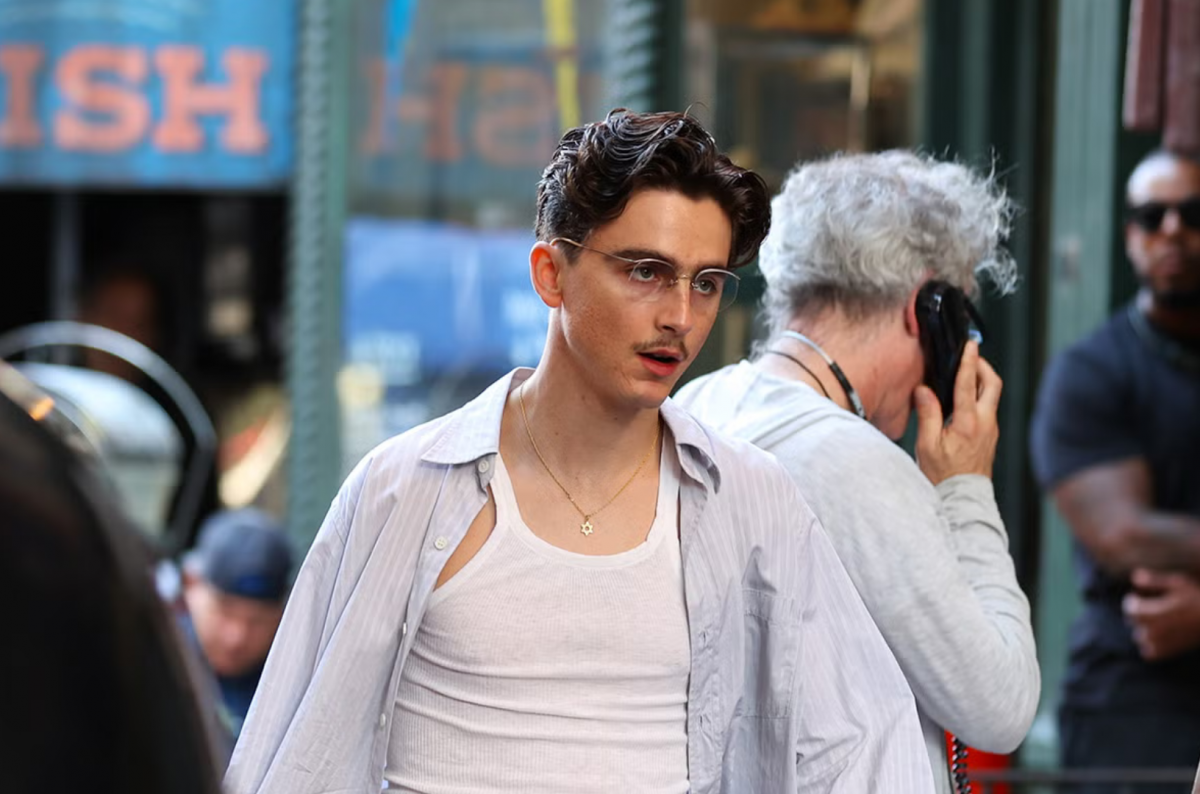
Meanwhile, Marty Supreme chronicles the overzealous ping-ponging exploits of a self-absorbed, Philip-Rothian Jew (Timothee Chalamet) with an unbridled Type A persona. The film’s tail-end leads to Marty discovering his raison d’être off the table tennis table. Tearing up, I recalled one of my favorite Roth observations from American Pastoral:
“The fact remains that getting people right is not what living is all about anyway. It's getting them wrong that is living, getting them wrong and wrong and wrong and then, on careful reconsideration, getting them wrong again. That's how we know we're alive: we're wrong. Maybe the best thing would be to forget being right or wrong about people and just go along for the ride.”
Well, more than a dozen such right-and-wrong moments are scattered among the 30 offerings currently being shared at the 35th Edition of the New York Jewish Festival presented by The Jewish Museum and Film at Lincoln Center.
Emily Lobsenz’s documentary short, “A Bit of Everything and Matzoh Balls Too,”boasts enough for several features. Comprised of Jewish families of varying size in the midst of rolling their matzah balls and simmering their chicken soups, the film showcases how this savory concoction has been passed from one generation to another. Recollections of lost ones, of childhoods, of joys yet to be grasped rise up along with a nod to Moses and his peers as the scent of fowl broth rises up from stove tops. A bonus: There’s also a defining of schmalz (rendered chicken fat).

The highlight of A Bit of Everything, though, is great-grandma Minnie Osher, whose ability to smile today was once part of a future she thought she would never experience. Looking straight at us, she recalls:
“My grandmother had 10 kids. She had 35 grandchildren. Hitler killed them all for no reason. They had shaved off all of our hair. No hair on my head. I looked at my sister. My sister looked at me. We couldn’t recognize each other. And Dr. Mengele . . . he was the killer in Auschwitz. He made the selection: who should live and who should die. So I took a brick while Dr. Mengele was in the back, and I rubbed the brick on my cheeks to make them rosy so I’d look good, and he let me live.”
Lobsenz’s offering is clearly a celebration of both Jewish survival and a reaffirmation of community that includes a Mexican matzoh ball recipe and a young woman who delivers the beloved soup to those who are ill.
All of which reminds me that when Marilyn Monroe was wed to Arthur Miller, she was said to have been served matzoh ball soup three meals in a row. After the third time, the star inquired: “Isn’t there any other part of the matzoh you can eat?”
I wish the answer Ms. Monroe received had also been recorded for posterity. No luck there.
And no matzoh here in Native Australian Jack Feldstein’s films that have nothing to do with “fressing,” but they do supply plenty of food for thought. His 30 or so shorts often explore the institutions and inhabitants of the Big Apple with a huge nod towards Judaism. When delving into his oeuvre, expect no less than a Yiddish song or two, a collapsing Golem, the 91-year-old former head of New York Culture Affairs, plus the book and lyrics for something subtitled “The World’s First Theremin Musical.”
But be forewarned: much of Feldstein’s output might trigger seizures in people with photosensitive epilepsy. “Why?” you ask. Simply because he’s the master of neon animation or neonism, which has been explained by critic David Jaffer as “cartoonish pop-art visualization. Strange, wonderful, and a must-see for fans of the monologue.” Feldstein himself has been said to describe this technique as “a stream of consciousness narrative with a cartoon aesthetic that takes modernist stream-of-consciousness filmmaking into a post-modern and humorous form.” As for his content, it’s been compared to that of Woody Allen and Spalding Grey.

The humor within Feldstein’s works is often evoked by an interplay between the visual elements and the solemnity of the souls he’s interviewing. With “Animated New Yorkers: Joel,” part of an award-winning series, the focus is on the eponymous Joel, who was born into an Ultra-Orthodox Jewish community from which he had decamped four years earlier.
So what do you do when you escape into a modern life that has a totally different set of restrictions and freedoms, most of which you are not yet familiarized with? You join a WhatsApp group with a few other religious Jewish people who are becoming secular.
What ensues is the five-minute story of Joel’s first romantic encounter told in a straightforward manner yet illustrated with ever-changing visuals that borrow from Chagall, Picasso, and maybe even R Crumb.
Joel: “I never felt a woman’s touch and certainly not with women my age, where’s there’s the possibility of this type of intimacy even happening.”
Soon, the pair are watching movies on a laptop in her father’s car and progress to hand-holding.
Joel: “No one had ever told me they liked me before. It exploded my brain. At the same time, I felt this tremendous pressure, like I didn’t know what to do in such a situation. And I immediately begin to worry about whether her level of like is more than my level of like...and do I like...and in what way do I like.”
Maybe if there’s a “Joel: Part 2,” we’ll discover if this chaste romance leads to our young man stepping on a glass and a few years later burping some babes, but sometimes hand-holding is more than enough.

For those seeking a feature-length entertainment that shoehorns in a funeral, a wedding, and a bat mitzvah, you might want to attend the festivities celebrated in Mazel Tov, which, according to Wiki, was the most successful Argentine film of 2025. Directed and starring Adrián Saur, who’s apparently a big deal in his homeland, this mildly comic, sometimes over-the-top, intermittently dramatic exploration of a dysfunctional family delightfully argues that when relationships are deteriorating, Jewish traditions can be the glue that mends.
But if you can’t get to see a screening of Mazel Tov, let me share a bit of it that Rabbi Telushkin shared in his classic Jewish Humor. He labeled this "A Final Jewish Reflection on Antisemitism.”:
“Albert Einstein said: “If my theory of relativity is proven successful, Germany will claim me as a German, and France will declare that I am a citizen of the world. If my theory should prove to be untrue, then France will say I am a German, and Germany will say I am a Jew.”