
We’re Not Safe Here is a hostage video shot by the hostage.
It belongs to that increasingly popular horror subgenre that’s visceral and open to interpretation. I’ve heard it called Elevated Horror. I like to think of it as Deep Dish Horror: dense and multilayered, with a hint of narrative topping. It doesn’t have to make sense if it tastes like something. (Great. Now I’ve made myself hungry.)
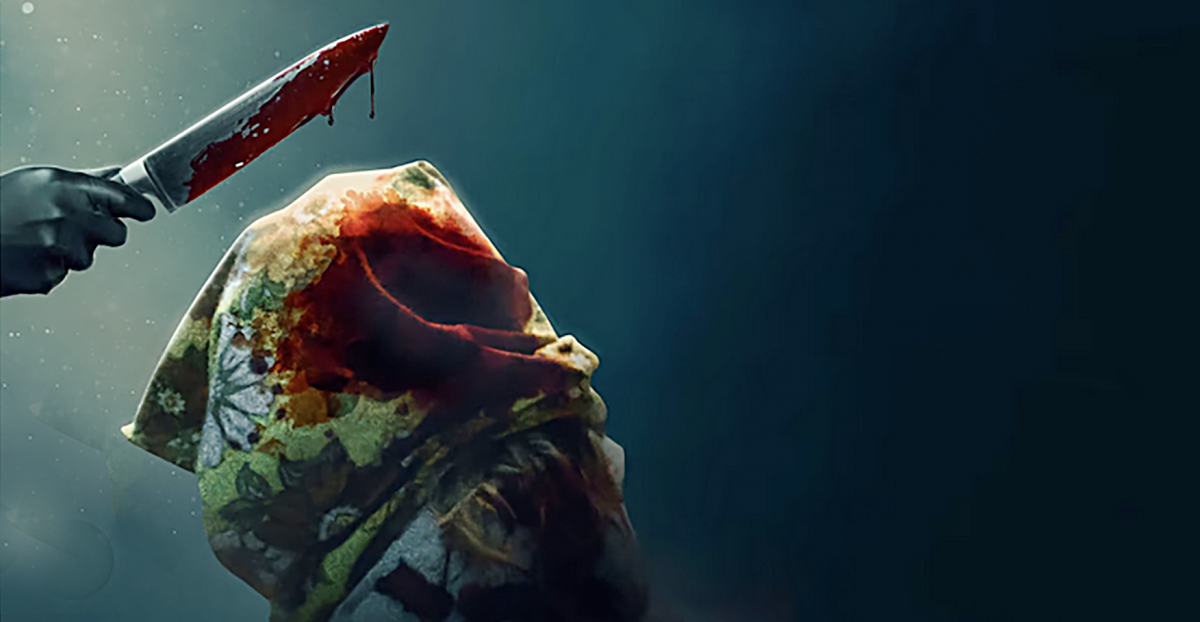
The poster for We’re Not Safe Here shows a person of indeterminate gender tied to a chair, head covered with a blood-stained pillowcase. A big ass knife is pointed above their head, poised to skewer. This image, cartel execution iconography, will appear at intervals throughout the film.
The story goes like this: Neeta is a young painter experiencing Artist’s Block. She lives alone and sits in front of a big canvas that remains blank. Her friend Rachel arrives unexpectedly and shares a tale from her childhood, about how she and a friend explored a big old house. “You know how every neighborhood has that one house, and little kids dare each other to step inside?” Rachel is jittery: she acts haunted, always looking over her shoulder. “Did you hear that?” she asks Neeta. Neeta doesn’t.
Rachel really is haunted by the pillow-headed presence described above. This figure whispers and drones, and for all we know, is imaginary. Pillow Head appears in dreams. Neeta comes to understand that Rachel isn’t there just to relate her trauma but to pass it on, bequeath it to her friend, after which she, Rachel, will be free of it.
Story within story, trauma upon trauma. We’re Not Safe Here works up some genuine creepiness, finding menace in long static shots of shadowy hallways. Mundane gestures, even buttoning a sweater, take on unnerving significance. The actors work hard and are extremely watchable: Sharmita Bhattacharya and Hayley McFarland bring empathy to Neeta and Rachel, respectively. Both give good closeup and are familiar from their TV work. Caisey Cole appears briefly as Sarah, Neeta’s friend and confidant. The sound design by Matthew Devore is a symphony of whispers, gender-switching voices, gasping breaths, and disembodied pleas for mercy. A turntable plays ersatz Hank Williams, mournfully punctuating the proceedings.
We’re Not Safe Here has the quality of a lucid dream. We the audience are simply, like Neeta, along for the ride. The film is an allegory about women’s fear of abduction and captivity, and the waves that emanate from uniquely female anxiety.
Thing is: We’re Not Safe Here is made by a man.
It’s the work of first-time writer/director Solomon Gray, who has stated that his only purpose is to explore the “magic of storytelling.”
But think about the dynamics, and it’s a little queasy-making. Is Pillow Head an emissary or a predator? Is it a metaphor for inspiration? Mostly, Pillow Head functions as a shock hallucination, except when Mr. Gray enters its point of view and we in the audience are put in the position of stalking the women. In one jolting scene, the pillowcase is lifted to reveal impressive scare makeup (at least I hope it’s makeup). Are we meant to assume this will be Neeta’s and Rachel’s fate?
Mr. Gray might well say, “Stop overthinking it! It’s all just scary fun!” But for a man to take it upon himself to tell a singularly female story is a revealing choice. Which begs the question: why aren’t those in danger men? In fact, the only significant male role in We’re Not Safe Here is that of the ghostly voice and vague silhouette of the “demon,” played by Arthur Higbee.
We’re Not Safe Here borrows heavily from It Follows in its theme of subjugation by an irresistible force, fate comin’ for ya. But even It Follows had a male component. Other films have used the grim specter of sexual violation as an allegory (the recent French film Animale comes to mind), but none are completely devoid of male ethos.
Mr. Gray goes so far as to quote the Charles Simic poem “Fear” in the press notes:
Fear passes from man to man
Unknowing
As one leaf passes its shudder
To another.
All at once, the whole tree is trembling,
And there is no sign of the wind.
Yeah, except We’re Not Safe Here is not about fear passing from man to man, but rather from woman to woman, of a fear usually propagated by men.
Pillow Head is built for franchise—imagine a whole series of movies with Pillow Head threatening women— but the idea is half-baked and facile. In Mr. Gray’s film, then, women are chess pieces in a game that’s meant to warn, not to be won.
______________________________________
We’re Not Safe Here. Directed by Solomon Gray. 2025. From Saban Films. Runtime 93 minutes. On VOD and digital platforms.