
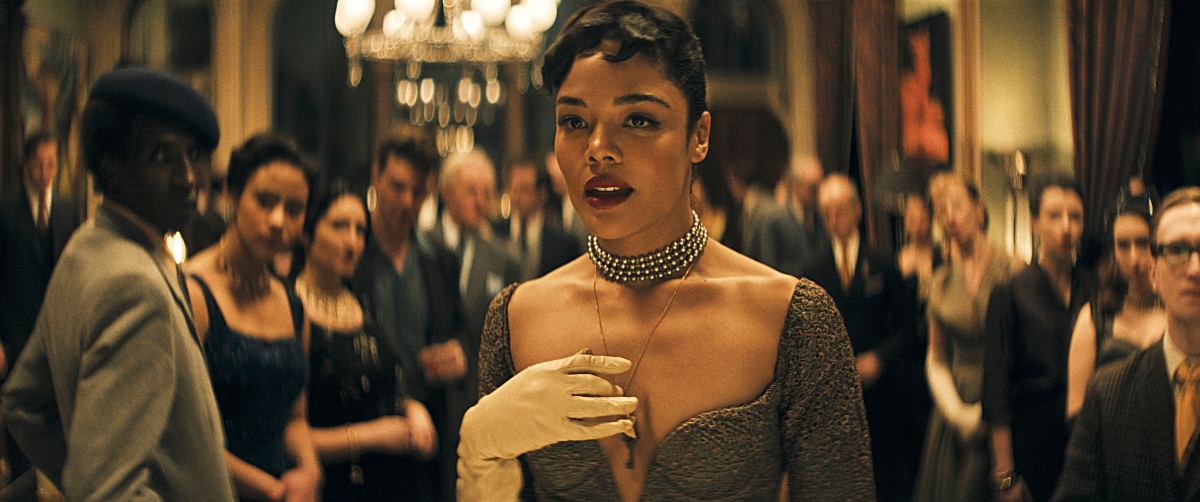
Before we see Hedda’s face, we see her in her surroundings. Under the shadows of night, she emerges from a dark lake, shedding rocks from her pockets. From a distance, we watch her run into a magnificent mansion. Inside, dwarfed by the size of the rooms, she darts up the stairs to her boudoir, dresses for a ball, then stalks through the various rooms. Preparations are underway for a grand party, and she’s making sure everything is right. We see her in a long shot, then through frosted glass. Finally, she settles down, and we see her face in a mirror. And what a face it is.
Hedda is played by Tessa Thompson, an actress best known as Valkyrie in the Thor movies and Avengers: Endgame. And that’s quite a face she has: big eyes, eyebrows like knives, high cheekbones—the beautiful face of sheer malevolence.
Let’s pause here to praise Ms. Thompson for having the cajónes to play Hedda. Hedda is based on Henrik Ibsen’s 1891 play Hedda Gabler. Ibsen is known as the Father of Realism, portraying the cruelties of striving and privilege in the wake of the Industrial Revolution. He wrote complex female figures (see also Nora in A Doll’s House), which presaged a new social order. Hedda Gabler is one of the most coveted roles in theater. The part requires range, and Ms. Thompson has that. She makes Hedda headstrong, conniving, with a finger in every pot.
The plot in a nutshell: Hedda (Tessa Thompson) has married George (Tom Bateman), whom she doesn’t love, for his social status. To maintain that status, George must get a professorship at a prestigious university; otherwise lose everything. Hedda throws a lavish party to lure Professor Greenwood (Finbar Lynch) to hire her husband. George’s chief competition is his former colleague Eilert, who, newly sober, has written a book that will tip the scales. He has a muse and savior in Mousey Thea (Imogen Poots), who is also in attendance. Turns out Eilert, besides being George’s former colleague, is also Hedda’s former lover. And so, busy Hedda contrives to a) relieve Elbert of his sobriety and b) steal the prized manuscript and destroy it.
While we’re talking cajónes, let’s praise Nia Costa, the director, also of the MCU (The Marvels). She approaches this material with ferocity and mixes us a primal stew of psychological conflict.
Ms. Costa dutifully credits Ibsen as the primary writer, herself as the second, and has made some radical revisions to the story. First, Hedda is a woman of color, her exoticism scandalous yet arousing to her guests. She conducts a not-so-secret affair with Judge Brack (Nicolas Pinnock), the only person of African descent in attendance, under her husband’s nose.
The second change: Elert, George’s rival, is now Eileen, a lesbian and former lover of Hedda’s, played expertly by Nina Hoss, memorable as Cate Blanchett’s lesbian lover in the film Tår. Eileen is stately and reserved. She wavers between domesticity and the wild mind under which she wrote the book (the scene in which she crashes an all-boys meeting in the library is amazing). Thea (Imogen Poots), her confidante and keeper, has left her husband for this woman, this artist. She becomes aware of and resolves to foil Hedda’s plan of destruction. Thea calls her out, and Hedda cattily counters: “Do you resent fun, you miserable creature?”
My notes call Hedda a “hip-hop Downton Abbey,” even though no hip-hop is heard (more about the soundtrack in a minute). The film has hip-hop’s energy: the camera swoops and careens amongst the guests at the party. Composer Hildur Guonadóttir punctuates the action and Hedda’s scheming with an insistent drum tattoo. The kinetic choreography of Steadicam and actor blocking really should be seen on the big screen to appreciate. That’s by cinematographer Sean Bobbit and editor Jacob Schulsinger under Ms. Costa’s direction. A dance sequence, with Hedda initiating couplings, comes close to the one in Sinners, a riveting tableau of figures in motion.
Hedda’s psychology goes deep. The theme of identity runs under everything. She proclaims when cornered, “Sometimes I can’t help myself. I just do things.” Who is this Hedda? Who is Eileen, and what do they mean to each other? What happens to Hedda once she seeks to fuck things up? “Before you were domesticated, you were like fire.” Mirrors are everywhere, and much is made of dressing and disrobing, constant costume changes, switching selves (Costume designer Lindsay Pugh keeps things ornate but not ostentatious).
But that face. So much of it is about that face. It’s not a spoiler to tell you we end with a stunning closeup of Hedda’s amazing face. And then... the screen goes black. And up over the closing credits comes the disco beat of Roxy Music’s Love is the Drug. Say what? Ending with such an overused song is easy irony. It’s the one discordant note in a whirlwind of a movie. Why does Ms. Costa give us an intelligent and absorbing film, then wink at us, telling us not to take it seriously?
Hedda. Directed by Nia Costa. 2025. From Amazon MGM Studios. Runtime 107 minutes. In theaters and on Prime Video.