
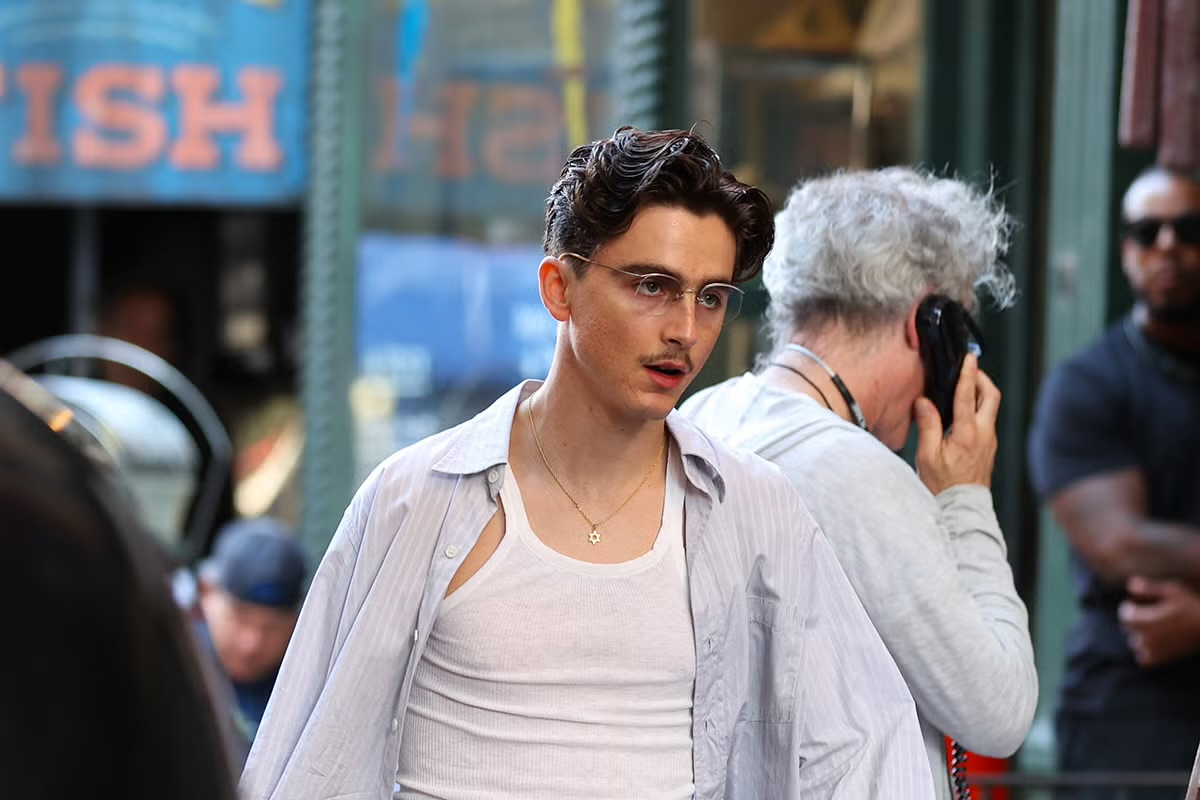
It's kind of humorous, given the Jewish-American hustling theme, if not downright appropriate that A24 are rolling out Marty Supreme on Xmas Day in theaters nationwide, as in this Josh Safdie joint Timothée Chalamet, who I hitherto dismissed as not really up to snuff in his assumption of the Bob Dylan mythos in A Complete Unknown, here ascends to full God-head status as Marty Mauser, Young Jewish Ping-Pong Hustler extraordinaire.
Ostensibly based on the real-life exploits of '50s table tennis hustler Marty Reisman, the half-Jewish-on-his-mother-side's Chalamet astonishes in this shaggy-dog version of Reisman's life and times in a 2-1/2 hour exercise in pure cinematic poetry that easily qualifies as Oscar-bait for Best Film of 2025. It's at the top of my list, in any case. And if there is any justice in the world (there isn't, but hey), Chalamet should win the Best Actor category hands down (and Gwyneth Paltrow as Marty's older woman girlfriend, the slightly faded actress Kay Stone, as well).
An advance screening at the Director's Guild here in Manhattan last week set the breathless tone of the film more or less with an audacious sequence concerning a graphic closeup in situ of one of Marty's sperm cells, after a furious competition with a whole gaggle of spermatozoa, breaking away from the pack to furtively fertilize the egg of his longtime married lover Rachel (played by a winsome Odessa A'Zion), which called to mind a similar transgressive sexual intra-vaginal closeup in French cinema badboy Gaspar Noe's 2010 psychedelic fever-dream Enter the Void.
The film documents the fall and rise of preternaturally gifted self-centered smartypants Marty Mauser, brimming with self-confidence and chutzpah aplenty, with the determination to establish himself as the GOAT ping-pong champion of the known universe by hook or by crook, to rise from the muck of his shabby genteel Jewish Lower East Side milieu, lovingly delineated by production designer Jack Fisk and cinematographer Darius Khondji.
Marty will not take "No" for an answer, and brashly motormouths and/or connives his way over, under, around and through one seemingly insurmountable obstacle after another–lying, cheating, stealing and seducing down the door to advance his career and make his way into the Table Tennis Championship of the World Finals held in London, where he is initially defeated. Obstacles overcome on the way to plotting his comeback include general impoverishment (we see him initially working half-heartedly at a shoe store); filial disapproval (a great comic turn by Dylan sidekick Larry "Ratso" Sloman as Mauser's uncle Murray Norkin and his mother played by Fran Drescher, who refuses to take seriously the notion of table tennis as an actual sport); ritual humiliation by predatory paddle-wielding fat-cat sponsor/enabler Kevin O'Leary (a regular on Shark Tank and a dead ringer for Bill O'Reilly); deus ex machine of an ancient bathtub literally falling through the rotting timbered floor of a grotty slum hotel (an appropriation of a bit in Ronald Neame's The Horse's Mouth) onto the southpaw of super-cult director Abel Ferrara, playing a seedy mobster named Ezra Mishkin (and what's in a name, Myshkin being the central epileptic character of Dostoevsky's The Idiot)—the dognapping and liberation of Mishkin's prize pooch entrusted to the safekeeping of Marty and Rachel; and numerous other picaresque episodes piling up one on top of another at breakneck speed which in the hands of a lesser director would prove both beyond belief and human endurance, but in the ambit of Safdie's assured story-telling mastery totally enthralled the audience at the DGA, who were mainly silent throughout this longish film, but dazzled and astonished by Marty Supreme's sheer humanity, wit and pathos, broke into cheers at film's end.
There are numerous cameos from the likes of Sandra Bernhard, Penn Gillette, David Mamet, Pico Iyer, and other notables who populate the world of Marty Mauser. Again, what's in a name—one thinks of both Art Spiegelman's holocaust-centric graphic novel Maus with its plucky Jews as mice, Paul Terry's uber-mouse superhero Mighty Mouse, whose persona Chalamet embodies, and the Mauser itself, a deadly German bolt-action pistol and rifle designed by Peter Paul Mauser in the late 19th century, a favorite of hunters and soldiers which saw plenty of action in both World Wars. An apposite choice of name for the pugnacious Chalamet, self-styled in newspaper interviews in the film as The Chosen One, who refers to himself as "the ultimate product of Hitler's defeat" and who gets off a jaw-dropping line about his first major ping pong opponent Bela Kletzki, a saintly Auschwitz survivor: "I'm gonna do to him what Auschwitz couldn't!" After gasps from reporters all around, he appends that with: "I can say that, because I'm a Jew." Shameless scoundrel that he is (although—spoiler alert—he gets a shot of redemption at the very end), Mauser basically is a more energetic, younger, brighter sexier version of the Safdie Brothers's protagonist the hapless and embarrassing diamond merchant/schlemiel Howard Ratner played by Adam Sandler in their previous film Uncut Gems (written by both Safdies and their regular collaborator Ronald Bronstein). There are many other references to and echoes of that earlier film within Marty Supreme (besides the titular characters' surnames: Ratner vs. Mauser). I loved Uncut Gems, but here, Josh Safdie, going it alone without his brother and with a much more expansive budget of 70 million bucks, has upped the ante by delivering what may be the last word on sports hustling.
Marty Supreme is possibly the most canny portrayal of the American side of the Jew as Striver (a/k/a The Ordeal of Civility) since, well, since Uncut Gems, and before that, the Coen Brothers' A Serious Man. I can't say enough good things about this film, which rockets from one jaw-dropping reversal of fortune after another like the whiplash back and forth of an epic ping-pong match. In Marty Mauser, Josh Safdie has crafted an enduring and ultimately likable despite himself character somewhat reminiscent of Paul Newman's blue-eyed pool shark "Fast Eddie" Felson in Robert Rossen's 1961 The Hustler (although Fast Eddie was never distinctly identified as being Jewish in that film), and of course, Richard Dreyfuss in Ted Kotcheff and Mordecai Richler's 1974 The Apprenticeship of Duddy Kravitz.
Just unstoppable, like the title character himself.