
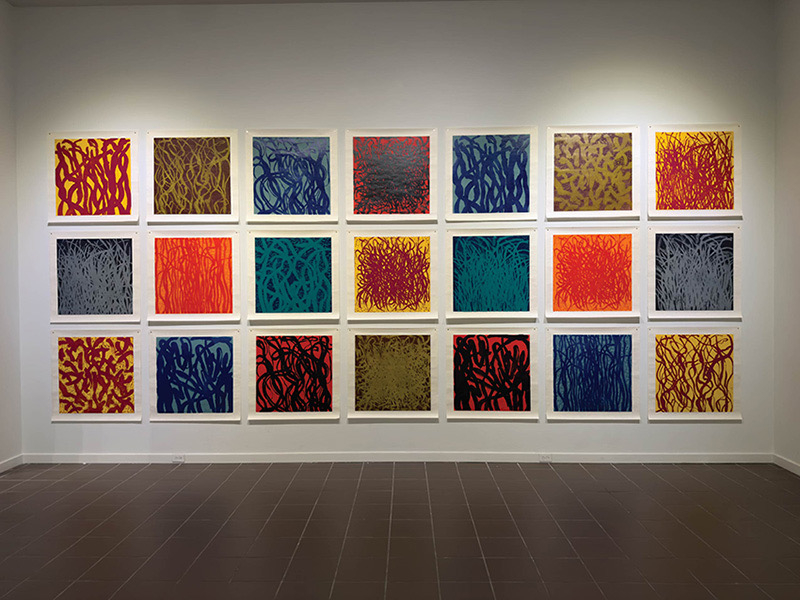
Bill Pangburn’s exhibition, Printed Traces: A Neches River Journal, at the Art Museum of Southeast Texas (AMSET), because of the subject’s personal significance to the artist, should first be discussed in terms of its symbolism. Rivers, since antiquity, have occupied a central position in the philosophical, religious, and metaphysical imagination of humanity, serving as enduring symbols of flux, temporality, memory, purification, and transcendence. In Heraclitus's fragments, the river becomes the ultimate expression of perpetual becoming, encapsulating the idea that existence is defined by constant transformation and instability. Classical philosophy and mythology have further developed this symbolic dimension of the river whose waters represented forgetfulness, oblivion, and the soul’s journey between worlds. Within the Abrahamic traditions, the Jordan River acquired spiritual significance as a site of revelation, purification, and rebirth, especially through baptism.
For Pangburn, the Neches River transcends its immediate geographical and industrial identity within Orange County, in Southeast Texas. Pangburn’s Neches River abstract woodcut prints are animated by shifting textures, layered surfaces, and fluid spatial rhythms, reminding us of various minuscule biomorphic and microscopic organisms. They evoke perpetual movement and light not merely as natural phenomena, but as manifestations of temporality and evanescence. Much like the rivers of ancient philosophical and religious traditions, the Neches River in Pangburn’s work functions as a liminal space suspended between material presence and immaterial transcendence, reactivating the archetypal symbolism of the river within a contemporary artistic vocabulary, transforming the landscape of Southeast Texas into a site of mystical reflection on the passage of time, the fragility of perception, and the continuous movement between the visible and the unseen.
In that sense, Pangburn’s dense black-and-white works of interwoven lines possess a visceral immediacy akin to the visionary writings of António Vieira, particularly insofar as both articulate encounters with the otherworldly through sustained engagement with the motif of the river. In Vieira’s case, his traversal of the Amazon River by canoe in the 17th century becomes not merely a geographical journey but a spiritual passage, wherein the immense and fluid expanse of the river functions as a catalyst for arcane reflection. The Amazon, in Vieira’s writings, is rendered as an unstable yet generative flux in which material reality and the uncreated energy of God converge, producing a mode of thought shaped by immersion, drift, and revelation. Pangburn described in an interview the formative experience of being in a boat at the center of the river, recalling how his attention shifted toward the reflections and shadows cast across the water’s surface. Much like Vieira’s account of drifting through the Amazon as a site of spiritual and perceptual transformation, Pangburn’s woodcuts channel the unstable rhythms of water, reflection, and movement into densely layered compositions that evoke both ecological complexity and visionary experience.
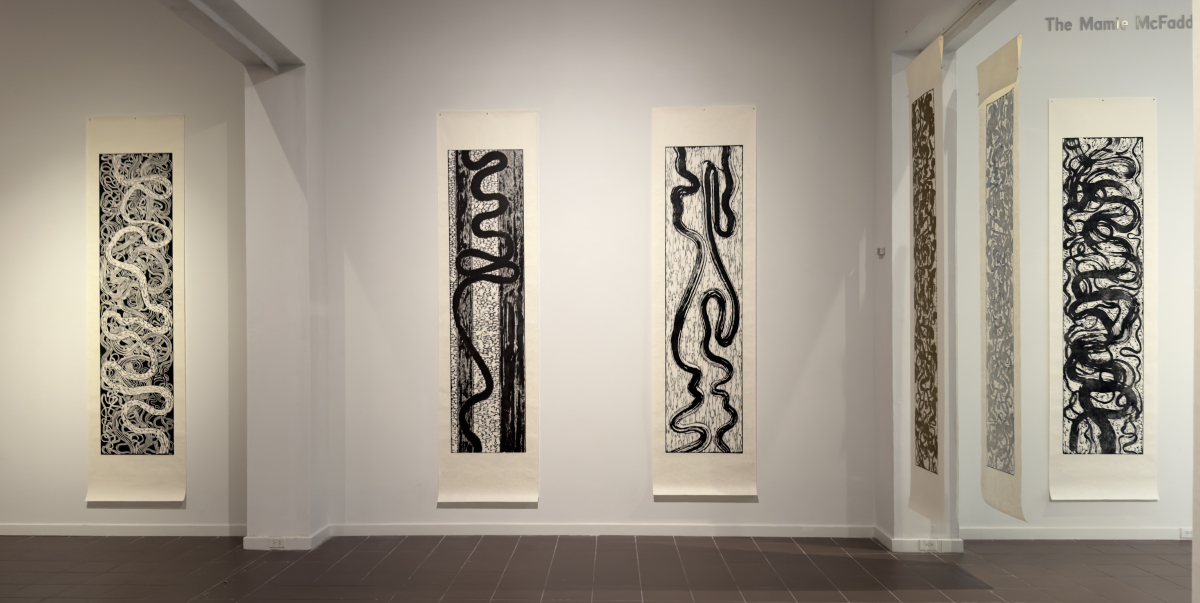
In a parallel but formally distinct manner, Pangburn’s practice translates this experiential logic into a visual and procedural language of drawing and printmaking, while also emerging from a sustained research interest in natural environments, biotopes, and riverine ecologies rooted in his identity as a native Texan. His aerial woodcuts evoke the dense landscapes of the Neches in the process of desiccation, where waterways appear fragmented into winding curves, exposed channels, hills, and eddies, suggesting the visible traces of ecological depletion. This sensibility is deeply connected to Pangburn’s concern with contemporary environmental crises, particularly the destruction of ecosystems and the increasing scarcity of accessible water sources affecting vulnerable and geographically isolated communities around the world.
In contrast, Margaret Scott Dobbins’ concurrent show Environments Imagined, also housed at the Art Museum of Southeast Texas, approaches landscape through an explicitly generative and improvisational mindset, allowing environments to emerge from imagination, associative memory, and the open-ended prompt of "what if," resulting in forms of dreamy aquarelles and vibrant colors that drift toward non-objective topographies. While both Texans, the artists depict the natural environment as a space of becoming rather than of static representation. Pangburn’s work remains more compelling in its refusal to surrender fully to romantic reverie or utopian abstraction. Even as the river operates as a crossing into the transcendent, it is continually anchored to ecological reality and the material consequences of environmental disruption. This tension prevents Pangburn’s imagery from dissolving into purely imaginative landscape-making, instead sustaining a critical awareness of ecological loss and instability that grounds the visual experience in contemporary environmental urgency.
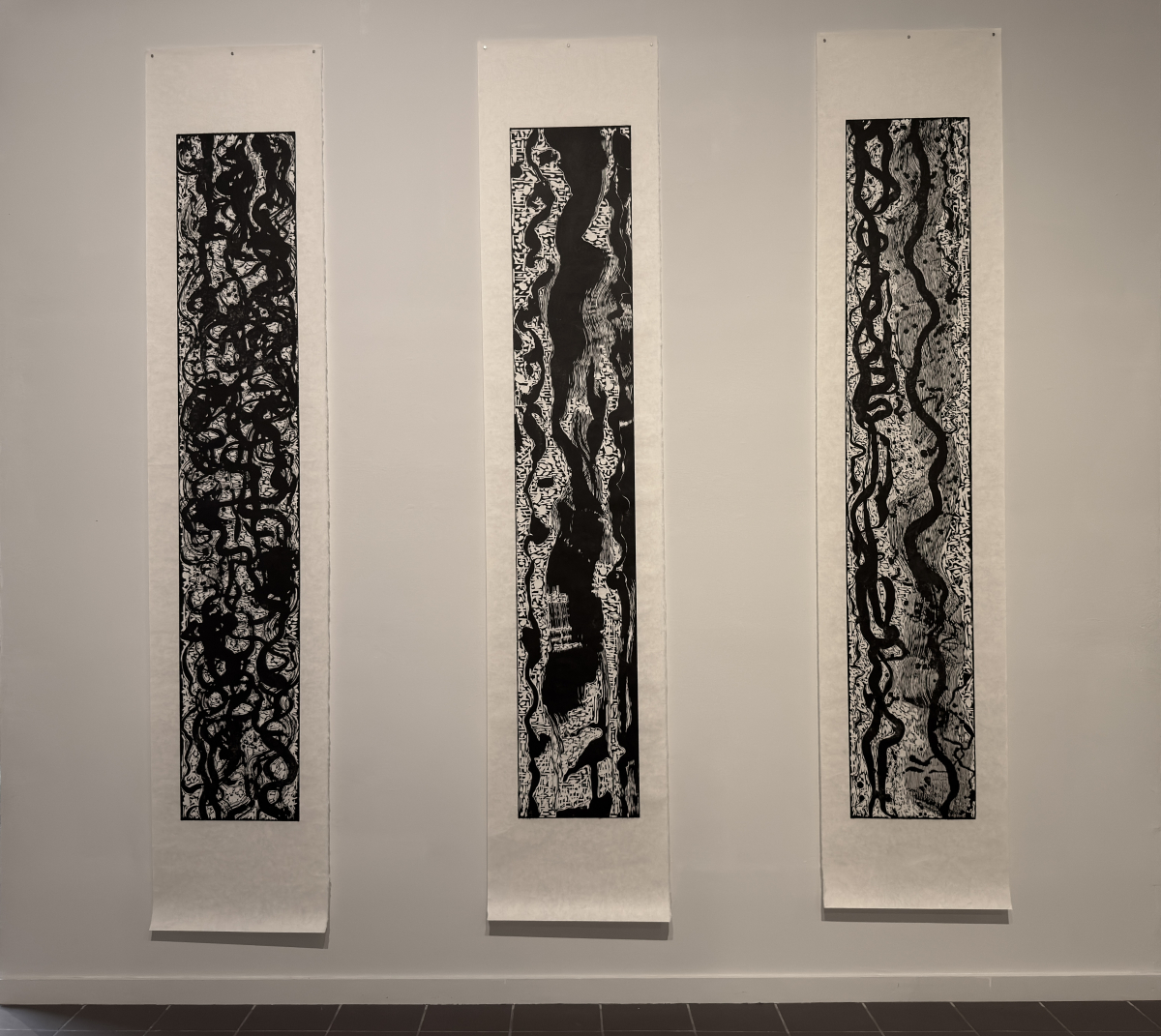
Yet Pangburn’s intricate, Daedalian configurations of infinite monochromatic linework (composed as endless mazes, labyrinthine structures, and recursive curves) operate as meditative constructions through which temporal and perceptual boundaries are suspended. Rather than describing the river through textual narration like Veira or imaginal fancy like Dobbins, Pangburn enacts a comparable condition of flow through the disciplined repetition of line, whereby the act of making becomes an embodied form of contemplation. From a distant vantage point, some of the compositions may evoke an affinity with the gestural intensity of Abstract Expressionism, recalling in particular the all-over fields of mark-making associated with Jackson Pollock. Yet such an initial reading is quickly unsettled upon closer inspection. As the viewer approaches, the surface resolves into an extraordinary system of interlacing forms: sinuous, river-like trajectories of black ink that interweave with finely articulated white interruptions, producing a dense, calligraphic topology of flow and counterflow.
Ultimately, Bill Pangburn’s Printed Traces: A Neches River Journal, presented at the Art Museum of Southeast Texas (AMSET), culminates in a visual language where his monochrome lines do not merely represent riverine systems but generate a perceptual environment in which the viewer is drawn into a continuous oscillation of flow, recursion, and spatial drift. In this sense, Pangburn’s practice subtly displaces the logic of the Situationist aerial cartographies and dérive, which sought to map psycho-geographical movement from an external or elevated perspective. Instead of surveying space from above, his works internalize movement, collapsing distance into an embodied experience of passage. The trajectory of the river is no longer diagrammed as an external network but approaches the contemplative intensity of calligraphic traditions in Islamic art and Zen Buddhist practice, where the gesture of inscription is inseparable from breath, attention, and inner stillness. The line becomes both a printed trace and an experienced event so that the viewer is not positioned outside the work but is gradually absorbed into its rhythmic continuity of ever-changing forms.