
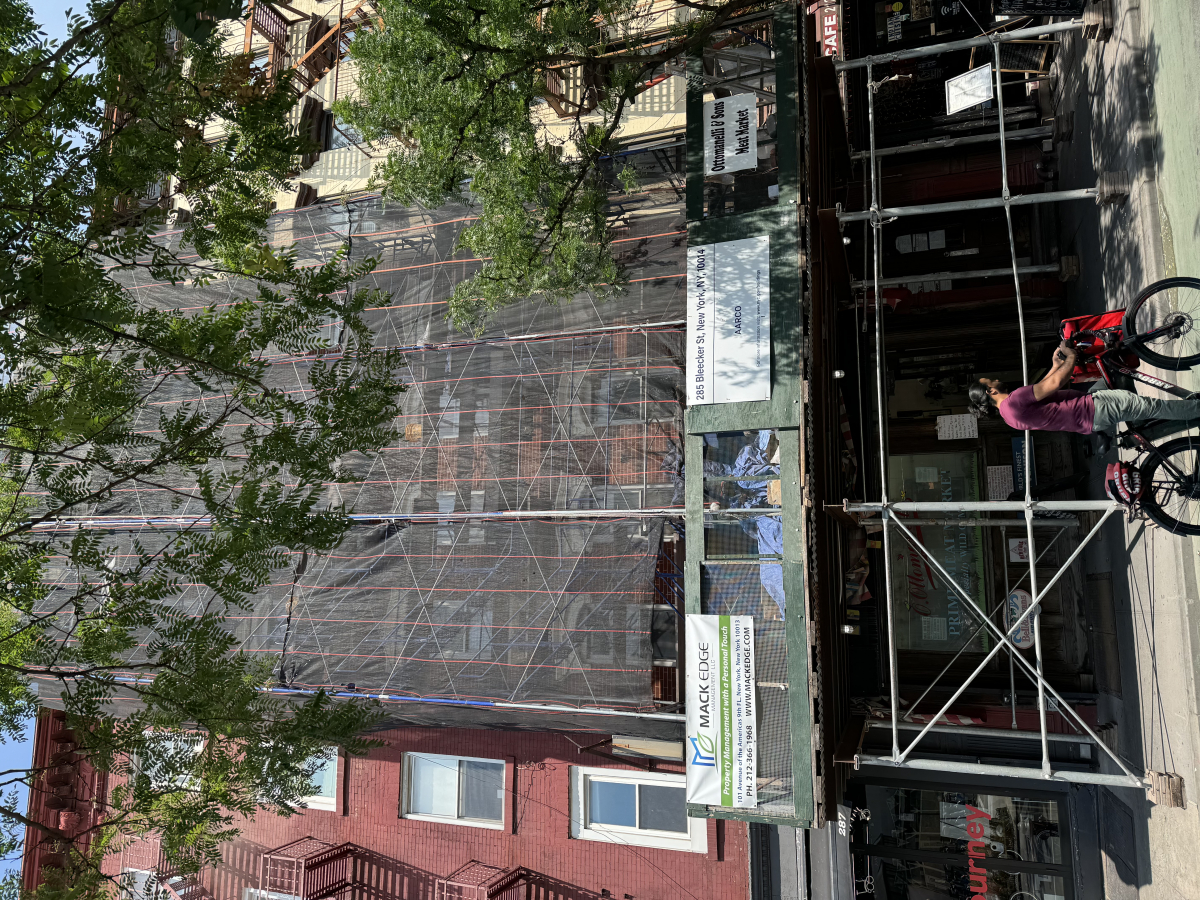
Sometimes all it takes is hearing a random sound out of context… a whiff of a subtle scent wafting your way…or coming upon a strange but naggingly familiar scene or tableau to trigger images buried deep in the past in your subconscious mind, memories you might have resigned as being lost to the ages if you ever recalled them at all. It's the old Proust and his madeleine effect. Here, an involuntary mnemonic device which comes to you out of nowhere and brings you up short and sharpish into the twilight world of phantoms and dreams…before the scene evanesces, and you are plunged back into what James Joyce referred to in Ulysses as the "shattering daylight of no thought."
The other day while walking in the West Village I came upon just such a recondite scene that brought to the surface of my cranial soup an entire chain of lost memories regarding my life in the West Village circa 50 years ago…which led to a vivid memory of a song lost to the ages involving me and my dear friend and collaborator Captain Beefheart (Don Van Vliet).
I had just turned the corner of Bleecker Street and Seventh Avenue on a stroll to Faicco's Italian Specialties, when...
Horrors!! Shrouded in construction netting, 285 Bleecker St., a 19th-century cast-iron tenement near the corner of 7th Avenue now being renovated for the first time in 50 years, to the best of my knowledge. A 19th-century walk-up tenement building and the first place we lived in the West Village circa June '77. On the ground floor: the legendary Village butcher shop Ottomanelli's, with dead rabbits and other wild game hanging on hooks in the window and all sorts of offal on display (yecch). Right across the street, the legendary Matt Umanov Guitars. Down the block, Italian pastry joint Rocco's (best cannolis in NYC). A great location!
During the super-hot, sweaty Summer of Sam, we lived 4 flights up in a railroad flat, a middle-aged dominatrix operating her by-appointment-only trade next door (lots of spanking and barked commands could be heard emanating through her door at random times of the day, on the order of "Bend over, I'm gonna stick my big toe in your ass!"). Then there was the young couple who screamed at the top of their lungs for hours at each other until eventually having loud make-up sex in which the female would bawl her brains out between bouts of balling. At night I would sit in a comfortable chair gazing out the huge window at the Brechtian Street Scene below. Lots of foreign tourists always, the endless passing parade slowly funneling down to the real Human Zoo around McDougal in the central village on Bleecker east of 6th Ave.
At around 9 pm nearly every night until mid-summer, the French mime Philippe Petit, several months away from walking the World Trade Center, rolled up in full whiteface make-up and tattered frock coat on a unicycle directly under my window, quickly gathering a big crowd of rubberneckers as he strung a taut rope hitched from a fire hydrant to a lamppost at a 45-degree angle, and pranced up and down the rope from bottom to the top while juggling bowling pins, somehow managing to stay upright. I had a front row seat every night and a water pipe! Folks showered him with tips, and then he would cycle off to who knows where, coming back there night after night for at least most of mid-June into early July. One night he looked up rapidly, spotted me sitting in my 4th floor window perch (he was aware of everything going on around him), and gave me a quick wave.
And then came the BIG BLACKOUT of July 13-14th. The power went off all over the city around 9:30 pm, but somehow the phones kept working. The New York Times had recently run an article about what they dubbed "The Feral People," the homeless living for years in the sub-basements of Grand Central Station many levels under the tracks, who rarely came up for daylight, and then usually only to forage for food (a very lurid article that made them sound kind of like the race of troglodytes lurking in the London Metro in the 1972 UK horror film Death Line, entitled Raw Meat in the US. When the lights went off, my pal and horror film actor Bill Moseley called me and insisted we get flashlights and somehow make our way to Grand Central, go down into the basements, and explore the catacombs, so to speak. A notion I was unable to sign on to...
Years later, after I'd moved out to more salubrious lodgings in the farther West Village, a one-bedroom with a fantastic view of the Hudson out one window and the Empire State Building out the other, I became passionately involved in Captain Beefheart's music and overall care and feeding. We, the members of his Magic Band, were required to go out and purchase miniature Sony cassette recorders to capture on the fly any of Don's imperious pronouncements or oracular observations, some of which might make it into subsequent lyrics or titles of paintings or poems. Don LOVED the sound of words, and frequently deployed some good ones—"giggy ghee," "expoobident," "frowsy," "insultuous"…
One night in 1981 during a period when I was between wives, Don rang me at 3 am, rousting me from a very deep sleep. He insisted I fetch my tape recorder, as he wanted to run down a new composition over the phone. I sleepily got up to retrieve it, and coming back to the phone, I jammed my mini-recorder into the phone's earpiece to catch the full flavor of his new composition.
"You ready?"
Don started to whistle tunelessly—"pssss shoooooeeeee wheessh sheeee whee woowie whooooo"—producing nary a melody or a rhythm or an actual musical tone, the fundamental necessary skeletal building blocks of music per se that might give one something to hang on to and base a song on. His whistling, which on a good day could charm the birds out of the sky, had here devolved into a mere pushing of random air through pursed lips with no apparent compositional design overarching—Aleatory? Yes. The basis for a new song? Well…
"Didja get that?" he asked breathlessly when he'd finished. Yeah, I got it, Don.
"Gooood! Now learn that on guitar!"
Oh yeah.
He went on: "It's a new song of mine called" (wait for it)—"MELODY ARMS." Good title. Poetic—romantic even. Wish I'd heard anything halfway resembling a melody in there though…but still.
Go on…
Don waxed enthusiastic:
"It's a song about a hotel, or a boardinghouse, called 'THE MELODY ARMS.'"
Wha???
The old rascal had set me up and just pulled the rug out from under me.
"Each room in the building has a different character or characters living inside. Every verse describes a different room and tells a story about the lives of the folks living there." Sounded a bit like Nico's song "Chelsea Girls" (co-written with the Velvet Underground's Lou Reed and Sterling Morrison), in which Nico devotes a verse each to Warhol Factory denizens like Brigid Polk, Pope Ondine, and Ingrid Superstar who were then all living at the Chelsea Hotel. But I doubt Don had heard that, or maybe it was inspired by the cheesy "Tenement Symphony" as sung by Tony Martin in the Marx Brothers' late clinker The Big Store.
But I kept shtum.
Immediately I flashed on an image of 285 Bleecker Street in 1977…and the characters who dwelled within its chipped plastered walls (especially the dominatrix). That crummy little building could have been "THE MELODY ARMS." I started getting into the idea.
THIS SONG COULD WORK!
Next day though, "Melody Arms" had become the One That Got Away; yet another potential masterpiece lost way back in the queue inside the hyperactive compartmentalized psyche of Don Van Vliet, who was off in the ether and otherwise occupied—busy painting, sketching, whistling, singing and humming myriad new songs composed right on the spot—and growling at any Magic Band member that wandered too close into earshot.