
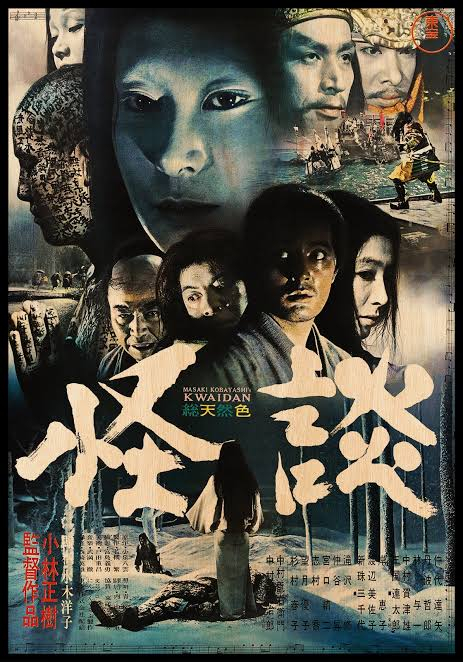
My wife Caroline and our friends, screenwriter David Hellman and his lady, artist-weaver extraordinaire Hiroko Takeda, went together Friday night to Film Forum NYC to view this incredible 1965 Japanese masterpiece Kwaidan, a rare compendium of Japanese ghost stories and folktales originally all written down in English at the century’s beginning by Greek/Irish expat and Japanophile Lafcadio Hearn…years later painstakingly realized by master director Misaki Kobayashi…and now in a breathtakingly beautiful new restoration.
I'd seen the film in the summer of '68 at Andover Summer School, and way back then thought it the most stunning cinematic objet d'art I'd ever seen. I actually bought one of the earliest DVD releases of the film at the dawn of the digital era. Kwaidan (Ghost Stories) has only improved over time, and I would rank it among my Top 10 Favorite Films.
Each painterly frame, each immaculately composed sequence, has the quality of a profound fever-dream of feudal Japan. It's right up there with Kaneto Shindo's nightmarish Onibaba, whose release in theaters in Japan predates it by a year on the Asian horror/fantasy continuum.
But Onibaba is filmed in the starkest, eeriest high-contrast black and white, with a thunderous percussive score by Hikaru Hiyashi — and Kwaidan (actually pronounced Kaidan in Japanese, go figure) is limned in the lushest, most florid oil colors you’ve ever seen (it’s also shot in Tohoscope, the Japanese version of Cinemascope), with a quasi-electronic score by the great Toru Takemitsu, whose music I adored as a boy, especially Vocalism AI (Love):
In Kwaidan, Takemitsu’s score is heavy on traditional Japanese instruments, especially the twangy stutter of the biwa (the 4-stringed Japanese lute), which figures prominently in what, for me, is the best of this quartet of ghost stories, the third and lengthiest one, known as Hoichi the Earless.
Here the action moves to the turbulent ocean as we witness the epic retelling in speech and song by the blind servant Hoichi of an epic sea battle between feuding warrior clans, lingering on the restless ghosts of the losing side (many of whom drowned themselves rather than be taken prisoner), who centuries later still stalk the shore. Listen to an excerpt here:
This marvelous film totally hypnotized the packed Film Forum crowd of cineastes and tourists Friday night, and is running for another week or so. Please do yourself a favor and try to catch it. It unspools at a languid 3-hour running time, broken up by heart-stopping passages of horror and suspense — and, thankfully, has a 10-minute intermission where you can catch your breath.
Most of Kwaidan is studio-bound with invisible practical effects ("that's the way uh huh uh huh I like it," fuck CGI) — even in scenes of wintry desolation in a dark forest besieged by a blizzard, as featured in the second folktale on display, The Woman In the Snow.
This episode begins with an old huntsman and his handsome young protege trying to make their way through howling winds, shaking, shivering trees, in-your-face swirls and blasts of thick, powdery snow, and various celestial bodies, including the moon looming over the tableaux, painted flats of sepulchral red skies boasting shapes as haints, which seem to wink and gaze down cruelly like some kind of malevolent gods at the struggling mortals trudging through the wilderness below — it's enough to give you frostbite.