
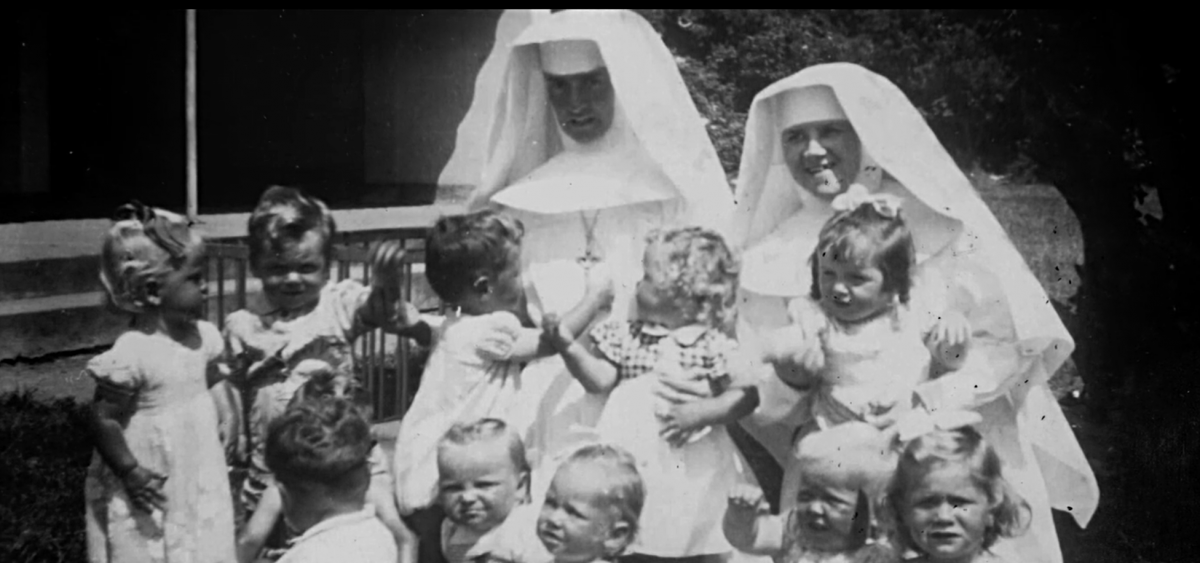
Time is running out for the girls — now women — of the Magdelene Laundries scandal. Over 10,000 women and girls were confined in the Irish institutions between 1922 and 1996. There they were pressed into slavish work, incarcerated and tortured by the Roman Catholic nuns who ran the places. Since these homes were exposed as a cottage industry of trafficking, the survivors have grown old and infirm. Many have died. If they are to attain justice, it has to be soon.
There’s a desperation to the story of the Magdalene Laundries, which are now in danger of vanishing into history. The remaining survivors of this abuse are ageing, elderly, and vulnerable women who see this as a last chance for redress. Identities have been obliterated, searches have been undertaken, and the statistics are astounding: one count contends that 57,000 children were separated from their mothers and trafficked to adoption.
The film Testimony uses as its starting point a small cemetery that stands in the way of the sale of High Park, one of the ”Mother and Baby homes” recently sold by the order. Exhumation revealed more bodies than documented, many unknown remains of women and children, marking the site as a clandestine mass burial ground. The incident opened new investigations, primarily by an intrepid group of academics, archivists, and activists. “Time was the one commodity these women did not have,” says Jim Smith of Boston University, who wrote a book about the “architecture of containment,” and never imagined it would launch a cause.
Testimony is more than just a document. It is a call to action, part of a campaign to recruit more women and bring justice to all. Many survivors tell their heartbreaking stories here on the premise that stories = testimony = evidence to counter the unwavering stubbornness of the Irish government to accept accountability.
Testimony follows an intrepid band of lawyers, academics, and volunteers known as Justice for Magdalenes. Mr. Smith is joined in these efforts by archivist Catriona Crowe, legal advocate Maeve O’Rourke, and activists Philomena Lee (about whom the 2013 film Philomena was made) and Mari Steed, one of the survivors, to name a few. Midway through the film, a busload of survivors is cheered by protestors, stigmas shaken off, in an exhilarating display that implies something has been won. But it’s only being acknowledged. Long overdue. Proverbial other shoes fall at a rapid rate from there, accompanied by new revelations and shocking statistics, one of which contends that 57,000 children were separated from their mothers and trafficked to adoption during the reign.
Testimony is directed by Aoife Kelleher, who deftly weaves interviews, news footage, and home movies into a damning indictment and vividly displays the frustration that the Magdalene matter has yet to be resolved. Ms. Kelleher has Irish TV series and movies to her credit, and feature films like One Million Dubliners (2014). Testimony is co-written by Ms. Kelleher and Rachel Lysaght.
_______________________________
Testimony. Directed by Aoife Kelleher. 2025. Runtime 105 minutes.
you should also check out several stirring fictional films on this topic, such as Small Things Like These and Philomena.