
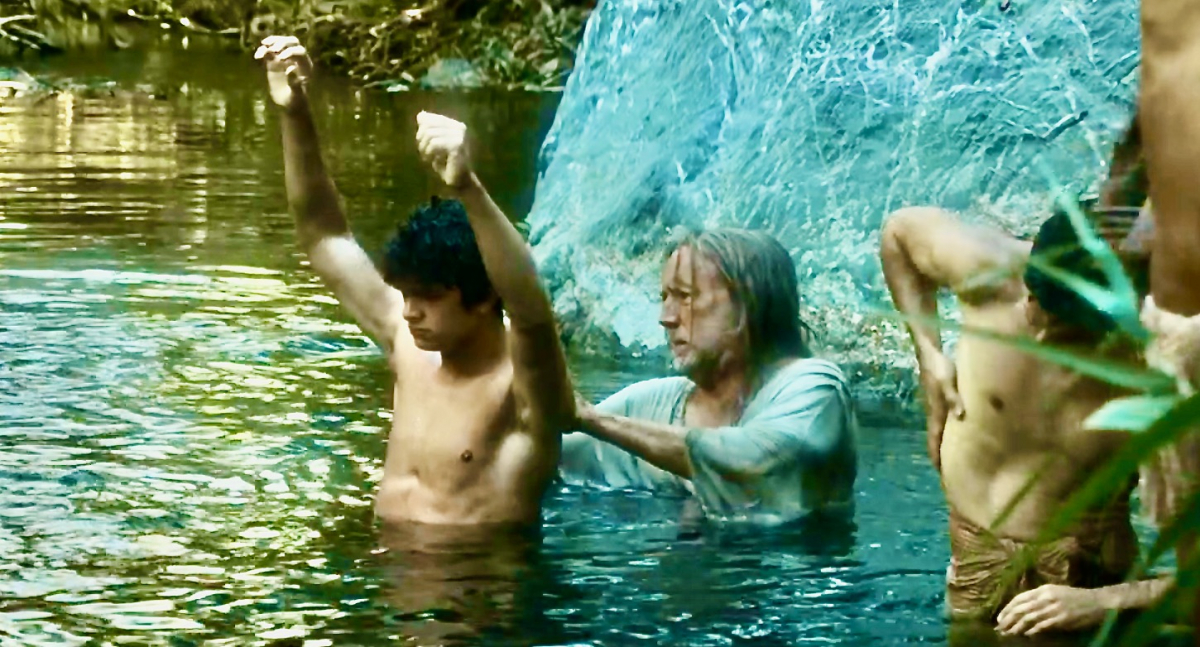
Making a film is seldom easy. Ask any director. You have to work with or against studio heads, screenwriters, agents, vegan actors, unsympathetic caterers, and those Porta Potty folks. Then, if you're hitched up, at the end of the day, you're obligated to go home and make believe you're interested in what your spouse and kids and their Lububus did all day.
Director/writer Lotfy Nathan, best known for his 2013 documentary on West Baltimore's illegal dirt bikers, had most of that to contend with, plus the Lord, in The Carpenter's Son. Shooting in Greece because Egypt was not welcoming to the subject matter, he and his crew had to reckon with more plagues than a Passover dinner. Thankfully, firstborn sons were spared, but according to press notes:
"Swarms of relentless flies took over the set, followed by an infestation of lice and fleas. To avoid the insects, the film began night shoots, plunging the set into darkness. Fierce storms disrupted filming, closing roads, flooding locations, and killing local wildlife. Frogs arrived en masse and suddenly died . . . . [Then] the day of a major shoot in the leper colony, thousands of wasps descended on the site. Nicolas Cage was surrounded, and multiple crew members were stung. The set had to be evacuated and ultimately abandoned." Almost makes Terry Gilliam's Don Quixote shooting sound like a picnic.
So what got the Lord into such a tizzy?
Well, the film, inspired by the Infancy Gospel of Thomas, opens with rather disconcerting groans. Apparently, Christ's virgin birth was a painful one. Shortly thereafter, his foster dad, Joseph (Nicolas Cage), and his genuine mom, Mary (FKA Twigs), atop a donkey with baby Jesus hidden, escape from the vicinity of Bethlehem. Why? Because King Herod had ordered the slaughter of all boys aged two and under. Known as the "Massacre of the Innocents," Giovanni Boccaccio, centuries later, took a break from writing The Decameron to swear that 140,000 tykes were slaughtered. Wikipedia notes that "most scholars reject the historicity" of the extermination. Ah, there those historians go again. Needless to say, Mr. Nathan showcases one bundled tot torn from his mother's arms and thrown onto a flaming pyre.
[An aside: While researching this review, I came across a discussion concerning whether Jesus burped as a baby and could have suffered from colic. Intrigued, I phoned the noted literary scholar Felicia Bonaparte, author of Will and Destiny: Morality and Tragedy in George Eliot's Novels. The good professor replied, the answer was definitely "Yes!!!" Christ was both completely man and completely God and thus exhibited normal tot behavior.]
With crickets a-chirping and goats a-bleating, years pass by. Wary of their son's identity being discovered, the nomadic family is constantly on the move until Joseph lands a job carving idols.
Well, Jesus (Noah Jupe), now a hormonally charged, strapping adolescent, one day in his new home, ganders through a window hole to witness his neighbor, a mute, lovely lass named Lilith, cleansing herself in the open completely nude. Guiltily awestruck, yet clearly enjoying what he views, he gazes on and on. But at that point, Jesus doesn't know who he is or how he came to be. That will be remedied shortly.
After the above-mentioned ogle, the teen begins teaching Torah classes with a menacing rabbi; brings a crushed bug back to life; is pushed onto a sleeping leper whom he cures to his own surprise; and is almost seduced into evil by a young Satanic temptress (Isla Johnston) who likes to hang from tree branches. Evenings aren't more peaceful. The teen dreams nightly of his own future crucifixion and learns that his real father is not the one he's been sending Father's Day cards to.
If that isn't enough for one Biblical epic, there are peaches poisoned by live scorpions; hills stirring with Satanic whisperings; the breaking of an idol; horror scenes that will freak out viewers suffering from ophidiophobia; and a sightseeing trek to view those already being crucified. Most enjoyable, though, is the feverish confrontation between Joseph and Mary, where she is asked whether Jesus was fathered by a Roman.
Truly, the reason most of us skedaddle nowadays to a Nicolas Cage film is that we're hoping to view another episode worthy of being added to his already top-heavy collection of absurd thespian moments. Or as Ben Walsh titled his Independent review of Season of the Witch (2011), "Nicolas Cage: From the sublime to the ridiculous."
May I here cite the too-oft-requoted Cage evaluation of his own career that opens Walsh's article: "I am not a demon. I am a lizard, a shark, a heat-seeking panther. I want to be Bob Denver on acid playing the accordion."? Mae West might have responded: “That's the right attitude, boy! Mmmmmm. Be like me. When I'm good, I'm very good, but when I'm bad, I'm better." With scraggly tresses, an untrimmed beard, mournful eyes, and a mouth besieged by woe, Cage's Joseph, attired in a ratty toga, does let loose several times. "WHAT HAVE YOU DONE?" he screams on learning Jesus has committed a miracle in public. "Without my protection, you would be dead." The screenplay even has Joseph explaining to the questioning Jesus why he's pouring some dirt in front of his hut: "If an evil spirit were to enter the house at night . . . the footprint of a rooster will appear in the sand." And one does.
Now, how you react to all of this depends possibly on how many films you've seen over the past 12 months. For example, the Metro's Tori Brazier shouts: "Nicolas Cage's Jesus horror movie is the most profound film I've seen in 2025." She's probably seen too few. If you are a devout Christian, you might scream, “blasphemous!" or be totally intrigued by this at-times bloody fantasy of Jesus' formative years. If you are a bit cynical, you might just chuckle a bit or look at the carryings-on with disdain. Is The Carpenter's Son too campy or too sincere? It's probably both.