
Han Ho ETERNAL LIGHT
Mana Contemporary, Jersey City, N.J.
Nov 21st - Dec. 10th, 2025
I recently encountered a consummate and mature articulation of the aesthetic imagination in Han Ho’s solo exhibition, Eternal Light, at Mana Contemporary in Jersey City. While differing from such artists’ work as Yuan Goang-Ming’s in his meditations on domestic fragility and geopolitical tension, it achieves an equal, if not markedly greater, degree of intensity. Internationally renowned for his monumental light sculptures, spatial installations, and large-scale works imbued with biblical and metaphysical symbolism, Han Ho constructs environments in which illumination itself becomes both the medium and the message, using Marshall McLuhan’s phrase.
Entering the exhibition resembled stepping into a prismatic, otherworldly field of perception rather than a conventional gallery setting. Vast luminous structures, radiant surfaces, and kinetic constellations of LED punctures upon traditional Korean Hanji paper generated a transcendental atmosphere of refracted light that seemed to suspend gravity. In a way, such an experience inevitably recalled the medieval cosmology of Robert Grosseteste, for whom lux was not simply illumination but the metaphysical origin of matter; the first corporeal form from which spatial extension and physical reality unfolded. In Han Ho’s installations, a comparable intuition is materialised sensorially. Light operates simultaneously as both the material and the ontological agent, shaping space while also suggesting its own pre-existence to it.
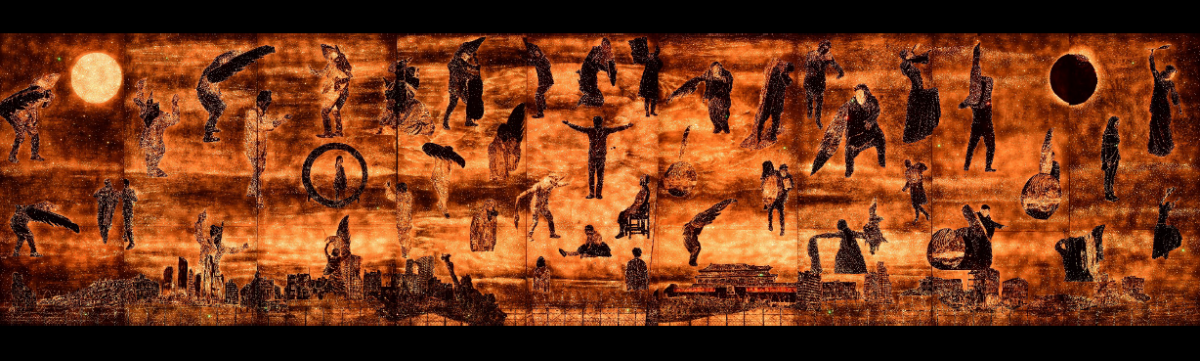
This metaphysical primacy of illumination finds a particularly forceful expression in the monumental work 21C The Last Judgement. A vast mixed-media composition of charcoal, oil with traditional black ink, Korean paper, and embedded LED constellations, in which light operates not merely as an accent but as the principal medium from which the entire visual field emanates. At once painting, relief, and glowing installation, the work evokes the grand iconographic lineage of Western art history, especially Michelangelo’s Last Judgment. Simultaneously, the piece displaces it into a contemporary register marked by nuclear anxiety, territorial divisions, and the fragile dialectics between war and peace reminiscent, in thematic gravity, of Yuan Goang-Ming’s reflections on state fragility and mediated disaster. Yet where Yuan often situates the viewer within the hyperreal circuitry of simulation, Han Ho propels the spectator toward a more cosmic horizon.
Structured in a tripartite vertical narrative of celestial aspiration above, the anguished threshold of lived reality at the center, and the infernal debris of human destruction below, the composition stages an allegorical drama in which clouds oscillate ambiguously between heavenly vapor and nuclear mushroom, embodying the Janus-like conceit of humanity’s technological triumph and existential peril. The punctured Korean paper, illuminated from within by LED light, produces an ethereal radiance that renders figures and gestures almost immaterial, as though suspended in an aethereal continuum where matter itself seems provisional; this internal luminosity simultaneously evokes the silent diffusion of radioactive glow and the spectral afterimage of irradiated atmospheres of nuclear fallout. Subtly interwoven into this vertical apocalypse is the unresolved memory of Korea’s partition, whose geostrategic fracture reverberates less as a cartographic fact than as a psychic and metaphysical condition.
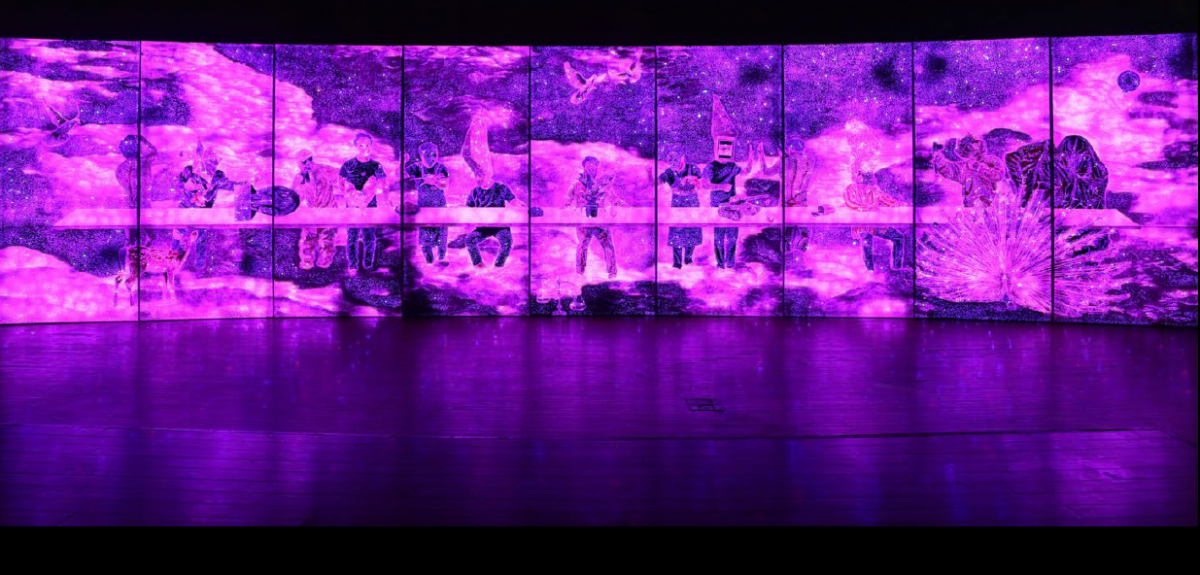
This particular concern likewise inflects the almost stereographic The Last Supper, in which Han Ho extends his theology of light into a historical and political allegory, reconfiguring Leonardo’s canonical tableau as the Last Supper of the Twenty-First Century and inscribing it with the unresolved tensions of the Korean peninsula. Christ occupies the center not as a doctrinal sovereign but as a luminous nucleus of life, of inexhaustible radiant vitality amidst collective precarity. Around him, the disciples are reimagined as fractured embodiments of contemporary subjectivity. A uniformed NBC-clad sentinel registers nuclear anxiety, and the aluminum mirror embedded in a Chinese costume reflects not only the spectator but also the weight of hostile forces bearing upon the peninsula. The nude figures facing toward a primordial Korea, silently split across the pictorial axis into North and South. Upon the table, symbolic objects such as tanks and barbed wire cruelly transmute into aestheticized toys, Peter’s denied chicken, kimchi as a sign of cultural homogeneity, and the sushi bomb as purposeless destruction, coalesce into a post-modern still life of poised devastation.
However, it is again light that confers metaphysical coherence upon this dense iconography. These images resist total instrumentalization even within a technologically mediated platform, understanding the form as a vital force rather than an inert representation. In a way, light here becomes a spectral intermediary, binding fractured histories, divided territories, and dispersed identities into a single, trembling field of presence; an eschatological supper staged at the end of time and history.
My encounter with Han Ho’s Eternal Light at Mana Contemporary became an occasion to contemplate through association the unsettling proximity of large-scale annihilation, sensing that the spectre of a global war no longer belongs solely to speculative discourse but hovers as a tangible possibility within the collective imagination. Yet the exhibition does not succumb to despair; rather, it staged the primordial element of light as a fragile but persistent counterforce, offering these aesthetic environs in which existential fear and the enduring human impulse face toward transcendence.
Han Ho’s sublime works, radiating an otherworldly glow, function as a spectacular luminescent architecture of consciousness, dissolving the boundary between sensuous experience and philosophical inquiry. In a way, Han Ho strongly affirms that even when art confronts the imagery of conflict and violence, it retains the singular capacity to momentarily liberate the observer from the contingencies of personal will and social turmoil, reconstituting the viewer as a disinterested and lucid subject of pure contemplation.