
It was Christmas, possibly in 1977, when my working-class brother-in-law, John, after drinking a previously unopened bottle of Kahlua, which I had unwisely gifted him, turned over the dinner table heaped with holiday goodies in front of his five children. He then took a rifle and chased my sister down a steep road with a rifle in hand. I called the police, and the family was broken up forever.
John was a “nice man”: selfish, funny, often sober, a major fuck-up now and then, and slightly charismatic in that stereotypical Italian Moonstruck way.
Once, years earlier, while my sister was in the hospital giving birth, I had been staying at their house to babysit. John, after being out all night, shuffled on in, but not from the maternity ward. Before the door had shut, he started bragging that he had just spent the night with two prostitutes. I was perhaps 12 or so.
I never told my sister. How do you tell a sister post-labor or otherwise that?
Decades later, after she discovered some of his infidelities, she phoned. “Did you know?” she asked. I could only answer with silence.
Poor Sister! She only married to escape a violent father who, on a hazy Bronx night, left a belt mark under her left eye. Reason: a bottle of shoe polish had spilled in his den. (Actually, my fault.)
Yes, men can at times be flawed, rather hostile creatures as Richard Gadd depicts so well in HBO’s Half Man. But isn’t it worse when they are someone you are supposed to be able to love in real life? Half Man I could put on pause? Diane had no remote control for her life. Cancer instead pressed her "off" button.
If you can relate, you might find yourself nodding when in director/co-writer Francesco Constabile’s prize-winning Familia, Fulvio (Enrico Borrello), a local fascist leader, in his one humane moment, notes: “These fucking dads, they can’t help but ruin your lives.”
Fulvio’s addressing a young man, Luigi Celeste (Francesco Gheghi), a character based on the real Luigi’s memoir, It Won’t Be Like This Forever (Non sarà sempre così) https://www.amazon.com/dp/B0DB4DDZCG?lv=shuf&channelId=500&plpRedirect=mhFallback. The Amazon synopsis of the book begins: “There are many roads to hell, but very few leading out of it.”
Well, who knows at the time that life is undermining you that this trauma you’re not coping well with is not forever? Who could have ever guessed Luigi’s serial anguish would one day find its way between hardcovers and then into neighborhood cinemas? Certainly not Luigi.
With a slight bow to neo-realism, showcasing a mamma role Anna Magnani would have killed, Constabile has fashioned out of oft-examined tropes an affecting film that rises above others exploring the same through finessed direction, superb casting, Giuseppe Maio’s subconscious cinematography, and Valerio Vigiliar’s angst-producing score.
Familia begins in an ill-lit hallway. Muffled voices are heard. One might be a mother’s scream. Another a father’s jealous rant. Listening are two scared boys, brothers, frozen in place, eyes agape. Marital rape is not yet part of their vocabulary.
Alessandro (Stefano Valentini): Stay here.
Luigi (Francesco de Lucia): I want to go.
Alessandro: When there are noises, we have to wait.
Gently cupping his brother’s face, Alessandro coaxes: “Breathe.”
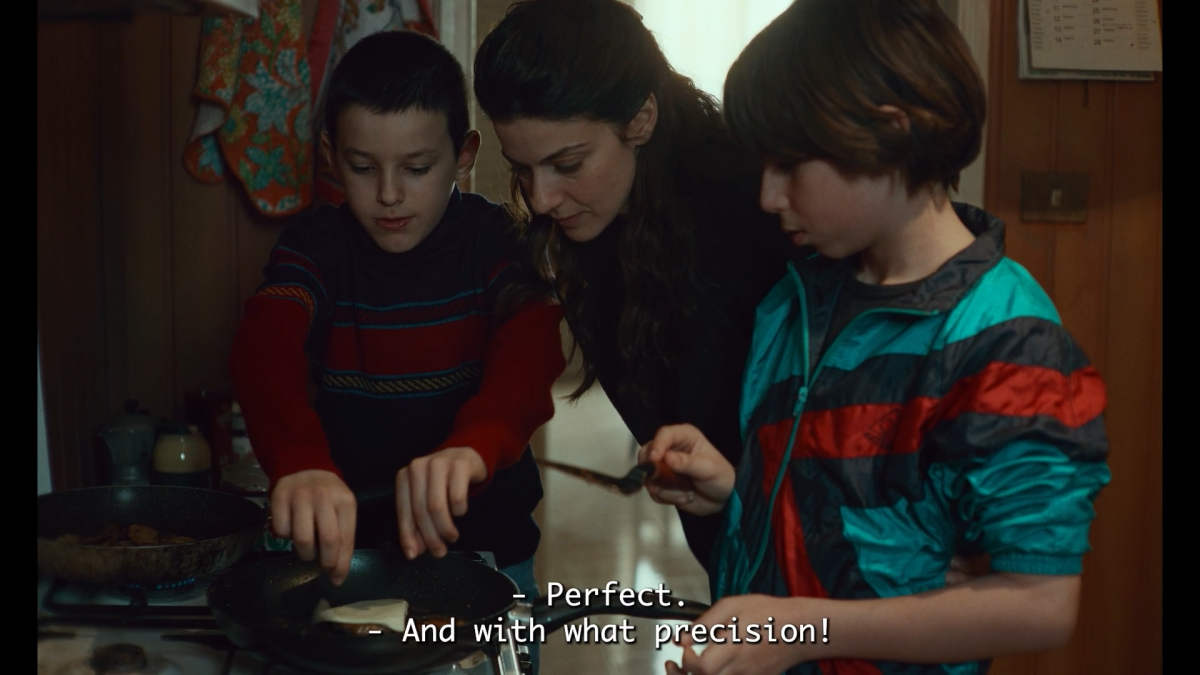
Jump. It’s the early 2000s. Mother (the wildly emotionally transparent Barbara Ronchi) is a smoker and a cleaning woman. Dad (Francesco De Leva), a one-time bank robber, is being released from prison. Mother changes the locks on the door. Dad sidesteps her, showing up unannounced where the boys are playing soccer. Luigi runs and hugs him. Alessandro stands back in fear. Dad slaps him, then smilingly orders: “Give me a hug!”
The three go to the fair. They ride the roller coaster. Dad teaches Alessandro how to shoot a gun. A teddy bear is won. Through wily manipulation, the family is united until Luigi writes a Father’s Day essay for class, a seemingly loving one that includes the wish that his dad would stop hitting his mom. The boy’s teacher is concerned. The social services and the police will shortly arrive, and the family is torn even further apart than before.
Jump. The boys have grown up. Alessandro works. Luigi, now with a girlfriend, has joined a fascist group where the shirtless skinheads pogo riotously to a pounding beat while screaming: “I despise what you are! . . . You’re prey for my thirst. . . Duce! Duce! Duce!” Give them a knife or a stick, put them on a street, and you better watch out.”
So has Luigi become his father or is he just the same scared little bambino who’s now shaving?
And can Mother ever escape the threatening mistake she made in her youth that continues to stalk her?
It’s hard to escape.
I remember when my dad ran down the hall of our apartment holding the back two legs of a chair, ready to smack it down on my head. I grabbed to other two legs and pushed back. Dad fell. I ran out shoeless, flying down five flights of stairs into the street forever.
Familia makes you remember, inciting forgotten incidents you might rather forget. Damn that past that rises up again.
In Patrimony: A True Story, Philip Roth writes of his father: “To be alive, to him, is to be made of memory—to him if a man's not made of memory, he's made of nothing.”
At the end of Familia, amidst the end credits, what has become of Luigi is revealed, a strong argument that there are layers and layers of hope in our lives, and all might not be dashed.
Familia is now available for purchase and rental on Amazon Prime and Google Play.
(If you or someone you know is experiencing domestic violence, please know that help is available. You can contact the National Domestic Violence Hotline 24/7 by calling 1-800-799-SAFE (7233) or texting "START" to 88788.)
(Wikipedia shares a rather anemic list of 32 American films with instances of domestic violence.)