
Stretch, Hold, Release
Picture Theory at 548 West 28th Street, NYC
The uniqueness of a work of art is inseparable from its being embedded in the fabric of tradition." - Walter Benjamin
AI is not regarded as a tool by artists the way the tools of the past were: burnt willow sticks, polished lenses, and Photoshop, because it’s seen as a threat to the artist’s existence.
Walter Benjamin's "Age of Mechanical Reproduction" is in full flow. Music, images, and books are being created to order by producers. Soon, just as Spotify is making its milquetoast music, Netflix wants to generate ambient, half-digested TV using AI and other means. It will be created according to the digitally tracked needs of the public in the service of the corporation. Mechanical Reproduction intends to obliterate the ‘who’ of art making.
Craft-based art returns the focus to the object—how it was made, where it was made, and by whom it was made.
At Picture Theory, the gallerist Rebekah Kim has curated a show of craft-based art called "Stretch, Hold, Release."
The relationship of the artist to where they are from is significant here. Unhitching art from its tethering post of origin has been useful for corporate-made content. It wants to make a global product from a global culture. The specifics of the place make it harder to control.
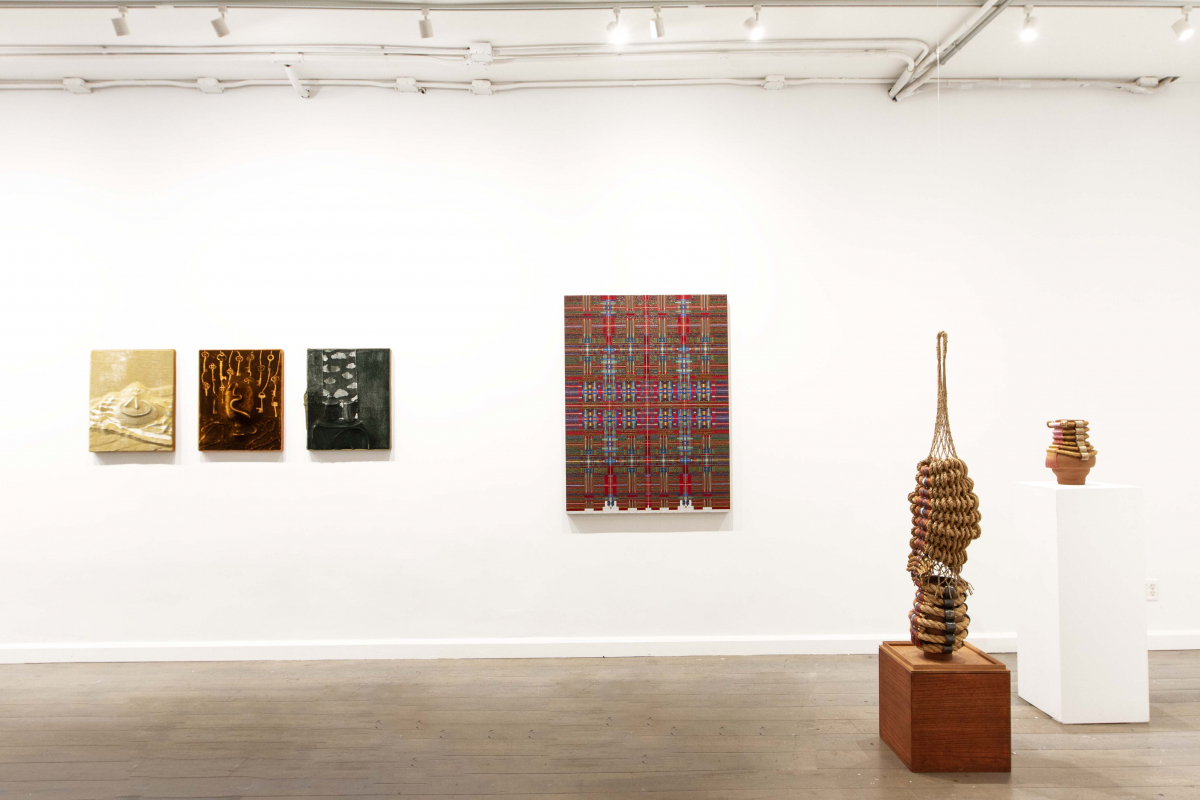
Luis Emilio Romero paints Guatemalan fabrics, going as far as to imitate the raised stitch in paint. They remind me of Scottish Tartan, '60s hard-edge abstraction, and city plans. However, here, all the shapes and colors that comprise a traditional woven piece can refer to animal, plant, or cosmological patterns. It’s a metaphor for the Mayan worldview.
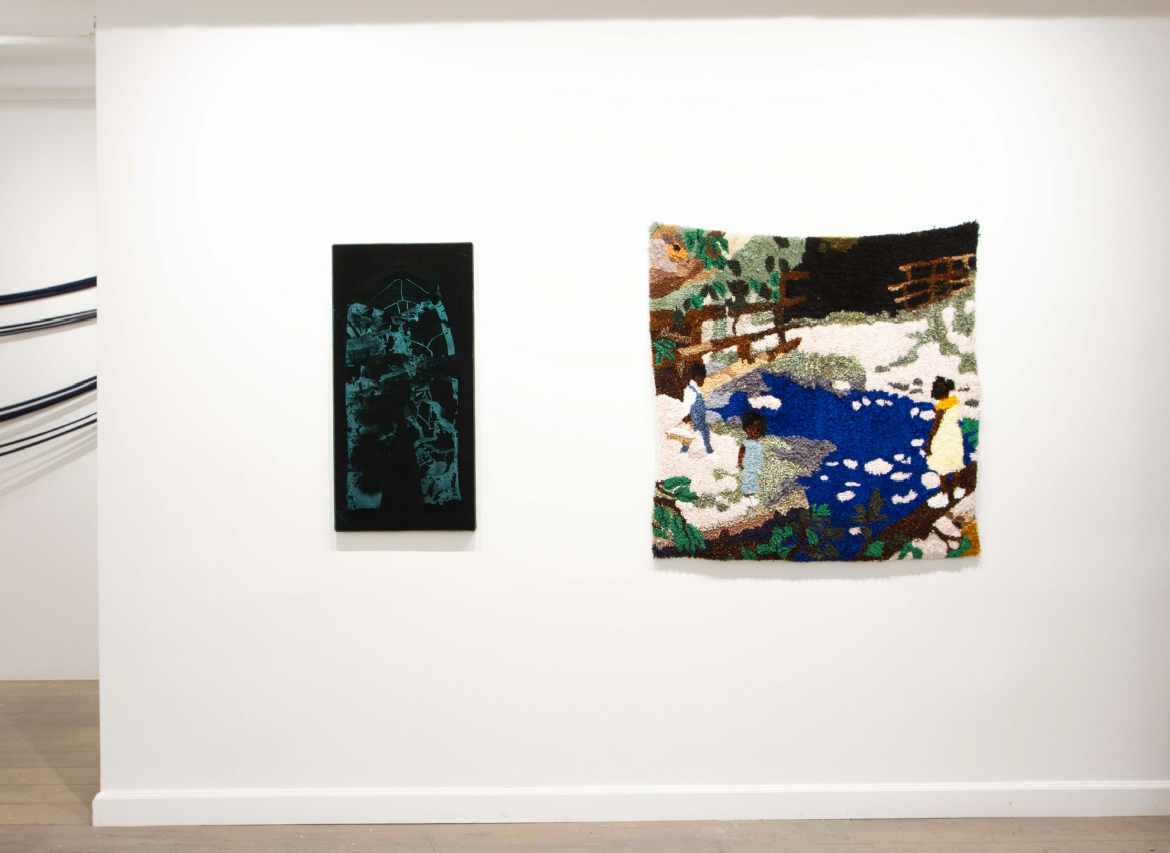
Lior Moran is an Israeli artist, raised in a country partly populated by people who came there because they had to hide their religion, now caught in a terrible darkness where the objectives on both sides are hidden. He takes found objects or makes sculptures that he hides under a velvet canvas. He shaves off the protruding planes, creating an inverse shadow. He uses twilight colors in his work. They are then bound along the side with a flesh coloured belt that sometimes has a buckle, like a bundle wrapped for a hurried exit.
The multiple handles and thick knotted rope, the little pinafores that she makes for her examinations of Peruvian pottery, draw attention to the utilitarian character of Terumi Sato’s own Japanese ceramic traditions.
Elisa Lutteral is an Argentinian artist born in New York. She is represented here by hanging lengths of woolen fabric with a glove at each end. In the video, the glove-wearing performers are positioned in a specific location from the camera's perspective. The resulting braid is achieved by their movements around each other. It’s an improvised group performance of one of the first crafts that we learn as children.
JaLeel Porcha’s contribution is the least didactic in the group. It’s a deep-pile hanging rug. It appears to represent a clearing in the woods, featuring two black children and a pond, perhaps. He’s influenced by the illustrators of classic American children’s books. The nostalgic quality is enhanced by being a knitted piece, which adds an ironic element to its shadowy mood.
An object that has only been created by hands and shows ´where’ and ‘when’ it is made and ‘what’ it is made from is crucial to understanding ‘what’ it is. Without these interrogatives being answered, it probably isn’t Art at all.