
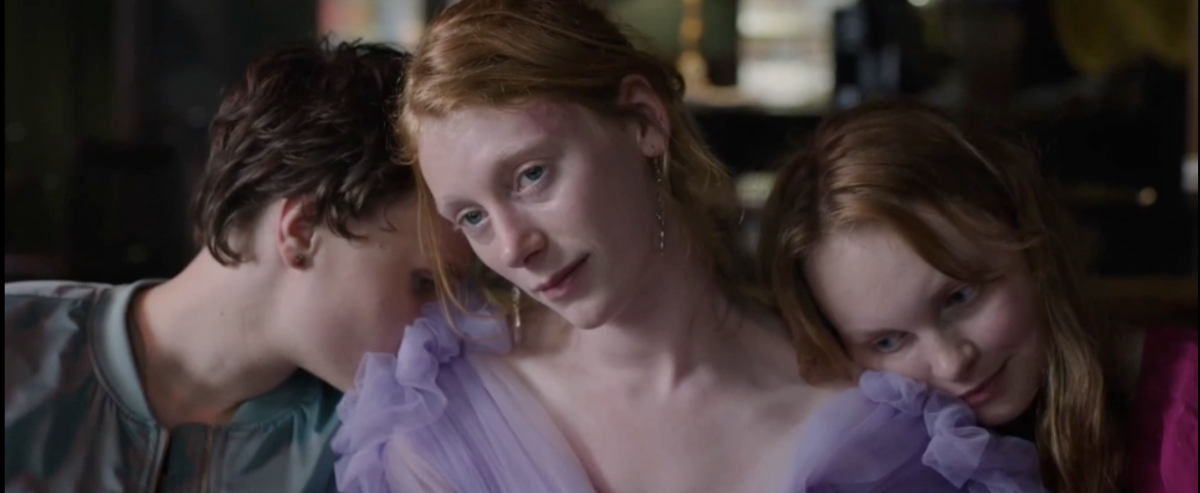
Poor Nore. She just wants to get laid, and none of the men will do it.
They know her. She’s a regular at the bar, and most of them have either bedded her or heard about her. She asks the owner. No go. The bartender. No go. A married man is sitting on the couch. She tells him she has nowhere to sleep, and he offers to pay for a room. But he won’t be joining her.
The new film Easy Girl is writer/director Hille Norden’s feature debut. Upfront, it asks the question: How hapless must a girl be to offer herself and be rejected?
All this is witnessed by Jonna, a shy tomboy who can’t take her eyes off Nore. When a man finally responds to Nore’s proposition, Jonna insinuates herself between them and drives him off. Jonna offers her a spare room in her apartment.
Nore moves in. Jonna doesn’t necessarily want sex with Nore, she just wants to bask in the glow. Jonna is fascinated. She watches her dress. Nore makes her own clothes, blowsy gowns that make her look like a cross between Tinkerbell and Blanche Dubois—fairy princess as predator. But even as Nore remains upbeat, Jonna notices her body is covered in bruises and self-harm scars.
Nore brings home a succession of damaged men: a masochist, one with one eye. Jonna takes up with the ones Nore has brought home and discarded. The men profess their love, but they get a cup of coffee in the morning, then get out. If they balk, Jonna defends her friend: “Do you have a problem with her liking sex?” One guy, Michel, can’t get it up for Nore, yet takes up with Jonna and becomes the women’s guardian angel.
And then the bottom falls out. Literally. In an unexpected cinematic trick, we plunge through the looking glass into Nore’s psyche. There’s her younger self, open and naïve and seen in what we suppose is a flashback, being violated by her first love. We hear her abuse happen off camera as her adult self and Jonna observe from across the room. Jonna asks, “Who would hurt someone they love?” Nore replies, “What’s the point of hurting someone you don’t care about?”
It’s this second half that sets Easy Girl apart. Surreally, the younger Nore joins her adult self and Jonna on the dance floor and on the prowl. The film switches from a depiction of casual sex to an intense meditation on the long-term consequences of sexual violence.
Easy Girl is writer/director Hille Norden’s feature film debut. It’s an incredibly intimate film, rendered with rich imagination. Ms. Norden has tricks up her sleeve and a story to tell. Her directorial style is at once earthy and flamboyant.
Easy Girl’s advertising campaign is misleading, suggesting a softcore thriller. Its title is sexist: who but a male would consider Nore “easy”? (The original title “Lihtne tüdruk” translates to A Simple Girl, closer to the mark. The film has also been seen under the title A Smalltown Girl, which is totally beside the point.
As Nore, Dana Herfurth is mesmerizing, as lean as a lightning bolt. She’s a waif, a lithe body with a strawberry cream complexion. Nore seeks out men (“I can’t be alone”) and accepts defilement, and her shift from party girl to abuse survivor is convincing. Luna Jordan plays Jonna with an impish charm that ripens into wisdom as she helps her friend. Jonna is Nore’s foil and alter ego until young Nore (Vera Fay) comes along. As Michel, Jakob Gessner simmers with razor-sharp conviction, you’re never sure what he’s capable of or how his impotence and suppressed rage will manifest.
Easy Girl most resembles Looking for Mr. Goodbar (1977), a similar study of sexual license, except that protag presented as a symbol of liberation and free love. Nore’s psychic wounds come from trauma, and they go deep: according to her, “You’re allowed to love people who hurt you,” even while carrying a burden of guilt and pain.
___________________________________________
Easy Girl. Directed by Hille Norden. 2026. In German with English subtitles. Runtime 124 minutes