
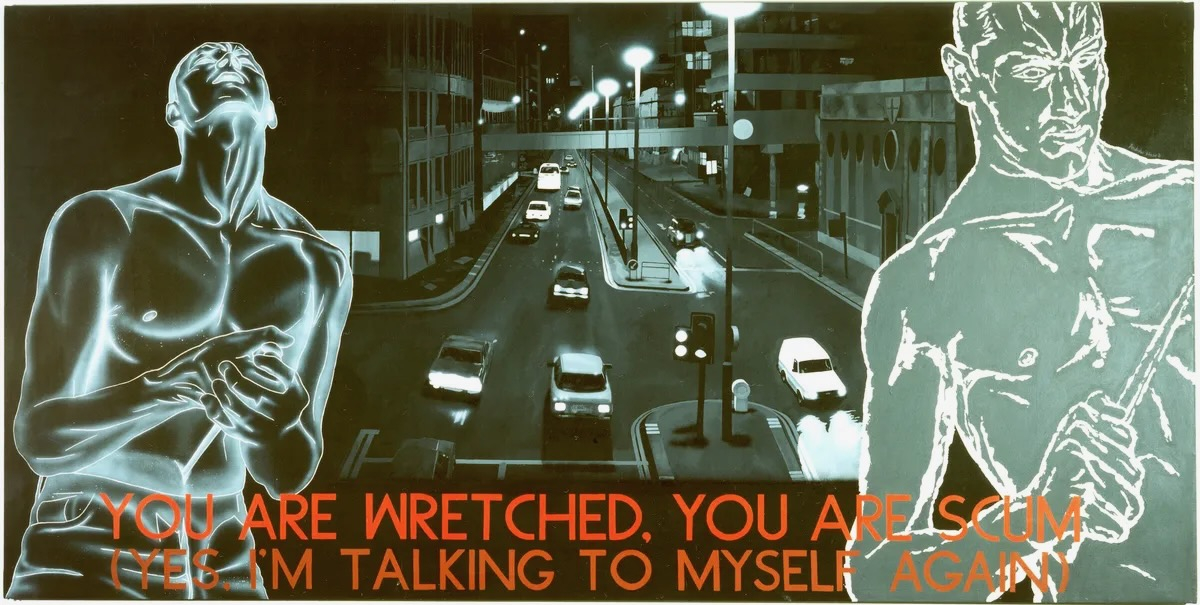
ANDREW HEARD - I Want To Be Good
Amanda Wilkinson Gallery, London
Stories were integral to the art of Andrew Heard. His panoramic canvases, festooned with jewels of detail, witty and profane, celebrated low culture in a highly artistic fashion. He trawled the gutters of memory, mostly his own. But these mirrored a sense of Britishness culturally in decline. A residue for others and a celebration of such sorrows, that murkiness of recall that we all harbor. His was a world of flickering monochrome and fading technicolor. The saltiness of snippets and vulgarity. Flea-pit warmth and the grace inherent within a half-remembered moment. 'Nudge! Nudge! Wink! Wink! Say No More! Know What I Mean?' Heard embraced not only double entendres but the 'in your face' blatancy of the singular kind, his works resembling posters for movies of the mind. Festooned with slogans, his magpie's sensibility became a patchwork of modernity contrived from a fading past. Sadly, till recently. Heard had fallen victim to the callousness of gallerists and art historians, those arbiters of taste with their fingers on the absent pulse and residue of the dead.
I Want To Be Good is shockingly Heard's first solo London show since the memorial show that followed his death, aged 34, in 1993. It encapsulates sublime talent and supreme relevance. The work remains fresh and engaging. Stark and still challenging, there pertains an elegiac air to his paintings, with an inherent sense of clever mischief. Early efforts were largely black-and-white confections, followed by a period in which the work was highlighted with splashes of red and blue, whilst his final phase was a cavalcade of color. He never quite wished to be easily categorized, was a maverick soul of beautiful contradictions. A public schoolboy who perfectly assimilated the guise of the skinhead, tattoos and braces, a neat collaring of downward mobility, attitude as a sense of otherness. His impeccable manners and accent belied his origins, though visually he had traveled well beyond such elements of conformity. His sports car, British of course, was the final jarring sight gag to accompany his impeccable attire. His interior world was populated by minor television-aries, actors of the eccentric and effete kind, especially Charles Hawtrey, Kenneth Williams and Barbara Windsor from the Carry-On series of UK comedies. He included all three in his canvases. Hymns to a former time. Terry Thomas and Arthur Askey also found their place on these canvases
One day, on a trek around Brick Lane Market, a favorite Sunday haunt of his, he guided me down a side street. "There's something here I want to show you," his sole clue for the self-explanatory epiphany that awaited me. At the end of the alley was a burger cart overseen by a blonde allure-ess of indeterminate age and extraordinary panache in a spotless fitted white housecoat, her hair, pure peroxide, not one strand out of place, her bust accentuated by the cut and shape of her outfit. From lips, sinfully red, she gushed, "Whaddaya Want Boys?" In awe, we ordered chips and sat gazing at a wall opposite this apparition of East End beauty, like a pair of schoolboys in utter disbelief. Andrew turned to me and smiled: "She's amazing, isn't she? I always come here just to see her." As we said our goodbyes, we were airily informed that she was in her final weeks of trade. We were both somewhat crestfallen. A few weeks later, I asked him if he'd seen her since. He said sadly, "When I looked there recently, the space was empty." It could have been a perfect parable for one of his paintings.
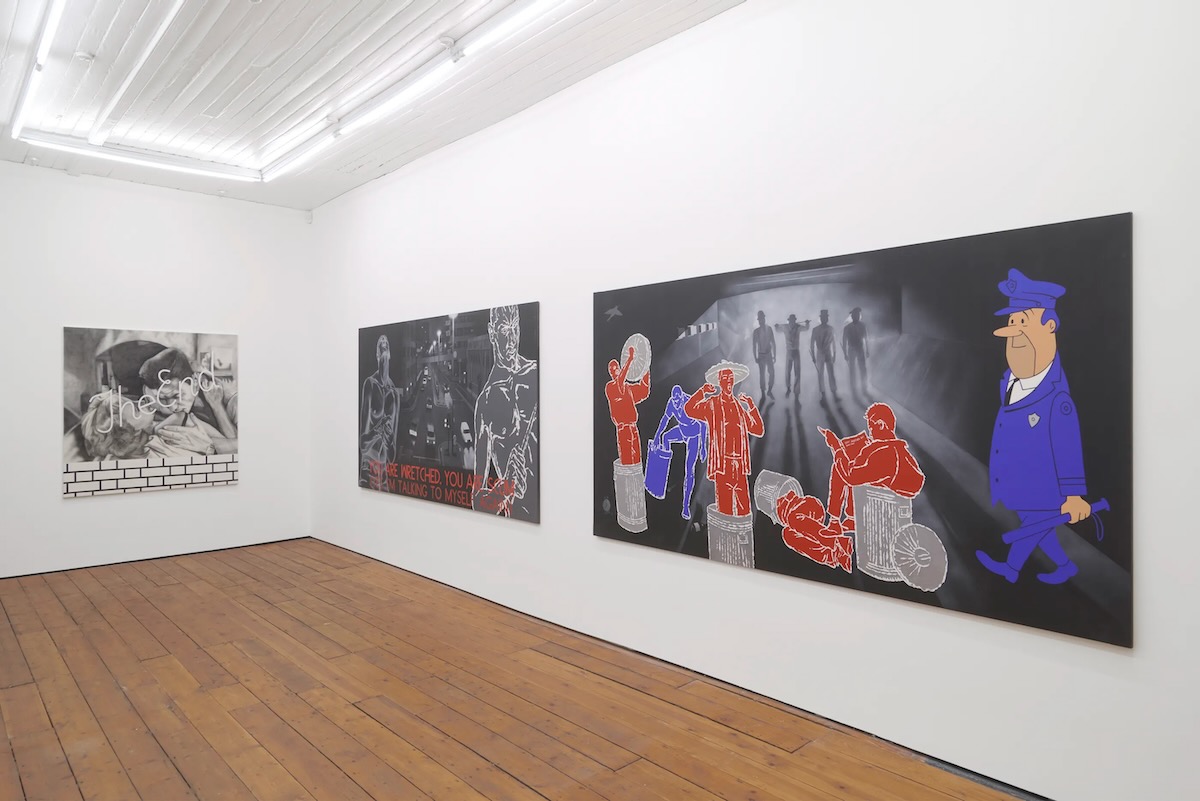
Dominic Johynson is to be applauded for curating this salient show, which encapsulates the salt and sweetness of Heard as a creator. It is a perfect thumbnail sketch, an entrée for a wider menu, and a reminder that many other treasures are yet to be remembered. There is "You Are Wretched. You Are Scum," is an overtly challenging cityscape at night, bookended by a pair of shirtless skinheads, as well as the early piece of camp froth from 1980, "Cowboy Can Can," which has a row of identical cowboys carouselling across the canvas in all their gharish glory. The late-period 'Melancholy,' when Heard was at his most affecting, has a pensive and unsettled image of the actress Deborah Kerr surrounded by flowers, a perfectly unsettling tondo juxtaposition of beauty and distress. The title picture in the show contrasts a fifties couple in their dream kitchen lovingly viewing a muscle man as a jack in the box on their gleaming work surface, whilst below the transformation sequence from man to werewolf, unsettles these elements of domestic bliss. Heard's work has survived largely due to the maintaining of his archive via his partner Chris Hall which has allowed it to be discovered. Many artists of that era saw their archives squandered by dealers or destroyed by family members. Andrew's friends, the iconic artists Gilbert & George, write movingly in their introduction for the show's catalog
'Andrew and his pictures were very happy and very sad, very nostalgic but also up-to-date, aggressive and gentle, simplistic and complex, lifeful and deathful. His pictures were filled with a warmth of human love and an extreme and unusual beauty. For us, he was a fantastic artist who built a life out of his own imagination and sense of reality. For this, he lived.'
Heard's work echoes the early creations of his friend David Hockney, Peter Blake, and the only recently re-evaluated Pauline Doty. There are also shades of Warhol and of his direct American contemporaries, Basquiat and Keith Haring. He was an endless advocate for David Robilliard, the artist/poet, one-time lover and friend with whom he shared studio and apartment space at 4 Garden Walk in the East End. David died on 3rd November 1988, on the eve of the opening of Andrew's debut Cork Street show. Robilliard's reputation has soared since his passing, whilst Andrew's has receded into the shadows. Years ago, a gallerist turned down a proposal for an exhibition by Andrew on account of the work making them feel sad. A sure example of getting the point and missing it at the same time. Much of his output transpired under the threat of AIDS in the eighties, and as his days darkened, so too did the tone of his creations. An artist who would have embraced the digital age, Heard also missed out on "Cool Britannia" and the Sacchi effect, and though a successful name, his career was in freefall by the time of his death. His main gallery had gone bus,t and a raft of his paintings were lost in that quagmire of legalities. Also, Andrew Heard was becoming ill. I last saw him at the David Robilliard show at the Royal Festival Hall in November 1992, and he looked frail and distracted. I arranged to visit him in the New Year, but opening the Independent newspaper on a Manchester bus that January, his obituary leapt out at me and my first thought was 'Why didn't you tell me you'd died?' the instant ridiculousness of loss in that sealed thought and moment.
One afternoon, we were sitting in Garden Walk listening to an old Max Miller comedy routine on LP about two 'sensitive boys'. Miller also features in one of Heard's paintings. He turned to me and smiled in embarrassment of disclosure, "You know I cannot do this with anyone else." I knew exactly what he meant. Perhaps it was due to the fact that only three months separated us in age, but we had a shorthand symbiosis about aspects of culture and the meaning of otherwise meaningless things. For years, we exchanged records and ephemera. I once found an old roll of color movie film of sights of London from the sixties. It immediately went in an envelope to Garden Walk, and Andrew was delighted to have it. Perhaps we simply longed for and remembered colors, images, and sounds that we almost missed out on experiencing—the near seed of impossible nostalgia.
Andrew once informed me that his notoriety had considerably increased with the workmen on the site near his studio with the arrival of the effete figure of the artist, designer, and Barbie enthusiast BillyBoy. Having been decanted from a London cab in all his gazelle-like finery, he was greeted by a chorus of catcalls and whistles until Andrew answered the door. The visit took an unfortunate turn when Catherine Brown, Andrew's painting assistant, accidentally spilled a cup of tea on their precious guest. The following week, a package arrived from Andrew with a copy of BillyBoy's Barbie biography enclosed. a thrifty, not terribly appropriate, piece of re-gifting that I still possess on account of its history.
There should be a book about Andrew Heard and David Robilliard's brief but productive tenure in the East End, when only artists could afford to live there, before it became prime real estate for developers. A lost world that was frustratingly brief, but infinitely vital and fascinating. Both were very different emissaries of their craft, but strangely complementary. Robilliard, didactic and spontaneous, Heard, reflective and mannered. Their mantles have been appropriated by successive, lesser talents. Theirs, a creativity stymied, removed, and marginalized by AIDS. Writing this has stirred memories afresh and a sense of former sadnesses.
I include this poem as part of that looming tragedy and as a piece of unwanted legacy. It annotates moments at the 1991 launch at Waterman's Art Gallery for The Cat's Pyjamas, the book of poems by David Robilliard that Andrew, Catherine Hollens nee Brown, and I had edited, the first to appear since his death.
---------------------------------------------------------
A PRIVATE VIEW for Andrew Heard 1958-1993
It was a day like yesterday
We left the crowd behind,
a day of rare sun and clean breezes
on the balcony above the river,
And I recall the rise below of children's voices.
It seemed private.
I'd sensed small clues,
odd details in mail,
our voices within wire,
and you were suddenly thinner.
Skirting the subject,
blaming overwrought concern,
I mentioned a friend's mother
had almost died of pneumonia,
but you said blankly
'Mine is a very special kind.'
The bomb and the penny fell.
I just hugged you.
Loss of hope at times stalls the urge to cry
and in the face of your brave one,
mine said nothing.
You said things I'd read
'Not accepting it as terminal.
Fighting this.'
Desperate, I conjured with
names of long survivors,
but you cut through
'At what cost, though?'
From all the words in my world of them
I could muster none,
my mind reeling at such savage progress.
Distant from the crowd,
these fragments of exchange,
felt personal, unseen,
but some months since your funeral,
a friend met there
recalled our exit from the gallery.
His asking who I was?
Her informative reply.
They watched us in the distance
like some silent film
and as I hugged you
she turned to simply say
'I think he's told him.'