
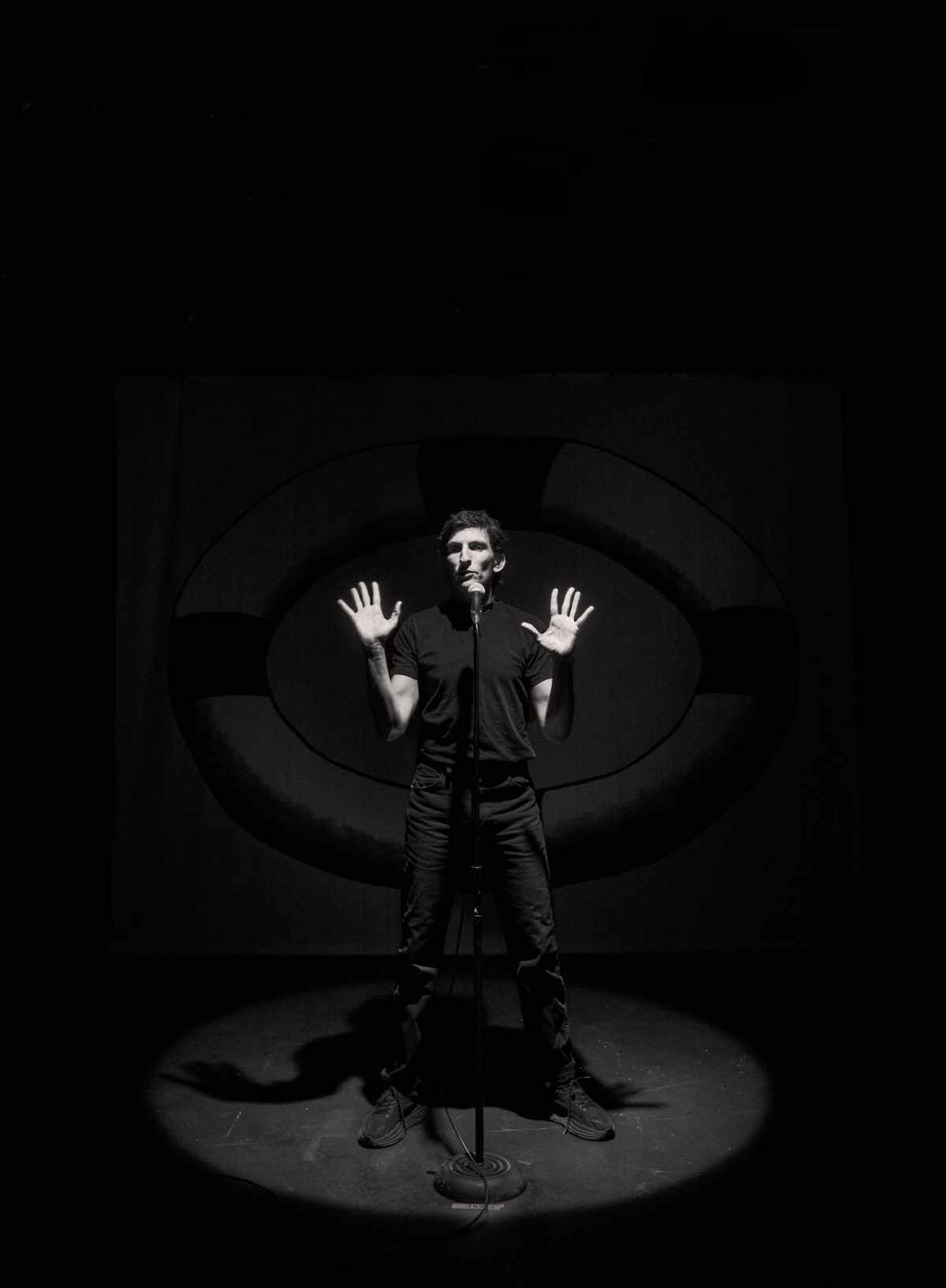
On a recent summery-spring evening in New York City, the small stage at the Soho Playhouse contained multitudes. As writer-performer Morgan Bassichis was unfurling their 70-minute triumph of excavation and connection—an audacious outing that goes everywhere but where the audience expects it to—a packed house watched, rapt, as a virtuoso of comic delivery navigated bold depths and giddy heights with seeming effortlessness. I’m still vibrating from the aftereffects. A delicious and indelible evening in the theater, Can I Be Frank? is not to be missed.
I had a few questions Bassichis was gracious enough to answer.
Are you surprised to find yourself where you are now?
It’s a dream come true. That I get to do a play every night, in which I get to be fully as absurd and crazy and loud and angry as I am, is thrilling.
What was your first inkling you were going to grow up to be a performer?
My first performance ever was as the ugly duckling in The Ugly Duckling in kindergarten—of course! They said: “YOU.”
You’d have to be the lead regardless of who the character was.
I always loved performing. I don’t think I knew you could be a—in high school I was like, “I really want to be like Alan Cumming in Cabaret”—that’s my path. And then eventually my path got a little windier, and I discovered politics. So I had a very windy path to get here, but fundamentally I’ve always been a performer. I feel it’s what I’m here to do.
Was there any resistance from your family to the unrepressed nature of your gifts?
My family has always been super supportive of me doing theater, since I was a kid. I don’t know why—I mean, I know why; they’re great people. They saw that I really liked it, maybe I had some skill at it, so they’ve just always unequivocally been, Go do it.
Was writing always in the cards, creating your own characters?
I don’t think I knew that was going to be my path. I studied some playwriting in college [at Brown]. I remember something that Lily Tomlin said in the '80s: "I write work for myself because I'm not getting the work," and that really resonated for me: you’ve got to make the roles for yourself.
How does performing other people’s work compare? You operate on such a high level, I would imagine it would be difficult to find something of equal caliber.
I haven’t really performed much of other people’s stuff. I would love to.
You do use Frank Maya's words to give your piece a framework. But as performers, you two strike me as very different.
When I first found out about him, I was really struck by our similarities more than our differences. I felt like, Oh, this is a neurotic, irreverent person who’s making weird stuff — and in the same rooms that I performed in. These downtown performance spaces are so haunted in all these ways. And I just loved that sense of how, kind of, derivative or unoriginal—we love, in this culture, to praise the “original,” the white male "genius" Zeus—you know, genius comes out of his head—and I hate that. I find it so patriarchal and so untrue! So it felt like a cosmic joke, to meet this person who I never heard of who was making kind of similar jokes that I'm making—and, yes, we have a very different style of performing, but there’s a core kind of neediness and flirtatiousness and love-to-be-seen-ness that I think we share.
And rage — and politics, obviously, a fury about the way things are.
Yes! A fury.
Do you have a favorite moment in the show? Does it change much from night to night?
It looks like it changes, but it doesn’t. It’s made to be experienced as: This is just happening.
Your performance really feels improvised in the moment, but your timing is so impeccable.
That’s my goal, for it to feel like, Is this the only time this has ever happened? But it’s pretty much the exact — it changes depending on how the audience feels, a little bit, their energy, but it’s the same. I think the favorite moment…I love when it starts to get confusing about who's Frank and who's Morgan. That’s my favorite. Because that's my politics: that we're not separable.
This idea that it’s human nature to be tribal, to scapegoat, to be pitted against each other doesn’t feel normal to me. I think we have more in common than we are different; we all want to be happy, to be loved.
I think you’re 100% right, and I think it's a spiritual sickness. Supremacy ideologies are a false refuge for the need we all have to belong and to feel connected and to feel like we have dignity and that we matter and that we have something to contribute to this world. I think supremacy ideologies are like sugar rushes; it’s that, Oh my god, I belong! But actually you’re going to end up feeling horrible, because it means you're complicit in killing other people.
Have you ever met resistance in your audiences? Do you find you’re preaching to the converted?
What I love about comedy, speaking of a spoonful of sugar, is I love entertainment—I love the radical potential of entertainment. My director, Sam Pinkleton, is really good at this, and this is where we align. He's like, “First and foremost, you make an entertaining night of theater—first and foremost.” Everything else comes second; you have to earn everything else. And that means that you can cast a wider net, because it’s not just a lecture—you’re saying, “I’m gonna make sure this is fun for you all, but we’re going to do some hard shit along the way.”
It’s not “Eat your vegetables” — the presumption that it’s good for you, so it’s not going to be entertaining. But every minute of your show is entertaining. How did you come to Sam Pinkleton?
Oh, thank god I did. We have a mutual friend named John Early, a genius comedian.
Have you seen his standup where he does the Trump “grab them by the pussy” speech, and it’s clear the words are from a closet case? It’s inspired.
I need to find that. I just adore [John]. I’ve worked with directors a little bit, but never really deeply; I knew that this piece needed one, that I couldn’t see what it would be on my own. I asked for recommendations, and he said Sam.
He’s a wonderful director. Is [the invisible stage manager character] Gloria from you or from Sam?
Gloria is from Gloria. Gloria was our stage manager from day one at La Mama, and she’s still with us! She’s in the light booth every single night.
I thought she was a fictional conceit!
She’s real. For three years.
How has the show changed over the three years? Or has it?
I think it’s gotten sharper. Sam and I both share a very obsessive personality and text each other at 1 a.m., like, I think that joke could be funnier. I remember last year he was like, “Take 45 seconds out of that song.” I was like, 45 seconds!
Because comedy is music! It’s rhythm and music.
Exactly. I’ve a friend who’s a poet, and she’s like, “Comedy and poetry are very closely related, because they’re both about being very economical.”
And the things that make both of them work are intangible. You were talking about the difference when it’s Frank and when it’s you. He’s a fascinating part of our history that begs to be told. What would he be doing if he were alive today? That’s what I think is so painful about all the forms of premature death that our society allows: you never get to see what people become as older people.
Not to jump to a super intense topic, but if you think about all the art that people in Gaza will never get to make, and the destruction, particularly of cultural institutions and schools—it’s an attack on the future. That’s the purpose of it. Of course, Palestinians will always survive and will continue to make art, but it’s an attack on culture. What would he make? His last show, which he did at the Atlantic Theater Company, he kind of got what I got, which is the Off-Broadway run that every solo performer dreams of, and it was amazing. And you really see his material from when I am looking at it in the late ’80s to the ’90s; it’s sharpened, and it’s tight; he’s at the top of his game.
Can it be seen?
It’s online. The show is called Paying for the Pool. I just find it really moving because it’s so sharp, and I’m like, "What could he have done if he could’ve developed his craft?" Today [he would be] 75.
We need an angry, horny 75-year-old voice!
“There’s a core neediness and flirtatiousness and love-to-be-seen-ness I think we share.”
Are there questions you wish people would ask you that they haven’t?
One thing that nobody’s asked me, one little treat that I love, is the cord that people see the cord work with the mic. I think about it as the umbilical cord between generations. Sort of like an umbilical cord between all the queers who are like, I gotta get on a mic, that’s the only way that I’m gonna find out who I am... So really, I just love that cord.
It’s hilarious the way you use it. Most of us wouldn’t even think of it having the depth you just gave it—the history that’s connected.
That’s the best, when something doesn’t need deeper meaning, but there might be one.
You performers put yourselves out there to face the live animal of the audience every night. Are there moments they’re not getting it, or you’re fighting them? But you still have to keep going.
Oh, yeah. What I’ve learned is, I think I know what’s going on, but I don’t. Sometimes I can read sluggishness and quiet, and that’s just how people were experiencing it, and that they were feeling deeply, that they were having their own experience. And part of my work as a performer and as a person is to try to detach and be like, Each night is going to be different. Everybody gets to have their own experience. Everybody processes art in different ways.
Do you crash in your downtime? Are you able to detox?
I am back in therapy [Laughs]. I tell it to my friends as: It’s an emotional, physical and spiritual boot camp. Like, riding the wave of I could have done better… all that stuff.
You have a brutal inner critic that’s just constantly reviewing you?
I have one of the meanest, most vicious critics that’s been living inside my head since I was age 0.
Maybe you could do a show in conversation with them. Well, you sort of are!
That’s what I see in Frank too — part of that fury is at himself. And I have that too, where it’s sort of that constant — and I think a lot of queer people do that constant—that hypervigilance about how you’ll be perceived, that fear of rejection.
We always have to monitor the safety of everyone around us. And make things safe for everyone else.
I have one of the meanest, most vicious critics that’s been living inside my head since I was age 0.
Do you live in New York City?
I just moved to 14th Street. I just moved here four months ago, after Brooklyn [Bed-Stuy] for 13 years.
You said you grew up outside of Boston. Do you see yourself as a New Yorker now?
I am very proud to live here. I’ve always loved living here; I’ve always felt very honored, and now with our beautiful mayor, I just walk around, and I could cry looking at how much pride and dignity our city feels.
“Hello, Gorgeous!” “Hello, Gorgeous!” It’s just that.
Is there any chance the show will move? Was it always at the Soho Playhouse?
I started it at La Mama — in the room that Frank performed it. Then last year, Soho, and this year, Soho. It can’t extend past June 27th because there’s another show that moves in.
Do you have a dream for what happens next?
I would love it to be filmed so people could see it, and I would love for that film to weave in Frank’s footage.
That seems totally doable.
We need a really famous person to get behind it.
Any thoughts as to who?
I would like Whoopi Goldberg to get behind it. I just think it would be really fun to…because he was so obsessed with being on TV.
It wouldn’t be out of the realm of possibility to go big—I didn’t think Oh, Mary would work on Broadway, but it sure did. Of course, we can’t have anyone take over for you.
We can’t have anyone take over for me!
Let’s put some dreams out into the universe…
Your mouth to God’s ear!
Can I Be Frank? runs at the Soho Playhouse only through June 27th. What are you waiting for?