
Sun Ra: Do The Impossible Soundtrack (Modern Harmonic)
My only complaint about the otherwise superb documentary Sun Ra: Do the Impossible, about the above named musical genius and cosmic revolutionary, which played the festival circuit in 2025 before its television broadcast on PBS’s American Masters this past February, is that I wished it would have at some point taken a respite from all the fascinating history, colorful backdrops, far out concepts and revelatory, sometimes anecdotal, information from witnesses, collaborators and experts and let some of the work of this legendary jazz artist play for an extended period of time. How else could a newcomer truly appreciate the artistry of what this visionary has concocted in the studio or on the stage over his multi-decade career?
Personally, I would have liked to hear a lengthy, preferably cacophonous segment from Sun Ra’s pivotal masterpiece The Magic City, just for the pleasure of knowing it would probably freak out a large portion of the staid PBS audience. That 1965 album is anchored by the mind blowing 27 minute title track, (they both take their name from the nickname of Sun Ra’s home town, Birmingham, Alabama), a towering monument in large ensemble free jazz improvisation that ranks alongside such mammoth and influential recordings as John Coltrane’s Ascension, Ornette Coleman’s Free Jazz and The Cecil Taylor European Orchestra’s Alms/Tiergarten (Spree).
But I can understand why the filmmakers felt that they couldn’t let a single piece of music (or even several pieces of music) stand as a representation for what this renowned Arkestra leader has endeavored to communicate over his lifetime. The scope of his career is immense. The man who legally changed his name to Le Sony’r Ra after being born Herman Poole "Sonny" Blount composed over 1,000 works and issued more than 200 self-produced records. They range from the swing era big band arrangements he wrote for Fletcher Henderson to the obscure doo-wop or R&B singles he created for the jukebox market to the various bop-derived avant-garde excursions into collective improvisation to the futuristic electronic experiments he dabbled in to the space age theatrics of his prime and finally to his contribution on a tribute album to Walt Disney towards the end of his life. It would be impossible, given the time constraints of a feature film, to use a few performances to encapsulate how Sun Ra figured in the world of jazz or music in general. Any example would beg the question of why any number of other works are being excluded.
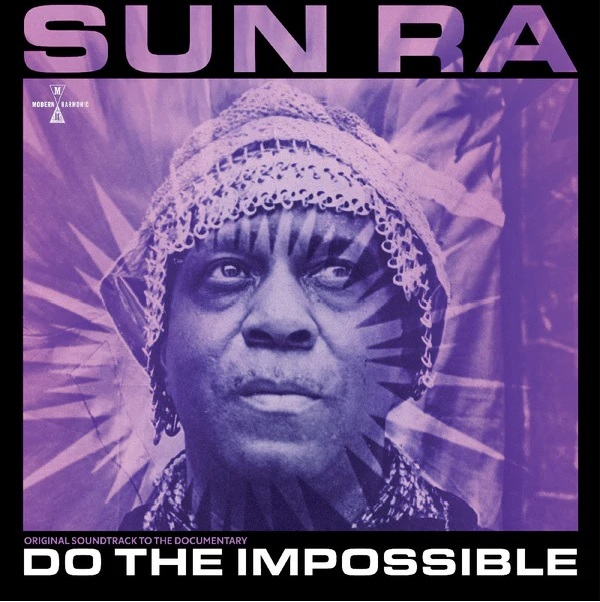
Thankfully, Modern Harmonic, a subsidiary of the vital archival label Sundazed, has more than compensated for this absence by providing a double-LP soundtrack, pressed on high-quality, appropriately regal purple vinyl, and a Blu-ray of the film. (The soundtrack is also being issued on CD. According to the listing on Amazon, it contains 3 CDs, and I logically assume it’s actually a double CD plus the Blu-ray of the film, but I cannot be certain of this.) This is the label that, in recent years, has launched a serious reissue campaign for Sun Ra’s work, spearheaded by Irwin Chusid, who, decades ago, did everything in his power to bring back into print the all-but-forgotten catalog of Raymond Scott’s classic 78s.
While this release is indeed a retrospective of this bandleader's multiple styles, it shouldn’t be seen as a “greatest hits” package by any means. Although a few titles come from such famous albums as Jazz In Silhouette and Super-Sonic Jazz, the majority are taken from lesser-known releases, even from a few posthumous ones of recent vintage. There are four previously unissued performances: two from Denmark in 1971 and two from Montreux in 1976. For better or worse, 13 of the 37 tracks are abridged. And so, listening to this soundtrack is not at all akin to listening to, for example, a comprehensive box set issued by Mosaic Records, where all the takes are complete. Every alternate version known to exist is presented in full array, leading to an experience that can either be fascinating or tedious, depending on one’s level of scholarly interest. Rather, this set is curated and sequenced for optimal pleasure rather than scientific knowledge, for both the uninitiated and the seasoned expert. As such, it is invigorating. More importantly, it works best as a companion to the documentary, which means it was a brilliant decision to include a copy of this film, even though I suspect most people will more frequently return to the audio document than the audio/visual one. The album and the film truly speak to one another.
Highlights include the contemplative and moving solo piano piece, "Quiet Ecstasy," originally issued on Aurora Borealis in 1981. It’s an almost-lullaby that occasionally and effortlessly drifts in and out of dissonance to great effect. "Pescara Mini-Moog Solo," taken from an Italian broadcast in 1976, segues into an abridged version of "Space Probe" from the 1974 album of the same name (although it was recorded four years earlier). Combined, these trippy, intergalactic electronic improvisations sound like a transmission from Saturn, both the name of Sun Ra’s record label and the planet he claimed he was “transmolecularized” to, where he was apparently informed that “the world would descend into chaos and that he must speak through music.” Given the current state of things, it’s hard to argue the veracity of this. Two fun tracks are "El Is a Sound of Joy," originally issued on Live at Montreux (1976), and "Watusa," presumably from that same concert but previously unissued. The former is a swinging big-band romp that, without a doubt, conveys joy, primarily through the dominant trumpet solo. It’s unclear if it is played by Ahmed Abdullah, Chris Capers, or Al Evans (all trumpeters in that lineup) because, unfortunately, there are no musician credits listed on the sleeve. The latter is a lively percussive jam with a heavy African vibe. Also worth noting is the inclusion of a fairly straightforward but totally swinging big-band rendition of the Benny Goodman classic "Big John’s Special" from a 1982 broadcast recorded at the Kongsberg Jazz Festival in Norway, and an endearingly offbeat 1960 doo-wop single "Dreaming" by a combo called The Cosmic Rays. Both speak to the versatility of this maestro and his dexterity in working within the boundaries of the mainstream. Also, they are, to use a term frequented by the late jazz scholar Phil Schaap, “quite fetching.”
All told, the soundtrack is an excellent entry point to anyone who has heard of this iconoclastic twentieth-century artist, and maybe has some vague awareness of the myths and legends that surrounded him, but has never found an opportunity to do a deep dive into his legacy, possibly because there is far too much material to know where to begin. Yet it is also an eye-opener for those who have lived with his music over the course of their lifetimes, as it offers many pieces of a complex and sometimes contradictory portrait worth savoring in this collage-like presentation. While I could have done without some of the spoken-word introductions and transitions included, especially those not spoken by Mr. Ra himself, there aren’t that many, and they are all thankfully brief.
Sun Ra is currently experiencing a renaissance, thanks to the devoted efforts of record labels such as Modern Harmonic that are not only bringing some of his essential albums back into print but also unearthing newly discovered live recordings. Sun Ra: Do the Impossible is a delightful addition to his vast canon. In an ideal world, this documentary and its accompanying album would bring this virtuoso to the widest possible audience.