
The Door Slams, A Glass Trembles
Written and Directed by Paul Zimet
La Mama - The Downstairs
66 East 4th Street, New York City
www.lamama.org
April 24 through May 10, 2026
Reviewed by Jay Reisberg (revised April 28, 2025)
This play, presented by members of The Talking Band theater company, is one of the most profound theatrical productions I’ve ever encountered.
A grand saga, unfolding in a compact seventy mesmerizing minutes, is about an essential human experience. If our lives are well-rounded, we all encounter it — sometimes with joy, more often with sadness: departure. Whether it is moving away from one’s parents, or to take a new job, or to retreat for healing--or that ultimate parting, death--departure is central (and inevitable) to our growth and life-path. And that seems ever truer in the Modern era, as traditional cultural patterns fray and life becomes more centrifugal. This play, through its structure, stories, and action, foregrounds various kinds of departures within an extended family and their close friends. It heightens the impact of such breakages (as almost all departures entail) by contrasting them with the routines of life, as pictured through carefully choreographed (and most precisely executed), almost balletic movement by this highly skilled troupe.
The play includes elements of coordinated group movement, gestures, tableaux, and dialogue, with unique original music composed by Ellen Maddow (who also appears in the cast), augmented with classical music--and all this set against a backdrop of dreamy video projections of the near wilderness of the play’s locale, and of the sea. The play’s dialogue and flow of action have been powerfully crafted, without a single wasted word or inessential action.
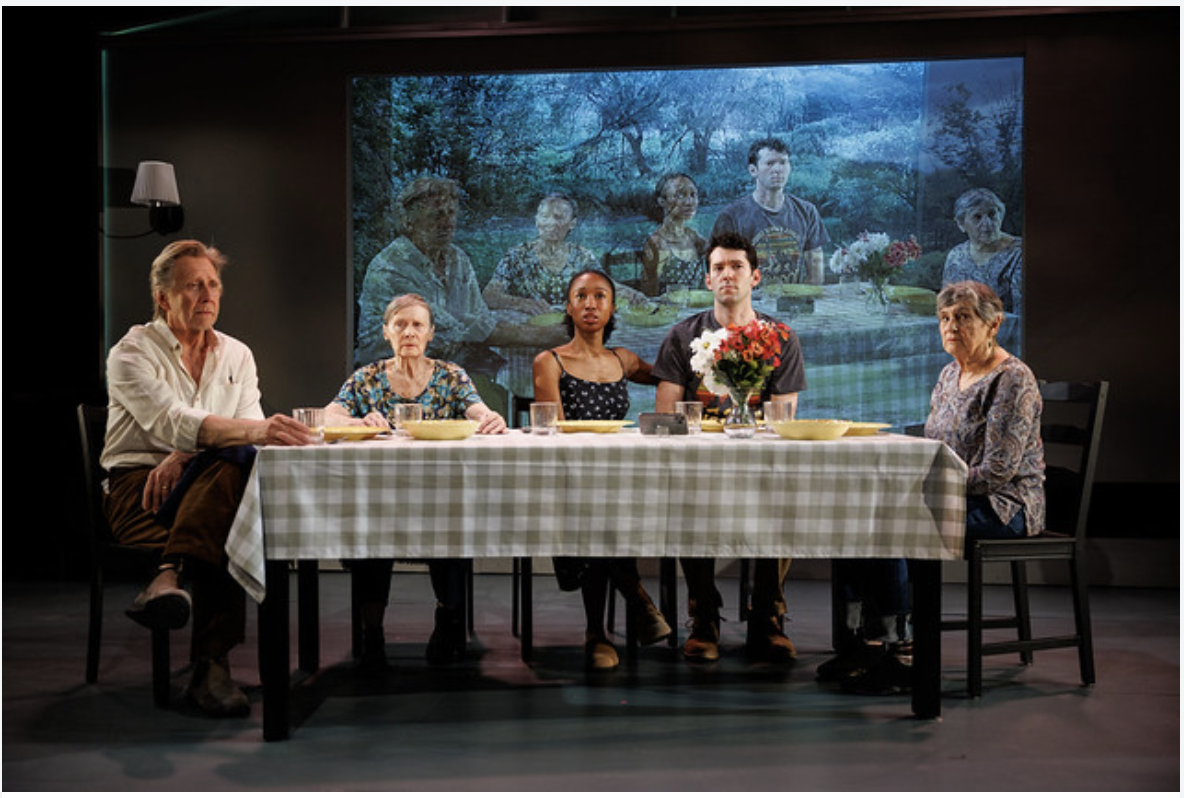
Let us now introduce the characters and a sense of the play’s tone and phases. It opens and is largely played within a shared house in forested southwestern New York State — and brings forth the cast as they, in precise choreography, repeatedly set and clear the dinner table, and finally sit down for dinner and warm conversation. We encounter a middle-aged couple, Marc (Jack Wetherall) and his wife, Clara (Ellen Maddow); their married son, Norm (Patrick Dunning), and his wife, Jenny (Amara Granderson); Oona (Tina Shepard); and another housemate. They are soon joined by Rick (Steven Rattazzi) and his wife Rita (Lissie Olesker). The conversation brings up an affair Marc had as a young man, from before his marriage, with Ann (Delaney Feener). The gathering progresses into sunset, and the moon's rise is shown in a mood-setting video. Later that night, a faint sound of the sea and a ship's engine is heard, as Clara recalls a sea voyage Marc took on an old freighter.
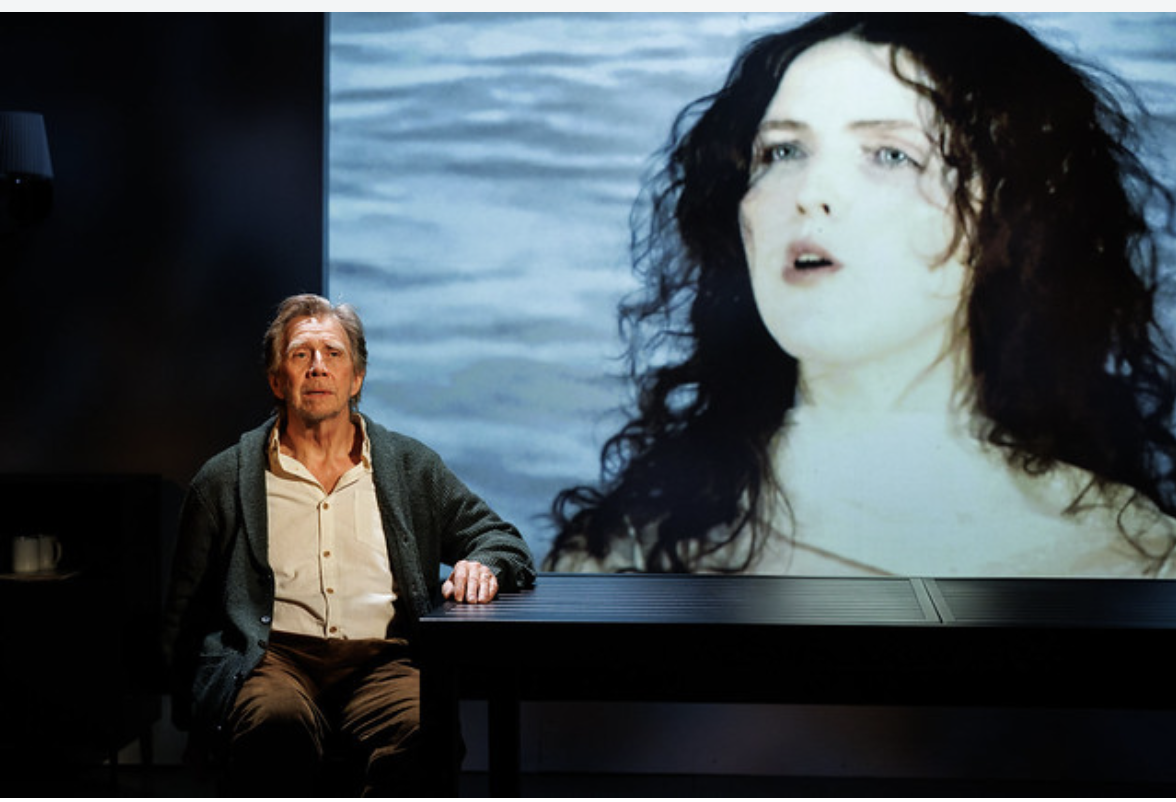
Marc shares that he relieved his restlessness on board by reading Thomas Mann’s “The Magic Mountain,” which is set in a tuberculosis sanatorium in Switzerland in 1906. There, the patients are lulled into monotony by the treatment routine, meals, walks, rests, etc. — each event at the same time, day after day. Days later, Clara notes that Marc is thinking about the sea again. Later, the contemporary Marc is seated at the table, while on video, Ann and the young Marc (Jesse Koehler) are looking out over a ship’s railing. Ann speaks, and today’s Marc responds with his younger self’s words--and as the young lovers blithely chatter, today’s Marc sings a French tune. Later, Marc, Clara, Norm, Jenny, Rita, and Rick once again set the table and discussed what they’ve been up to. It is revealed that Marc and Clara had been medical research scientists, and they’d done work showing that if mice are infected with tapeworms, their memory improves—and this evolves into a discussion of what’s worthwhile in life. Rick and Rita have begun farming and delivering their produce to restaurants, and Rick starts railing sharply about the evils of capitalism. Rita is now teaching an after-school program, and Jenny and Norm share that they are pondering moving to Montreal---when Rita pipes in with “We could use some fun!” — and with gusto, another time-filling game starts up. Later, Marc continues singing in French to the sound of the sea and the freighter. On video, Ann appears on the deck of the ship, and commences an exegesis on the Greek word “Kairos”, which means the decisive moment for action--and closes with another Greek word: “Eremia”, which here means “the pregnant pause”. Marc takes a breath and declares, “That’s it”, followed by the stage instantly going black.
From this description, it may appear that the play's action is superficial and going nowhere, but we sense that a greater depth is being explored.
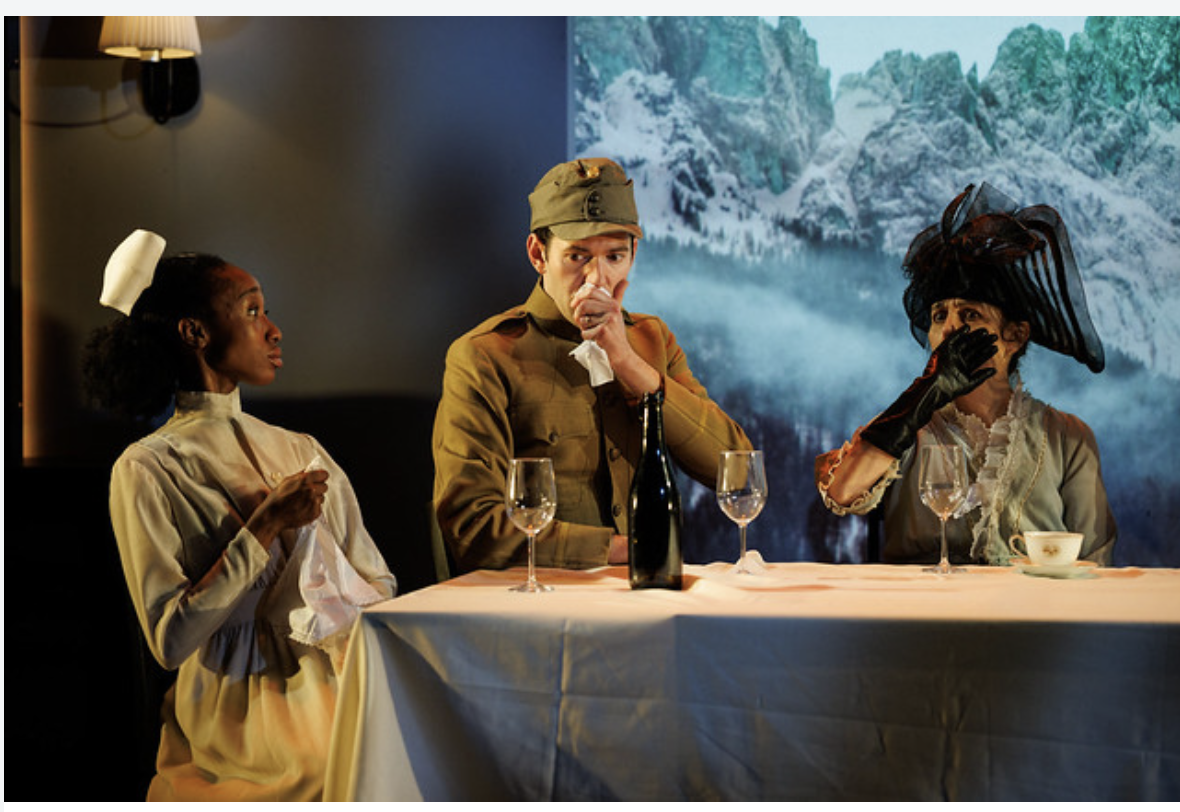
The lights slowly come up for a scene set about a hundred years earlier, in the dining room of a Swiss tuberculosis sanatorium, and the video background now shows the Alps. Two players in period attire are extending the dining table to a great length. The lights brighten to normal as the rest of the cast slowly enters, lavishly outfitted in the fashions of the time, and moves with a mannerly, take-your-time gait. They have been transformed to correspond to characters from Mann’s “The Magic Mountain”. Marc is sitting at the table wearing a button-down sweater or jacket. Jenny is Maryusay, a giddy, emotional young woman all in flowing white with a big white bow on her head. Rick is now another patient: Dr. Blumenkohl, a stiffly formal, anxious man, who evidences his illness by a discomfort-inducing cough. Rita takes on the role of Miss Robinson, an English woman, and Norm is Joachim, a soldier in a close-fitting khaki uniform. Oona becomes loud-talking Frau Stohr, and Anne has been transformed into Clavdia, who, majestic in both attire and deportment, flips her hair as she swaggers across the room, with a haughty smile. The group engages in polite gossip. These characters—offering us visions from the past — will appear in several more scenes. One shows them sitting in a tableau: a woman with her huge hands closely listening to Schubert’s song “Der Lindenbaum,” and their last scene is a fete with a party game and waltzing.
Now I’m sure you’re all asking yourselves: “All these characters! — All these snatches of dialogue revealing aspects of their past! — And all these time-bending scenes mixed in! What does all this come to?”
The fact is that the play’s action and dialogue support a bigger purpose, and just narrating them, scene-by-scene, cannot convey the entrancing mood and movement of the play — and indeed, such telling might make it all seem inconsequential. But the truth is that the audience is getting more than just words and action: as staged, through these fine performances, we are transported toward something profound. We come, movingly, face-to-face with loss and endings--via a range of departures. But there’s also something more: the hints of new possibilities for us all, a perfume of life whose vivid aroma keeps our hearts open — as well as open to quest, gamble, and adventure.
The original engaging music was composed by Ellen Maddow. Anna Kiraly designed the sets for both the contemporary and period scenes, as well as the gorgeous scenic video backdrops and dialogue scenes. Olivera Gajic designed both the modern and period costumes. Her turn-of-the-century hats were set pieces all their own. Choreographer Flannery Gregg created the actors' prominent ballet-like movements. Mary Ellen Stebbings’ lighting designs set the perfect tone for the play's action. The production stage manager was Erica Schnitzer, assisted by Mia Harada.