
Gong Byung: Density of Emptiness, Light of Presence
Exhibition Tenri Cultural Institute, New York City
April 13th - 25th, 2026
As the season nears the threshold of summer, the Manhattan art world undergoes a palpable transformation, mirrored in the city's shifting meteorology. There is a particular resonance this Spring in the way the atmosphere softens, as the Atlantic wind loses its wintry bite and grows progressively warmer. This sense of a hyper cosmic bridge between the primordial and the contemporary is nowhere more evident than in the city’s galleries.
Anastasiya Tarasenko’s solo, Primordial Soup, at Anna Zorina Gallery, emerges as a profound anchor for such a pre- and post-historical mediation. While the title ostensibly references Alexander Oparin’s hypothesis regarding the elemental biogenesis of the planet, Tarasenko transcends the purely biological to offer a spiritualized rendering of this evolutionary sludge. Her Old Master-like canvases deconstruct and challenge evolutionary theory, saturating it with a visceral Boschian grotesque that exposes the raw instincts of human consumption. Amid this material instability, the work channels the sublime mysticism of artists such as Mikalojus Ciurlionis, who was known for translating musical spirituality into turbulent seascapes.
An even more compelling bridge is found in the abstract work of Korean artist Gong Byung with his debut solo exhibition, Density of Emptiness, Light of Presence, curated by Paris Suechung Koh at the Tenri Cultural Institute. Gong’s series is paired with the sophisticated precision of Koh’s curation, where the strategic placement of each piece allows the ambient light to activate the artist's intricate carvings. Gong’s series offers a unique visual synthesis of non-objective abstraction with the Zen metaphysics of emptiness or Sunyata. The thirteenth-century Japanese Zen monk, Dogen, in his celebrated writings, does not conceive of emptiness as a nihilistic void or mere absence of being, but rather as the dynamic interdependence and impermanence of all phenomena. Herein, emptiness and fullness cease to exist as opposites, and reality is understood as an unbroken process of becoming; a generative matrix of boundless potentiality. By systematically carving into the transparent substrate, Gong creates a sculptural idiom where the act of removal becomes the very genesis of form. This density of emptiness mirrors Dogen’s rejection of dualism, effectively collapsing the distinction between the void and the manifest. Simultaneously, light refracts through the engraved trajectories of Gong’s chisel, manifesting a light of presence that captures the fleeting and luminous nature of existence, elevating the industrial to the spiritual and providing a profound encounter with the essential non-duality of being and non-being.
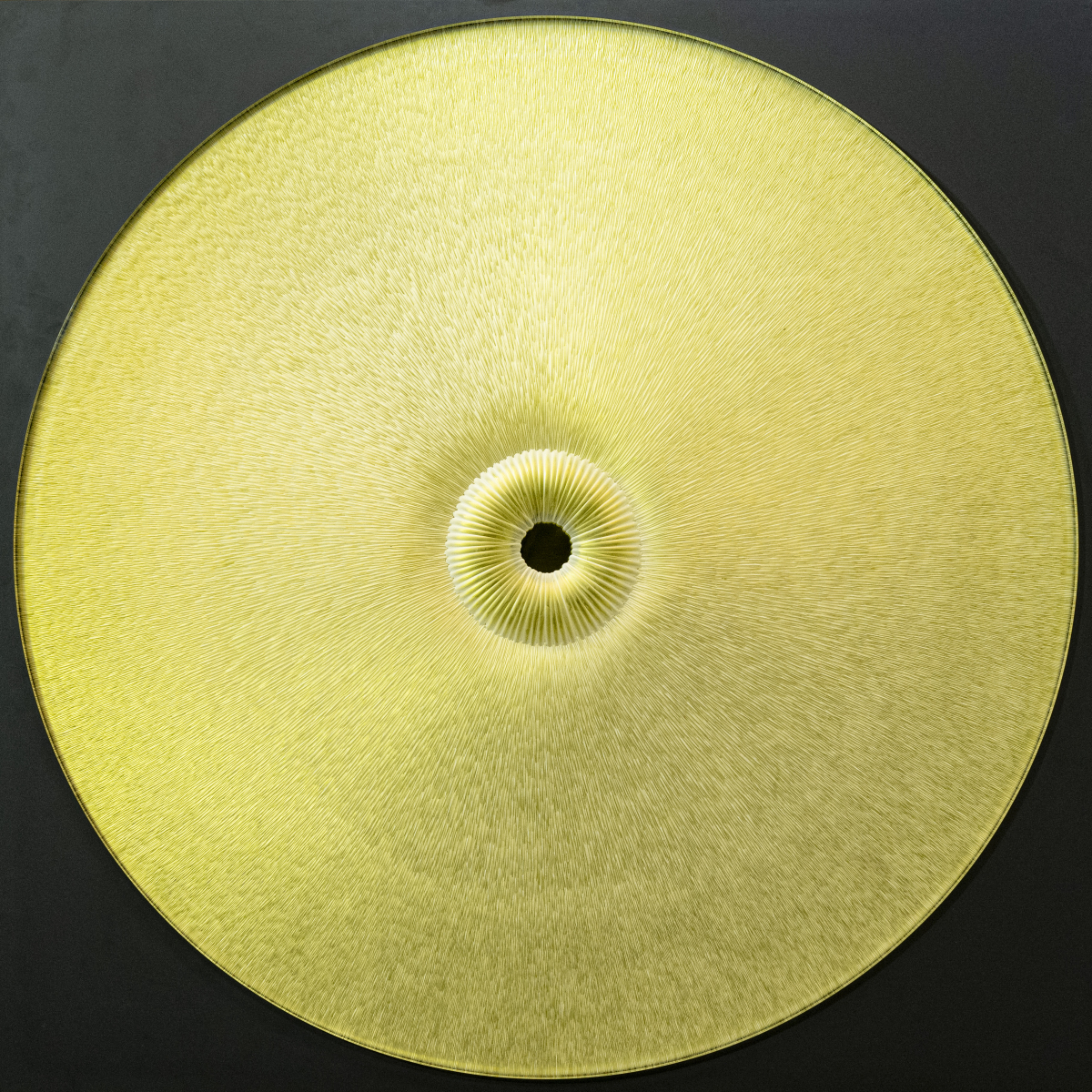
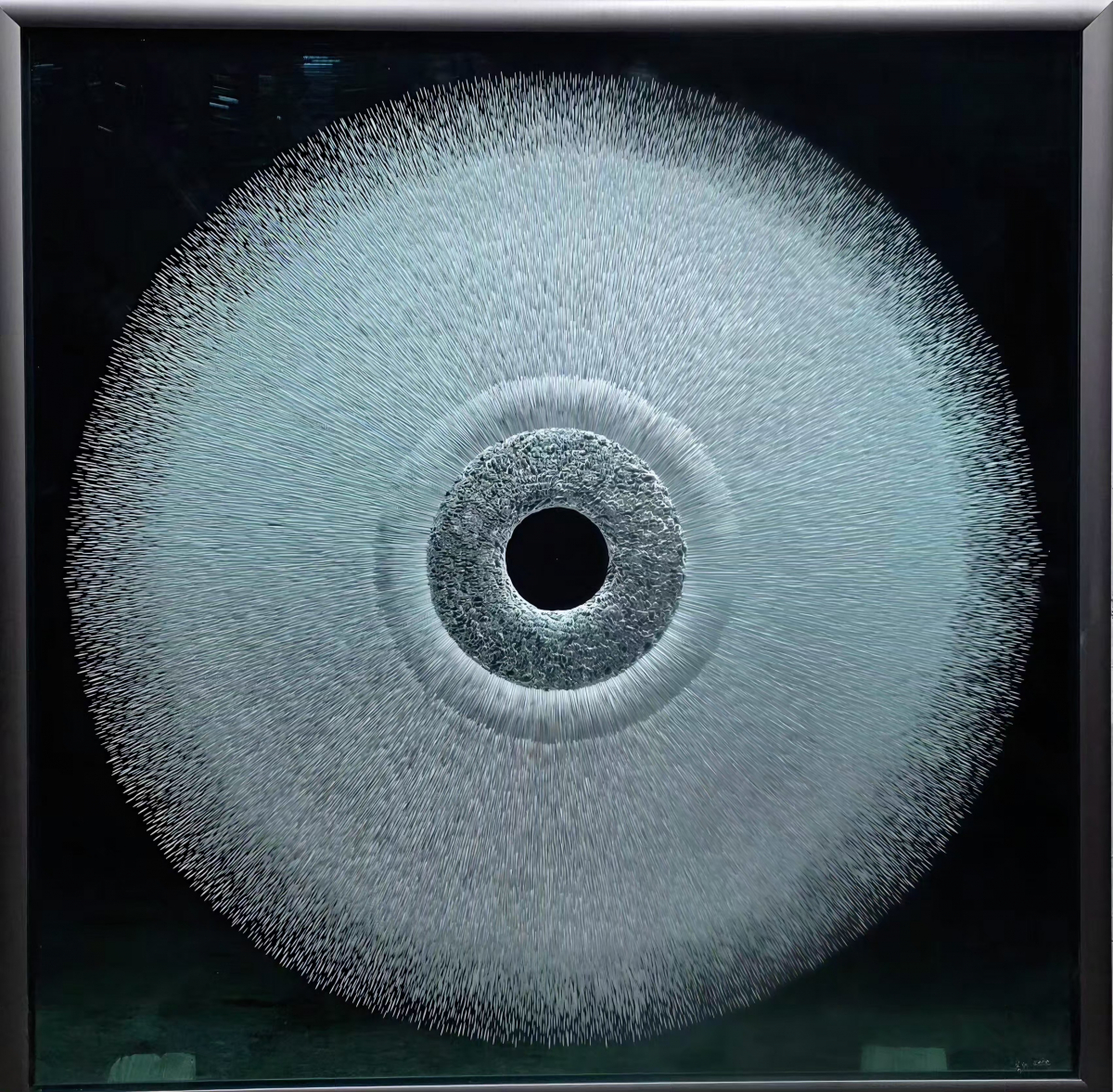
At first glance, Gong’s circular works A Figure of the Soul and The Eyes of the Soul resemble an immense eye suspended in darkness. The work’s hollow center recalls a pupil as both a physical aperture and a spiritual emptiness. Yet this void is not an absence in the negative sense. Rather, it evokes a condition akin to śūnyatā, empty of fixed substance, yet immeasurably full of cosmic vastness. The radiating lines extending from the center create the impression of an industrialized periphery, simultaneously mechanical and organic, as though the works exist between celestial cartography and engineered precision. The golden surface of The Eyes of the Soul resembles a monumental cymbal caught in perpetual vibration. At the same time, the silver-white expanses of A Figure of the Soul suggest a biomorphic galaxy in continuous expansion, within the infinite flux of the universe. This sensibility resonates profoundly with the artist’s own statement that “time is flow, and living is flow,” and that the layered traces of carving, scratching, pressing, and pouring become material manifestations of existence itself. The transparent acrylic surface, which according to Gong “reveals everything, even the smallest dust and the innermost layers,” functions not merely as material but as a philosophical membrane through which the artist seeks to render “more beautiful and pure forms of the soul, as well as unknown worlds.”
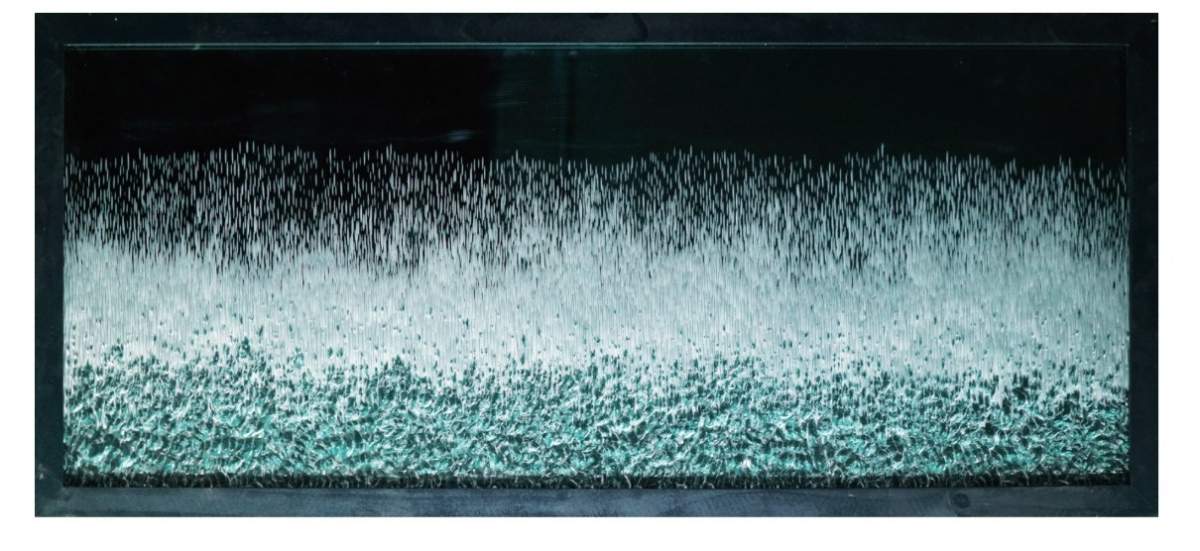
In his monumental work Emotional Loneliness, Gong abandons the centripetal cosmology of the earlier round compositions in favor of an immense horizontal field that unfolds like a haunted threshold between matter and disappearance. The work evokes the spectral atmosphere of an analog transmission slowly dissolving into static; its dense accumulation of vertical incisions resembles both frozen rainfall and electronic interference hovering in vacant nullity. In this sense, the piece possesses a haunting quality: it appears as though the image was caught between memory and erasure, between the persistence of presence and the inevitability of entropy. The lower register, with its fractured crystalline textures and sediment-like accumulations, recalls the abstracted ice landscapes of Caspar David Friedrich, yet stripped of Romantic figuration and translated into a post-human vocabulary of material vibration. Vast, empty, and glacially silent, the composition confronts the viewer with a sublime expanse that resists narrative anchoring, producing instead a meditative confrontation with immeasurable distance and existential isolation.
At the same time, the work extends the transcendental ambitions of Mark Rothko into a radically different metaphysical terrain. Whereas Rothko’s chromatic fields sought spiritual immersion through color and atmosphere, Gong’s Emotional Loneliness approaches sublimity through the ontology of emptiness itself, an abyssal field in which form continually dissolves into nothingness. The acrylic panel, transparent yet resistant, records countless acts of carving, scratching, and accumulation until the surface itself appears fossilized by duration. What emerges is an image that feels simultaneously geological and digital, ancient and post-industrial; a frozen psychic landscape in which silence acquires material density, and where the soul, stripped of all symbolic ornament, confronts the infinite coldness and beauty of emptiness itself.
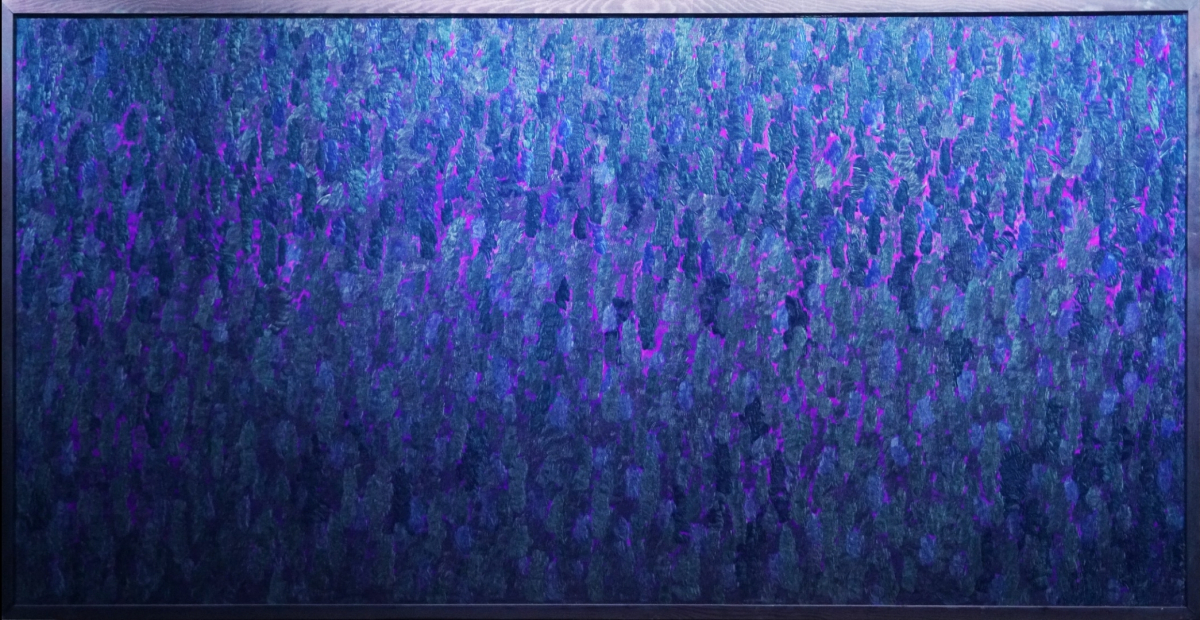
Similarly, Gong’s My Inner Self, with its dense violet-electric hues recalling the crystalline luminosity of Mikhail Vrubel, intensifies the charged energy of the inner landscape. In this striking composition, Gong moves beyond the earlier themes of silence and loneliness, transforming the canvas into an ethereal field of chromatic vibration alive with metaphysical force. The work evokes, with even greater philosophical tension, Mahāyāna Buddhist ideas of emptiness as a generative and dynamic state of being. At the same time, its luminous interiority suggests certain Vedāntic notions of consciousness, without fully equating emptiness with Ātman. Here, Gong creates a deep panorama of indigo and pulsating magenta that seems to flicker with its own inner light. This chromatic intensity suggests that the emptiness of the self is not a static void, but a charged space of latent spiritual energy. The inner self thus appears as a vast, non-objective expanse in which the carved acrylic substrate serves as a conduit for shimmering otherworldly force.
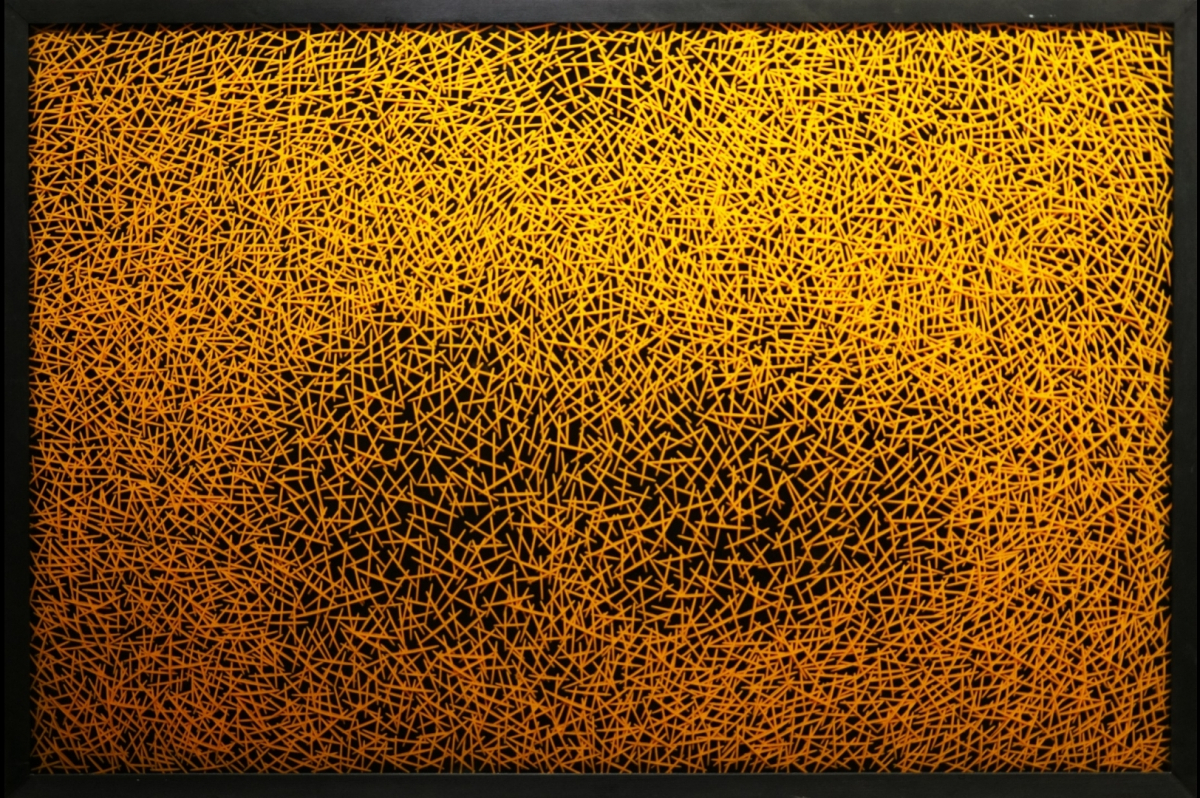
Gong Byung’s work urges us to depart from mere optical observation toward a more radical mode of perception. As the Atlantic winds carry the promise of summer, his canvases remind us that we must learn to see through the eye, not with it. To see with the eye is to be trapped by the industrial rigidity of the material and the surface-level finish of the acrylic; to see through it is to engage the inner vision of emptiness as a lens of enlightenment. Gong’s masterfully carved substrates act as this very threshold, where the transparency of the medium ceases to be a physical barrier and becomes a conduit for the sublime. Density of Emptiness, Light of Presence forces the viewer into a state of seeing through the physical towards the hyperphysical. Ultimately, the "Density of Emptiness" is revealed not as a void to be feared, but as the primary site of a "Light of Presence," an internal landscape where the soul, unburdened by the dualism of being and non-being, finally recognizes its own luminous continuity within the infinite flow of the universe.